Science-backed dragonfly facts
Dragonflies are ancient aerial predators with four controllable wings, enormous compound eyes and a juvenile life spent underwater. These interesting dragonfly facts explain how they fly, hunt, develop and migrate—without relying on exaggerated internet claims.
Fact-checked using entomology references and peer-reviewed research. Flight speed, hunting success and feeding estimates vary by species, habitat and study conditions.
What is the most interesting fact about dragonflies? A dragonfly lives as two very different predators. It begins as an aquatic nymph that hunts below the water and later emerges as a winged adult that captures insects in the air. There is no pupal stage between these two forms.
Interesting Facts About Dragonfly Flight and Vision
Dragonflies are not remarkable simply because they can fly quickly. Their greater advantage is controlled, visually guided flight that allows them to hover, reverse, turn sharply and intercept moving prey.
Dragonflies Are Not True Flies
Despite their name, dragonflies are not closely related to houseflies or mosquitoes. True flies belong to the order Diptera and have one functional pair of wings. Dragonflies belong to the order Odonata and have two functional pairs.
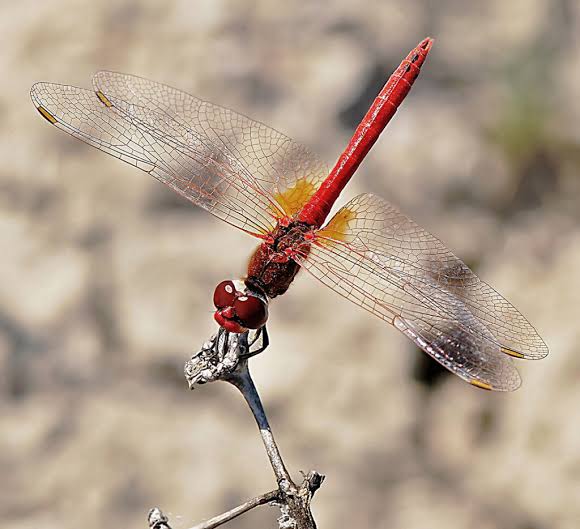
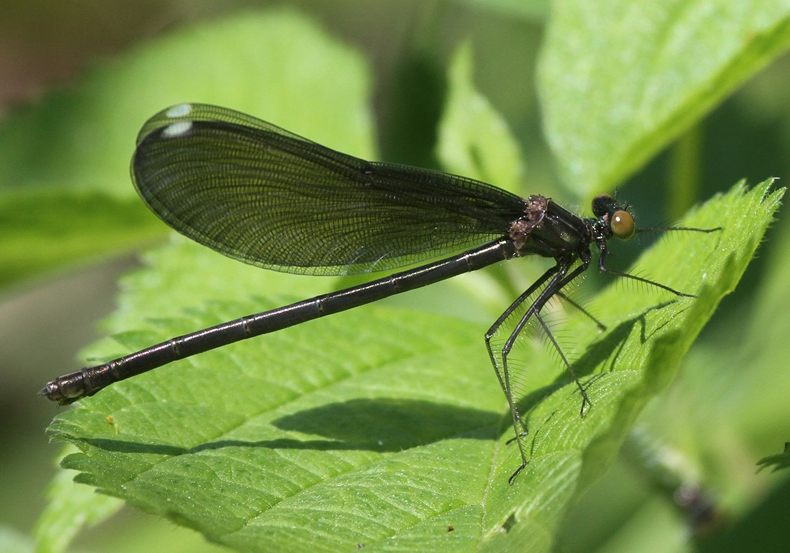
Dragonflies are classified mainly within Anisoptera, while damselflies belong to Zygoptera. Both groups are predators, but they differ in body shape, eye placement, wing form and typical resting posture.
Their Wider Evolutionary Lineage Is More Than 300 Million Years Old
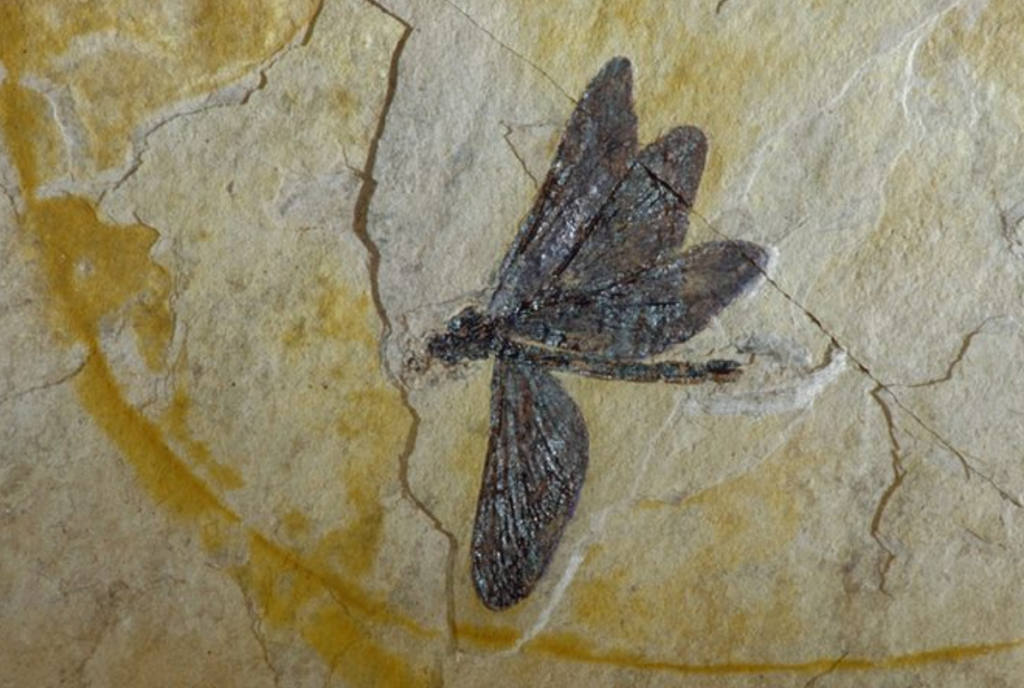
Dragonfly-like insects and other early members of the wider odonatopteran lineage were already flying during the Carboniferous period, more than 300 million years ago.
The largest prehistoric examples were griffinflies, not modern dragonflies. Some had wingspans far greater than any living dragonfly, but they belonged to an extinct related group rather than being oversized versions of today’s species.
The Forewings and Hindwings Can Use Different Timing
A dragonfly has two forewings and two hindwings. The two pairs are not permanently locked into one movement. By changing the timing and angle of its wing strokes, the insect can alter lift, thrust, stability and turning performance.
The wings also flex and twist during flight. They do not behave like four rigid, flat boards.
Dragonflies Can Hover, Reverse and Move Sideways
Dragonflies can fly forward, climb, descend, move sideways, hover and travel backward. Reverse flight is not their normal method of long-distance travel, but it is useful when repositioning, avoiding another insect or adjusting an attack.
Their ability to switch rapidly between flight modes is more important than any single maximum-speed figure.
There Is No Single Speed for Every Dragonfly
Speed depends on species, body size, temperature, wind, flight purpose and measurement method. Large dragonflies may sustain roughly 23–24 mph under favorable conditions, while exceptional short bursts by particular species have been reported near 35–36 mph.
These values should not be presented as the normal speed of every dragonfly. The famous 60 mph claim came from an old ground-speed observation that may have included wind assistance.
See the full evidence review: How Fast Can a Dragonfly Fly?
Their Heads Are Dominated by Compound Eyes
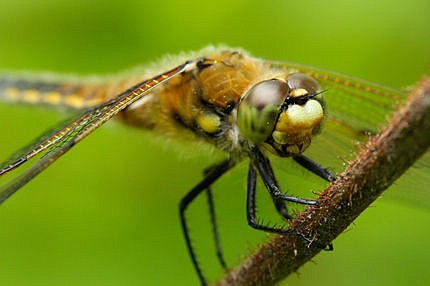
Each compound eye is composed of thousands of visual units called ommatidia. Their arrangement provides a very broad field of view and allows dragonflies to detect moving insects quickly.
Describing this as perfect “360-degree vision” is too simple. Different parts of the eye have different visual properties, and the body still creates limitations. The accurate conclusion is that dragonflies have an exceptionally wide and movement-sensitive visual field.
They Can Steer Toward a Predicted Interception Point
High-speed tracking research has shown that dragonflies do not always chase directly behind their prey. Their head tracks the target while the body turns toward an interception path.
The evidence suggests that the insect uses internal models of its own movement and the prey’s expected motion. Vision then helps it react when the prey changes direction unexpectedly. Research
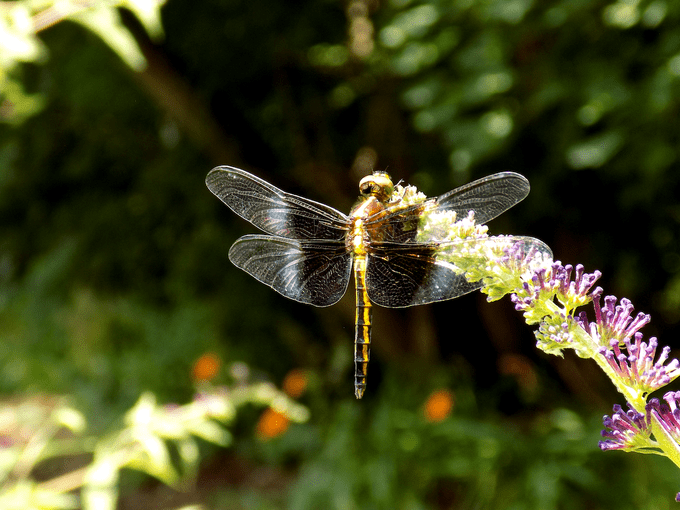
Fun Facts About Dragonfly Hunting and Diet
Adult dragonflies are aerial predators. Their eyes detect prey, their flight path closes the distance, their legs trap the target and their chewing mouthparts process it.
A Study Recorded Hunting Success Between About 83% and 95%
One outdoor enclosure study followed nine dragonflies hunting fruit flies across thousands of pursuits. Median capture-success rates for the individual dragonflies ranged from approximately 83% to 95%.
This is evidence of highly effective predation under those study conditions. It does not mean that every dragonfly catches every prey species at the same rate in the wild. Study
Their Legs Form a Spiny Prey Basket
A dragonfly’s legs are better suited to gripping and capturing prey than to walking. During an attack, the legs can be brought forward beneath the body, creating a basket lined with spines.
Small prey may be eaten while the dragonfly remains airborne. Larger prey is often carried to a perch before being consumed.
Dragonflies Really Do Eat Mosquitoes
Adult dragonflies catch mosquitoes, while aquatic nymphs may eat mosquito larvae. Mosquitoes are therefore a genuine part of the dragonfly diet at more than one life stage.
There is no reliable universal rule stating that every dragonfly eats exactly 100 mosquitoes each day. The amount and type of prey depend on species, body size, temperature, habitat and local food availability.
Explore the wider diet: What Do Dragonflies Eat?
Some Dragonflies Eat Other Odonates
Larger dragonflies may capture damselflies, smaller dragonflies or newly emerged adults whose wings have not yet hardened.
This behavior shows why “mosquito eater” is only a partial description. Dragonflies are opportunistic predators that hunt a range of suitably sized insects.
Why the famous 95% figure needs a qualification
The high capture rates came from particular dragonflies hunting fruit flies in a controlled outdoor enclosure. Wind, vegetation, prey density, prey behavior and lighting can produce different results in natural habitats. The study supports the conclusion that dragonflies are highly capable hunters—not that every individual has one fixed success rate.
The Hidden Underwater Life of a Dragonfly
The winged adult is only the most visible stage. Before emerging into the air, a dragonfly lives underwater as a wingless predator with a very different body.
Many Dragonflies Spend Most of Their Lives Underwater
Dragonfly eggs hatch into aquatic nymphs, also known as naiads. Depending on the species and climate, this stage can last from several months to several years.
The adult stage is generally much shorter. This means the familiar flying insect may represent only the final part of a considerably longer life.
See the juvenile stage: What Do Dragonfly Babies Look Like?
A Nymph Captures Prey With an Extensible Labium
Beneath the head is a hinged mouthpart called the labium. It folds against the body when not in use and extends rapidly when prey comes within range.
Depending on its species and size, a nymph may eat aquatic insect larvae, small crustaceans, worms, tadpoles or very small fish. Larger prey should not be presented as normal food for every dragonfly nymph.
Dragonfly Nymphs Have Internal Rectal Gills
Water is drawn into a chamber inside the rear of the abdomen. Internal folds associated with the rectal chamber exchange gases with the water, allowing the nymph to obtain oxygen while submerged.
Damselfly nymphs are usually easier to recognize because they have three external, leaf-like structures at the end of the abdomen.
Some Nymphs Escape Using Jet Propulsion
A dragonfly nymph can forcefully expel water from its rectal chamber. The reaction pushes the body forward, producing a rapid escape movement.
The same part of the body therefore contributes to respiration and sudden propulsion—one of the strangest verified dragonfly adaptations.
Dragonflies Do Not Form a Chrysalis
Dragonflies undergo incomplete metamorphosis. Their life cycle consists of egg, nymph and adult stages, with no pupa, cocoon or chrysalis.
When development is complete, the mature nymph climbs out of the water. The adult emerges directly from the old nymphal skin, expands its wings and waits for its body to harden.
Follow the complete process: Dragonfly Life Cycle
The Empty Skin Left Behind Is Called an Exuvia
After the adult emerges, the hollow nymphal skin may remain attached to a reed, grass stem, rock or tree trunk. One shed skin is an exuvia; the plural is exuviae.
Finding exuviae is stronger evidence of local breeding than simply seeing an adult fly past, because it confirms that a nymph completed its development at the site.
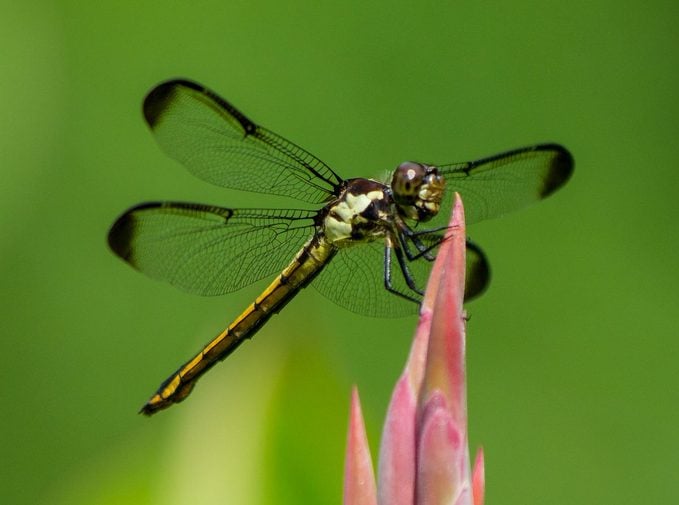
More Amazing Dragonfly Facts About Behavior and Ecology
Dragonflies Cannot Sting People
Dragonflies do not possess a stinger. Their strong jaws are used for eating insect prey, not for attacking people.
A large individual may attempt a defensive bite if it is trapped or held roughly, but an undisturbed dragonfly is harmless and normally tries to escape.
Dragonflies and Damselflies Are Different
Dragonflies generally have stronger bodies, broader hindwings and eyes that are close together or touching. Most rest with their wings extended away from the body.
Damselflies are usually slimmer, have clearly separated eyes and commonly hold their wings together above the abdomen. Spreadwing damselflies are an important exception to the simple resting-wing rule.
Some Species Migrate Across Seas and Continents
The globe skimmer, Pantala flavescens, is associated with exceptional long-distance movements linked to seasonal winds and rainfall.
Evidence supports a multigenerational migration system around the Indian Ocean region. The complete route is not flown by one individual; successive generations continue the movement as temporary breeding habitats become available. Research
Dragonfly Communities Can Reveal Freshwater Conditions
Different dragonfly species require different combinations of water flow, vegetation, depth, temperature and water chemistry. Researchers can therefore use the species present at a site as part of a freshwater habitat assessment.
One adult dragonfly does not automatically prove that water is perfectly clean. A meaningful assessment considers species identity, abundance, ecological tolerance and evidence of successful breeding.
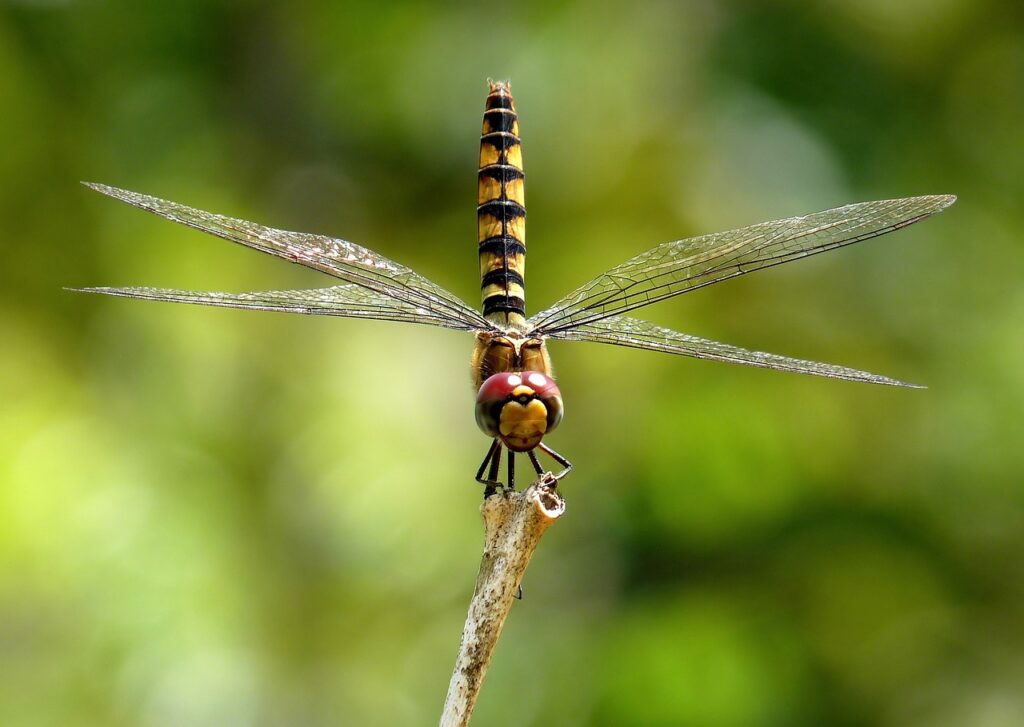
Some dragonflies point their abdomens toward the sun
During hot, sunny conditions, certain species adopt an “obelisk posture” by raising the abdomen toward the sun. This can reduce the body surface directly exposed to intense solar radiation. Not every upright abdomen necessarily has the same purpose, so behavior and weather conditions should be considered together.
Common Dragonfly Claims Checked
| Common claim | More accurate explanation |
|---|---|
| All dragonflies fly at 35–60 mph. | Speed varies by species and measurement method. Around 35–36 mph is better treated as an exceptional short-burst figure for particular large species, not a normal speed for every dragonfly. |
| Every dragonfly eats 100 mosquitoes each day. | Mosquitoes are real prey, but no fixed daily number applies to every species, individual or habitat. Dragonflies also eat midges, flies, gnats and other insects. |
| Dragonflies have a 95% success rate everywhere. | High success rates were measured in particular enclosure experiments. Natural results vary with prey, vegetation, weather and other conditions. |
| Dragonflies sting with their abdomens. | They have no stinger. A roughly handled individual may use its jaws defensively, but dragonflies normally avoid people. |
| One dragonfly proves that a pond is pollution-free. | Dragonfly communities can provide ecological information, but species differ in habitat and water-quality tolerance. |
How to Watch Dragonflies Without Disturbing Them
Warm, bright conditions around a pond, marsh or slow stream can reveal hunting, territorial behavior, mating, egg-laying and adult emergence.
- Approach slowly and avoid casting a moving shadow over a perched insect.
- Use binoculars or camera zoom instead of catching the dragonfly.
- Watch for repeated perches; many individuals return to the same stem.
- Look for empty nymph skins on emergent vegetation.
- Avoid broad-spectrum pesticide use around ponds and wetland plants.
Frequently Asked Questions About Dragonflies
Are dragonflies dangerous to humans?
No. Dragonflies do not have stingers and do not hunt or attack people. A large individual may attempt to bite only when trapped or handled roughly.
Do dragonflies eat mosquitoes?
Yes. Adults can catch flying mosquitoes, and aquatic nymphs may eat mosquito larvae. Mosquitoes are only one part of a broader diet that includes midges, flies, gnats and other insects.
How fast can dragonflies fly?
There is no single speed for all dragonflies. Large species may sustain roughly 23–24 mph, while exceptional short bursts by certain species may approach 35–36 mph. Wind and measurement method can significantly affect reported values.
How long do dragonflies live?
The complete life cycle may last from months to several years, depending on species and environment. Much of that time is spent underwater as a nymph. The adult stage is usually considerably shorter.
Why do dragonflies live near water?
Their eggs and nymphs develop in aquatic habitats. Adults may travel away from water to feed, mature or migrate, but suitable freshwater habitat is required for reproduction.
What is the difference between a dragonfly and a damselfly?
Dragonflies are generally more robust and commonly rest with their wings open. Damselflies are usually slimmer and often hold their wings together. Eye placement and hindwing shape provide additional identification clues.
Do dragonflies have 360-degree vision?
Their compound eyes provide an exceptionally broad field of view, but “perfect 360-degree vision” is an oversimplification. Different regions of the eyes have different visual performance.
Can dragonflies walk?
Their legs can grip stems and adjust their position, but adult dragonflies are not efficient walkers. Their legs are primarily adapted for perching and catching prey.
Do dragonflies bring good luck?
Good luck is a cultural interpretation rather than a biological fact. Different traditions associate dragonflies with renewal, courage, summer, water, change or good fortune.
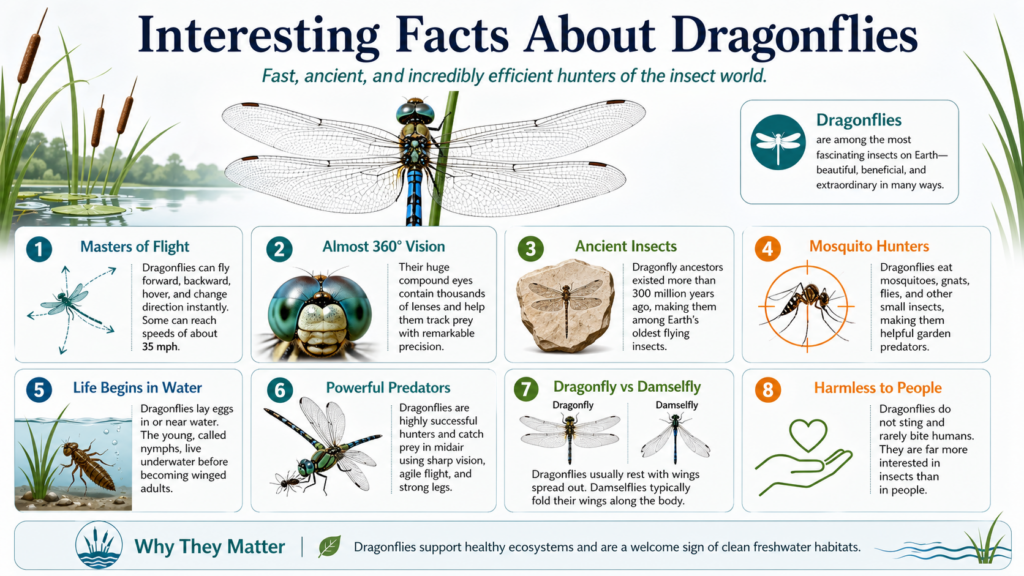
Why Dragonflies Are More Remarkable Than the Myths
Dragonflies do not need exaggerated speed records or fixed mosquito counts to be extraordinary. Their real adaptations include four controllable wings, compound eyes linked to predictive interception, spiny prey-catching legs and an aquatic nymph equipped with an extensible mouthpart, internal gills and jet propulsion.
The next time a dragonfly passes a pond or garden, remember that the winged hunter is only the final stage of a much longer story—one that began below the water and belongs to an evolutionary lineage extending back hundreds of millions of years.
References and Further Reading
- Mischiati, M. et al. “Internal models direct dragonfly interception steering.” Nature, 2015. View research .
- Combes, S. A. et al. “Linking biomechanics and ecology through predator–prey interactions: flight performance of dragonflies and their prey.” Journal of Experimental Biology, 2013. View research .
- Gonzalez-Bellido, P. T. et al. “Eight pairs of descending visual neurons in the dragonfly give wing motor centers accurate population vector of prey direction.” Proceedings of the National Academy of Sciences, 2013. View research .
- Anderson, R. C. “Do dragonflies migrate across the western Indian Ocean?” Journal of Tropical Ecology, 2009. View research .
- University of Florida, Entomology and Nematology. “Dragonflies and Damselflies: Odonata.” View reference .
- British Dragonfly Society. Dragonfly identification, ecology, recording and conservation resources. View reference .