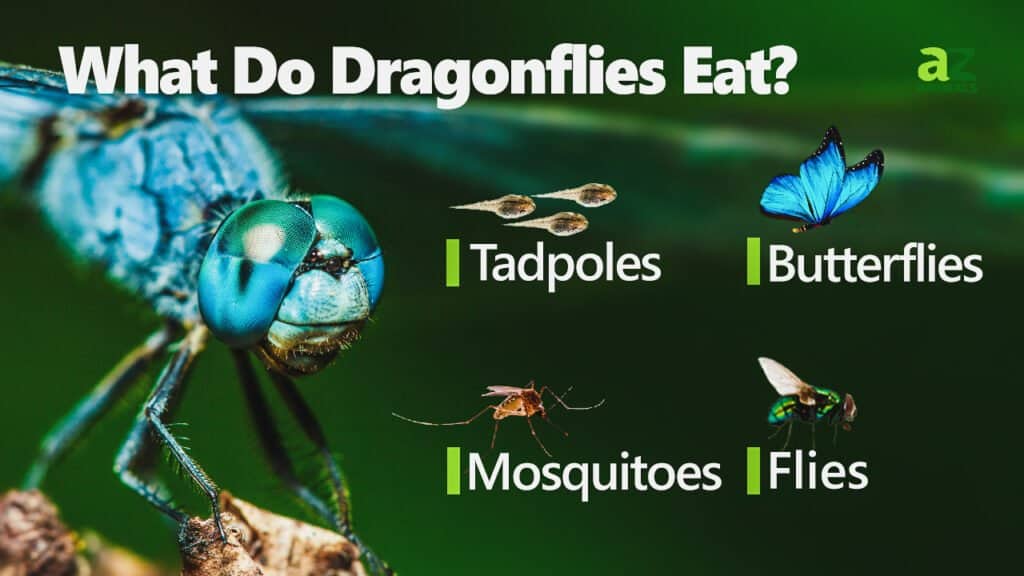
What Do Dragonflies Eat? Adult and Nymph Diet Explained
Dragonflies are predators throughout their lives, but a flying adult and an aquatic nymph encounter very different prey. Species, body size, habitat, developmental stage and local prey availability all affect what an individual actually eats.
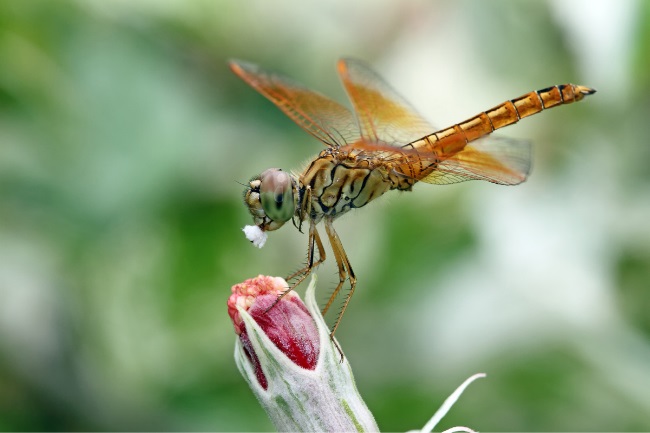
Dragonfly Diet at a Glance
| Feature | Adult dragonfly | Dragonfly nymph |
|---|---|---|
| Where it feeds | In the air, from a perch, over vegetation or away from water | Underwater among sediment, plants, stones or submerged debris |
| Typical prey | Midges, flies, mosquitoes, small moths and other flying insects | Aquatic insect larvae, small crustaceans, worms and other small aquatic animals |
| Capture structure | Bristled legs that help secure prey, followed by chewing mouthparts | A rapidly extending prehensile labium, followed by chewing mouthparts |
| Main limitations | Prey size, flight conditions, hunting strategy and local insect availability | Instar, body size, habitat structure, prey size and prey density |
| Larger occasional prey | Butterflies, bees, wasps, damselflies or other dragonflies | Other odonate larvae, tadpoles or very small fish |
What Do Adult Dragonflies Eat?
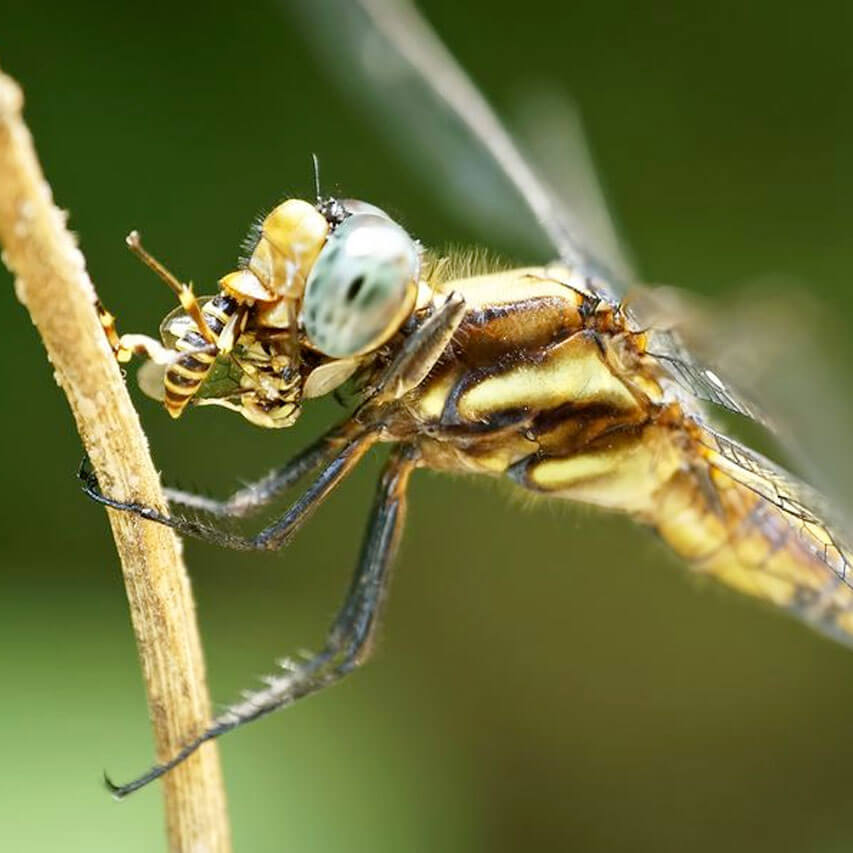
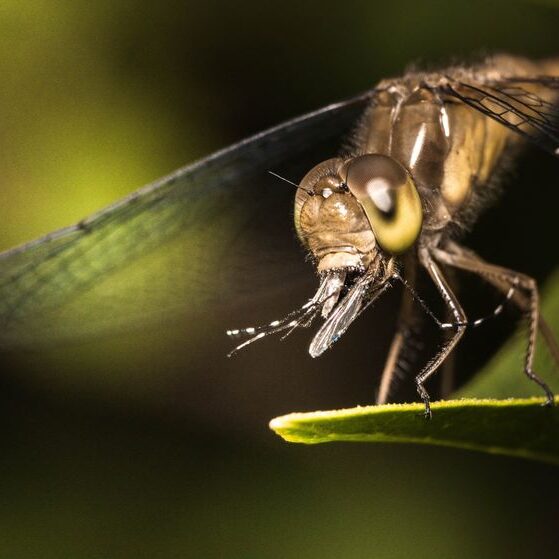
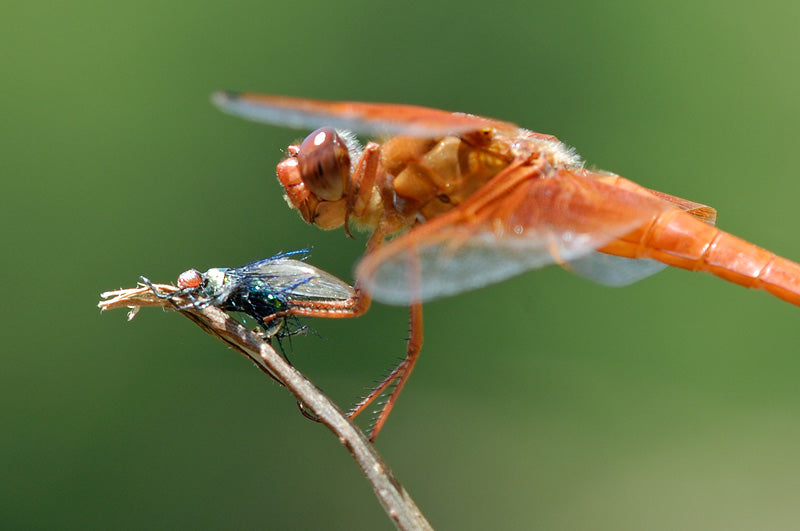
Adult dragonflies are visual aerial predators. Studies based on gut contents, direct observations and DNA recovered from fecal material show that their diets can contain many insect groups. In several studied populations, small members of the order Diptera—flies, midges, gnats and related insects—formed an important part of the diet.
Commonly documented prey includes midges, small flies, mosquitoes, small moths, small beetles and other airborne insects. Flying ants or termites may become available in large numbers during reproductive swarms and can then be taken opportunistically.
That does not mean every adult species has the same menu. A small meadowhawk hunting from a low perch cannot routinely handle the prey available to a large darner or dragonhunter. Time of day also matters: a crepuscular species encounters a different insect community from a dragonfly that hunts mainly in bright midday conditions.
| Prey category | Examples | How it should be interpreted |
|---|---|---|
| Frequently documented small prey | Midges, gnats, small flies and other small Diptera | Often important in studied diets, although proportions differ by species and location |
| Regular but locally variable prey | Mosquitoes, small moths, caddisflies, small beetles, flying ants and termites | Availability, flight period, habitat and predator size strongly affect consumption |
| Occasional or size-limited prey | Bees, wasps, butterflies and larger moths | Documented for capable individuals or in particular ecological settings; not a universal staple |
| Other odonates | Damselflies, smaller dragonfly species and sometimes smaller members of the same species | Intraguild predation and cannibalism occur, especially where predator and prey sizes differ |
What Do Dragonfly Nymphs Eat?
Dragonfly nymphs, also called larvae or naiads, are aquatic predators. Their everyday prey usually consists of animals they can detect, capture and manipulate in the water—not automatically fish or tadpoles.
Depending on species and habitat, prey can include mosquito larvae, midge larvae, mayfly nymphs, other aquatic insect larvae, water fleas and other small crustaceans, worms, small snails and smaller dragonfly or damselfly larvae.
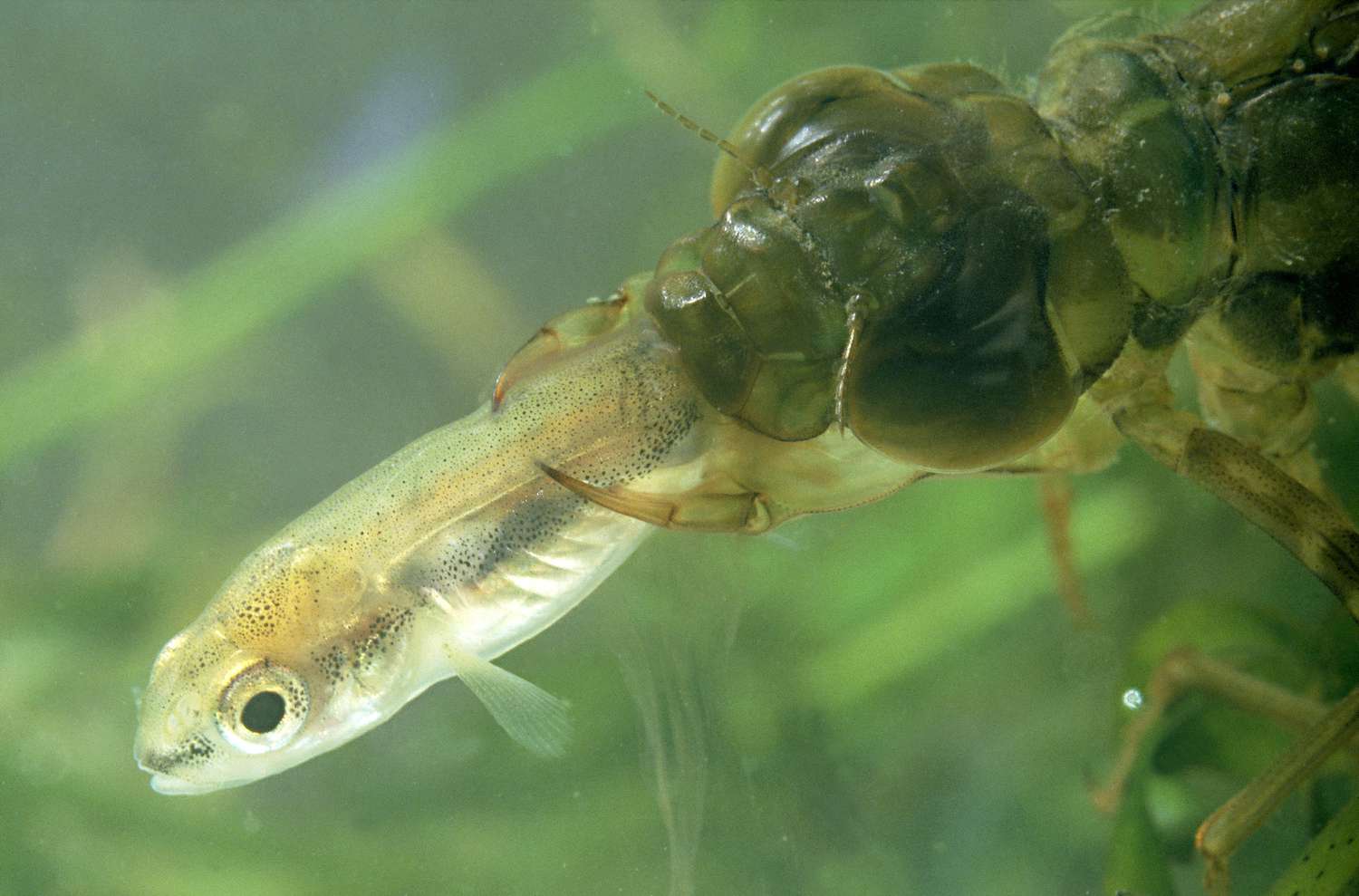
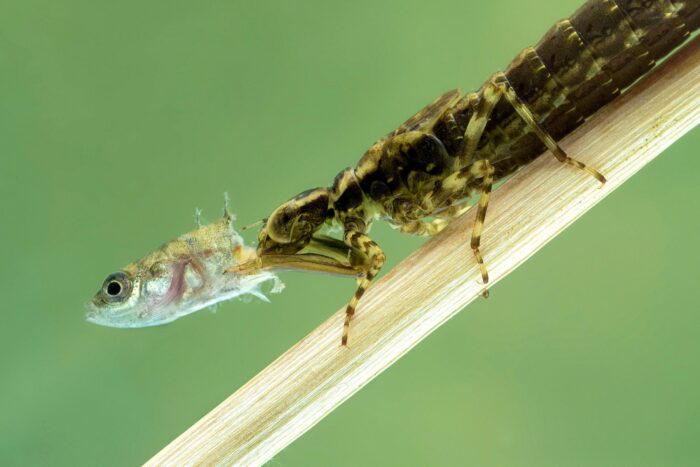
Larger late-instar nymphs of some species can overpower tadpoles or very small fish. These records demonstrate what sufficiently large nymphs can eat; they do not show that vertebrates dominate the diet of dragonfly larvae generally.
For more information about identification, body form, gills, habitats, development and emergence, see the complete dragonfly larvae guide.
How Diet Changes as Nymphs Grow
A dragonfly nymph passes through a succession of instars, growing after each molt. Its potential prey range changes during that development, but the change is not simply “small insects first, fish later.” Capture success still depends on the ratio between predator size and prey size, the prey’s movement, handling time and habitat complexity.
Very small aquatic prey
Young nymphs are limited to prey they can subdue, such as tiny crustaceans, small worms and very small insect larvae.
A broader invertebrate diet
Growing nymphs can handle a wider range of aquatic insects, including midge larvae, mayfly nymphs and smaller odonate larvae.
Larger prey becomes possible
Large nymphs may take bigger invertebrates and, in some species and circumstances, tadpoles or very small fish.
How Adult Dragonflies Catch Prey
Dragonflies do more than fly directly behind an insect until they catch it. Research on selected species has shown that they can track a moving target and steer toward an interception point. Predictive control helps the predator meet the prey’s path, while visual feedback allows corrections when the target changes direction unexpectedly.
The large compound eyes provide a broad visual field and include neural systems specialized for detecting small moving targets against complex backgrounds. It is more accurate to describe this as wide-field, motion-sensitive vision than to assign every species an exact universal viewing angle.
The compound eyes distinguish a small moving target from the background.
Head and body movements help keep the target in a useful part of the visual field.
The dragonfly adjusts its path to meet the prey rather than relying only on direct pursuit.
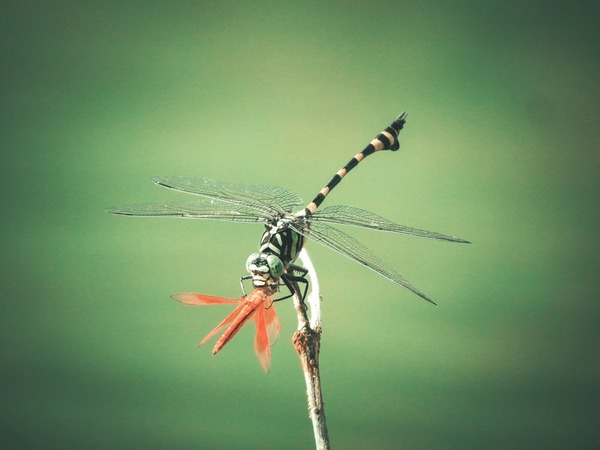
Bristled legs help form a capture structure around the airborne insect.
The prey is transferred toward the mouth and broken down with chewing mouthparts.
Perching hunters
Many skimmers, darters and related species spend substantial periods on exposed perches. They launch short feeding flights when an insect passes, then may return to the same or a nearby perch. A perched dragonfly may be scanning for prey, resting, warming itself or defending space; the posture alone does not prove active hunting.
Continuously flying hunters
Many darners, hawkers and cruisers patrol while airborne. They search over water, clearings, paths or vegetation and may remain in flight for long periods. Some can manipulate and eat suitable prey while flying, while others land to process larger or more difficult prey. Neither behavior applies to every species or every meal.
How Nymphs Catch Prey Underwater
A dragonfly nymph captures prey with a modified lower lip called the prehensile labium. At rest, it folds beneath the head. During a strike, it rapidly extends toward the prey, and terminal structures help grasp or impale the target before the labium retracts toward the mouth.
Different nymphs do not all hunt in exactly the same way. Plant-dwelling species may rely strongly on vision and slowly approach prey among stems. Bottom-dwelling forms may remain partly concealed in sediment and respond to nearby movement using visual and mechanical cues. Ambush, stalking and sudden strikes occur in different combinations according to species and habitat.
The labium captures the animal, but it is not the nymph’s only “jaw.” After the prey is brought to the mouth, the regular mouthparts cut and chew it.
Do Dragonflies Eat Mosquitoes?
Adult dragonflies can eat adult mosquitoes, and nymphs can eat mosquito larvae.
Mosquitoes are only one part of a much larger potential prey community. They are not proven to be the main food of every dragonfly species, and the presence of dragonflies does not guarantee a measurable reduction in local mosquito numbers.
Actual mosquito predation depends on whether predator and prey occupy the same place at the same time. Adult mosquitoes may be most active under light, temperature or shelter conditions in which particular dragonflies are less active. In the water, mosquito larvae also coexist with fish, beetles, other insects and many additional predators.
Experimental studies can show that particular dragonfly nymphs consume mosquito larvae under defined conditions. Those results should not be converted into a universal daily number or a promise of landscape-scale control. Prey density, alternative prey, vegetation, water chemistry, predator size and the wider food web can all change the outcome.
For a complete evaluation of biological control claims, see can dragonflies control mosquitoes?
Do Dragonflies Eat Bees, Butterflies or Other Dragonflies?
Bees and wasps
Some dragonflies can attack bees or wasps small enough to handle. Field experiments indicate that prey size influences attack decisions, and observations of bee or wasp predation do exist. These insects should nevertheless be described as possible or occasional prey, not as a routine food for every dragonfly.
Butterflies and moths
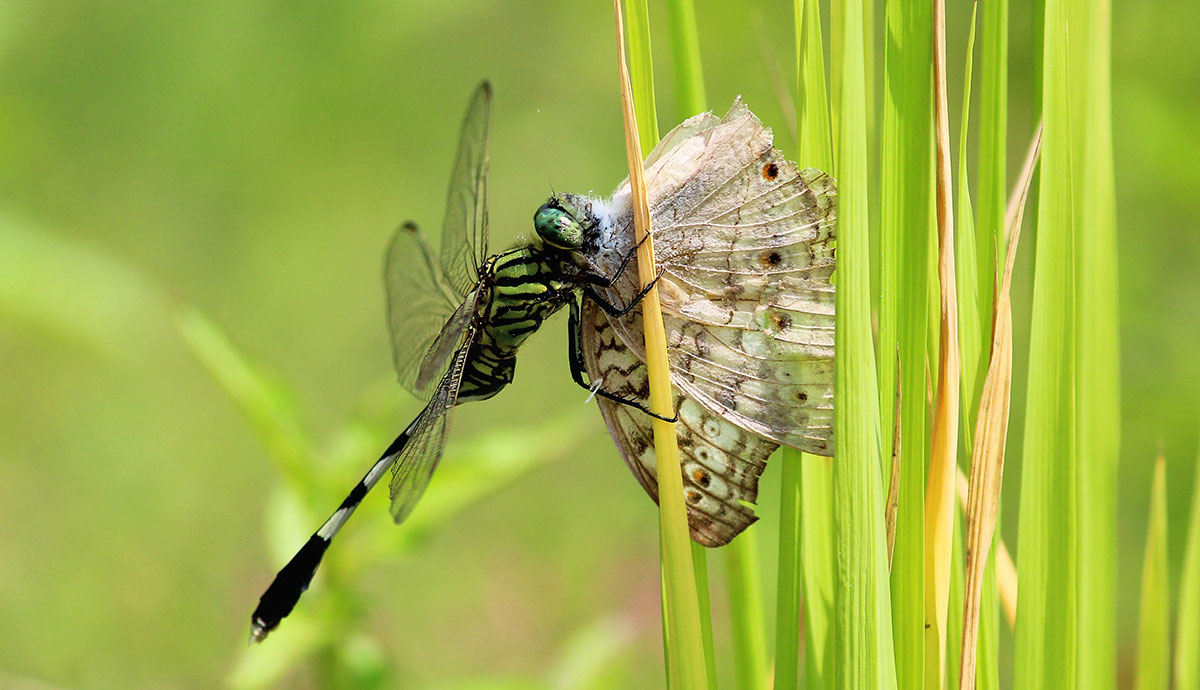
Dragonfly predation on adult butterflies has been documented, and it can be ecologically important in locations where suitable large dragonflies and butterflies overlap. Small moths may also be taken. The frequency varies with prey size, season, habitat and predator species.
Other dragonflies and damselflies
Yes. Large dragonflies may capture smaller dragonflies or damselflies, and adults can sometimes eat members of their own species. Aquatic nymphs also engage in intraguild predation and cannibalism, especially when there are strong size differences between individuals.
Do Nymphs Eat Fish and Tadpoles?
Large dragonfly nymphs of some species can capture tadpoles, fish fry or very small fish. Whether an attack succeeds depends on relative body size, prey behavior, water temperature, hunger, habitat structure and the nymph’s hunting morphology.
Small and middle instars usually cannot handle the vertebrate prey available to large final-instar nymphs. Even among large nymphs, aquatic insects and other invertebrates may remain more frequent than fish or tadpoles. The safest wording is that fish and tadpoles are documented, size-limited prey—not the universal foundation of the nymph diet.
How Much and How Often Does a Dragonfly Eat?
There is no scientifically defensible worldwide number for how many insects a dragonfly eats per hour or per day. Dragonflies differ greatly in body mass, activity period, temperature, reproductive condition and prey availability. A large continuously patrolling darner cannot be assigned the same feeding rate as a smaller perch-hunting species.
Feeding also changes from day to day. Cool, wet or windy conditions may reduce adult flight and prey encounters. Warm conditions and a mass emergence of midges, termites or other insects may create an intense but temporary feeding opportunity. Nymph feeding rates likewise change with water temperature, instar, recent meals, prey density and the presence of competitors or predators.
It is therefore better to say that dragonflies feed repeatedly when conditions and prey permit, rather than quoting an unsupported fixed daily total.
Dragonflies Within Aquatic and Terrestrial Food Webs
Dragonflies connect freshwater and terrestrial food webs. Nymphs consume aquatic animals and are themselves eaten by fish, amphibians, birds and larger invertebrates. Adults consume flying insects but are prey for birds, spiders, frogs, robber flies and larger dragonflies.
That dual role makes them important predators without making every species an apex predator. The ecological terminology and exceptions are explained separately in are dragonflies apex predators?. Information about ponds, streams, wetlands and other environments belongs in the dragonfly habitat guide.
Frequently Asked Questions
Do dragonflies eat plants?
No. Adult dragonflies and aquatic nymphs are predators, not herbivores. They do not normally feed on leaves, flowers, nectar or aquatic plants. Vegetation is used for perching, shelter, emergence or egg-laying rather than as food.
Do dragonflies drink water?
Adult dragonflies require water physiologically and obtain much of their moisture from prey. Direct drinking is not a well-established universal routine. A dragonfly repeatedly touching the water with the end of its abdomen is often laying eggs rather than drinking.
Do dragonflies eat while flying?
Some do. Continuously flying species can manipulate and consume suitable prey in the air. Other dragonflies land on a perch before eating, particularly when the prey is relatively large or difficult to handle.
Do dragonflies eat flies?
Yes. Small flies and related Diptera are among the most consistently documented adult prey, although exact proportions vary among species and study sites.
Do dragonflies eat bees?
Some large dragonflies can capture bees, but bees are not established as the main food of dragonflies generally. Predator size, bee size and local opportunity all matter.
Do dragonflies eat butterflies?
Yes, butterfly predation has been documented. It is more likely where suitably large dragonflies overlap with butterflies of manageable size, and it should not be presented as equally common in all species.
Do dragonflies eat other dragonflies?
Yes. Larger adults may eat smaller dragonflies or damselflies, and aquatic nymphs may consume smaller odonate larvae. Cannibalism is also possible.
Do dragonfly nymphs eat fish or tadpoles?
Large nymphs of some species can take tadpoles, fish fry or very small fish. Smaller instars usually depend on much smaller aquatic invertebrates.
How often do dragonflies eat?
There is no fixed schedule. Feeding frequency changes with species, size, temperature, weather, hunger, prey density and life stage.
Can dragonflies control mosquitoes?
They can contribute to mosquito mortality, but seeing dragonflies does not guarantee fewer mosquitoes. Reliable control depends on the complete habitat, predator community and mosquito breeding conditions.
Sources and Further Reading
- Pritchard, G. “The Prey of Adult Dragonflies in Northern Alberta.” The Canadian Entomologist, 1964. https://doi.org/10.4039/Ent96821-6
- Kaunisto, K. M. et al. “Pellets of Proof: First Glimpse of the Dietary Composition of Adult Odonates as Revealed by Metabarcoding of Feces.” Ecology and Evolution, 2017. https://doi.org/10.1002/ece3.3404
- Schilder, R. J. et al. “Metabarcoding Prey DNA from Fecal Samples of Adult Dragonflies Shows No Predicted Sex Differences, and Substantial Inter-individual Variation, in Diets.” https://pmc.ncbi.nlm.nih.gov/articles/PMC8686731/
- Mischiati, M. et al. “Internal Models Direct Dragonfly Interception Steering.” Nature, 2015. https://doi.org/10.1038/nature14045
- Hirvonen, H. and Ranta, E. “Prey to Predator Size Ratio Influences Foraging Efficiency of Larval Aeshna juncea Dragonflies.” Oecologia, 1996. https://doi.org/10.1007/BF00334569
- Koehnsen, A. et al. “A Switchable Joint in the Head of Dragonfly Larvae.” https://pubmed.ncbi.nlm.nih.gov/37186461/
- Rashed, A. et al. “Prey Selection by Dragonflies in Relation to Prey Size and Wasp-like Colours and Patterns.” Animal Behaviour, 2005. https://doi.org/10.1016/j.anbehav.2005.03.009
- Tiitsaar, A., Kaasik, A. and Teder, T. “The Effects of Seasonally Variable Dragonfly Predation on Butterfly Assemblages.” Ecology, 2013. https://doi.org/10.1890/12-0541.1
- British Dragonfly Society. “Life Cycle and Biology.” https://british-dragonflies.org.uk/odonata/life-cycle-and-biology/
- British Dragonfly Society. “Frequently Asked Questions.” https://british-dragonflies.org.uk/odonata/frequently-asked-questions/