Culture, modern interpretation and natural history
Dragonfly Meaning and Symbolism
Dragonflies do not have one universal symbolic meaning. In modern symbolism they are often associated with change, adaptability, maturity and living in the present, but cultural meanings vary by place, period and source. Seeing a dragonfly is a natural event; any personal or spiritual meaning is an interpretation rather than a scientifically testable message.
Dragonfly Meaning at a Glance
Natural science
A dragonfly is a predatory insect whose life includes an aquatic immature stage and a winged adult stage. An encounter is first of all a normal wildlife observation.
Modern symbolism
Contemporary writing frequently connects dragonflies with change, adaptability, maturity, perspective, resilience and attention to the present.
Historical tradition
A cultural claim is reliable only when it can be connected to a particular place, period, text, object or community rather than to “all cultures.”
Personal significance
A person may associate a dragonfly with a memory, relationship or life transition without claiming that the insect objectively delivered a message.
| Context | What can reasonably be said | Evidence status |
|---|---|---|
| Biology | Dragonflies develop through egg, aquatic larva and adult stages, without a pupal stage. | Scientifically testable |
| Modern symbolic writing | Change, adaptability and present-moment awareness are common contemporary interpretations. | Documentable as modern usage |
| Historical culture | Meanings must be tied to a named source, period, object or community. | Source-dependent |
| Spiritual encounter | The experience may feel meaningful to an individual, but a supernatural message cannot be scientifically verified. | Personal belief |
What Does a Dragonfly Commonly Symbolize Today?
In contemporary English-language lifestyle, spiritual and artistic writing, the dragonfly is most often used as a symbol of change. Other recurring ideas include adaptability, emotional maturity, resilience, clarity and living more attentively. These associations are widespread in modern popular culture, but widespread use does not make them ancient, universal or predictive.
- Change and transformation A contrast between aquatic youth and aerial adulthood provides an intuitive metaphor for a major transition.
- Adaptability The insect’s agile flight and movement between aquatic and terrestrial environments are used metaphorically for flexibility.
- Maturity and perspective Some modern interpretations treat emergence into the adult stage as a reminder to reassess priorities or see a situation differently.
- Presence and lightness Brief encounters, reflective wings and rapid movement may encourage people to notice an immediate moment more carefully.
- Resilience Surviving a long aquatic development period can be used as an analogy for persistence through difficult circumstances.
- Good luck Some people personally regard a sighting as fortunate, but it does not provide evidence that a particular outcome will occur.
The safest wording is therefore “dragonflies are often interpreted as symbols of change” rather than “a dragonfly means change is definitely coming.”
Why Is the Dragonfly Associated With Change?
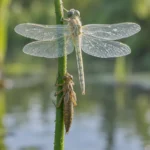
Dragonflies undergo incomplete metamorphosis. After hatching, they spend their immature life as aquatic larvae, also called nymphs, before leaving the water and emerging as winged adults. They do not form a chrysalis or pass through a pupal stage.1
The contrast is visually powerful: an animal that lived and hunted below the surface later climbs out of the water, sheds its final larval skin and takes flight. Modern writers can easily use that process as a metaphor for growth, a new phase of life or a change in perspective.
For the stages, timing and science of emergence, see the complete dragonfly life cycle guide.
Is Dragonfly Symbolism Scientifically Proven?
No. Science can investigate dragonfly anatomy, development, vision, flight, habitat and behavior. It can also study how people use symbols in language, art or ritual. It cannot demonstrate that a wild dragonfly was sent to announce a future event, confirm a decision or deliver a message from another person.
Dragonflies are highly visual aerial predators. Adults regularly patrol, hunt, defend territories, rest on exposed perches and gather near suitable water or abundant prey.2 These ordinary behaviors usually explain why a dragonfly appears in a garden, near a pond or along a walking route.
A natural explanation does not prevent an encounter from feeling emotionally important. It simply separates the cause of the encounter from the meaning a person later chooses to give it.
What Does It Mean When You See a Dragonfly?
In biological terms, seeing a dragonfly usually means that suitable habitat, prey, warmth or a resting place is nearby. Water may be close even when it is not immediately visible, although some adults travel well away from the site where they developed.
In a personal or spiritual context, a sighting might prompt someone to think about a transition, a relationship, a memory or the need to adapt. That reflection belongs to the observer; it is not proof that the dragonfly intended to communicate.
Before assigning a symbolic explanation, consider what the insect was actually doing. Was it hunting repeatedly over one area, defending a pond edge, warming itself, avoiding wind or using a convenient perch? Learning the behavior can make the encounter more interesting without requiring a supernatural claim.
Dragonfly Meaning in Documented Cultural Traditions
Cultural symbolism is strongest when it can be connected to evidence: a dated text, a museum object, an identified artist, a recorded vernacular name or information supplied by the community being discussed.
Evidence also has limits. A dragonfly design on one sword guard proves that a craftsperson used the motif; it does not prove that every person in the same country interpreted it identically. A folktale recorded in one language or district should not be expanded into a belief held throughout a continent.
For these reasons, the sections below focus on a small number of examples that can be traced to identifiable records. Chinese claims about universal wealth or prosperity are not included because such broad statements require more precise literary, artistic or folkloric evidence than is usually supplied by popular symbolism websites.
Dragonflies in Japanese Art and Cultural History
Dragonflies have a long and visible presence in Japanese literature and material culture, but their meanings depend on the source. The old term akitsu is associated with the dragonfly, and Akitsushima, commonly rendered as “Island of the Dragonfly,” appears as a literary name connected with Japan in early textual tradition.3
One episode in the Kojiki tradition, under Emperor Yūryaku, describes a dragonfly eating a horsefly that had bitten the ruler and connects the event with praise of Yamato as the Island of the Dragonfly.4 The Kojiki was compiled in 712 and combines mythology, genealogy, royal memory and literary narrative. It should therefore be cited as an early textual tradition, not treated as a straightforward scientific or modern historical account.
Dragonfly motifs also appear on Japanese sword guards, or tsuba. A British Museum catalogue describes a dragonfly motif as kachimushi, commonly translated as “winning insect,” and connects it with martial ideas of advance and victory.5 The Metropolitan Museum of Art holds additional sword guards with openwork dragonfly designs and a dragonfly-and-grapevine motif.67
Museum collections also preserve lacquer cases decorated with dragonflies, showing that the insect functioned as an artistic and decorative subject beyond weapon fittings.8 The meaning of an individual object may involve season, poetry, visual beauty, wordplay, status or martial symbolism. It should be interpreted from that object’s date and context rather than assigned one permanent “Japanese meaning.”
European Dragonfly Folklore
There is no single European dragonfly belief. Folklore collections and linguistic studies document different names and stories in different languages and regions, including ominous English-language expressions such as “devil’s darning needle” and “horse-stinger.”910
Such names reflect local fears that dragonflies might sting, sew a person’s mouth or eyes, or harm livestock. They do not describe actual dragonfly anatomy: dragonflies do not possess a stinger. Nor do these names demonstrate a unified European religion or worldview.
Dates attached to modern books and articles indicate when a name was published or discussed, not necessarily when it first entered oral tradition. A responsible account should therefore identify the language and record without inventing an exact ancient origin.
Negative folk names also should not obscure other ways Europeans have regarded dragonflies—as subjects of natural history, art, poetry, collecting and admiration. Contradictory responses can exist in the same region and period.
How to Evaluate Claims About Indigenous Traditions
Statements such as “Native American culture says the dragonfly means renewal” are too broad to be reliable. Indigenous nations and communities have distinct languages, histories, artistic conventions and rules about cultural knowledge. A claim associated with one community must not be transferred to another.
Before repeating an Indigenous symbolism claim, check whether the source:
- Names the specific nation, community, pueblo, tribe or language group.
- Identifies the region and historical or contemporary period.
- Comes from the community itself, a tribal museum, cultural center or carefully documented scholarly source.
- Explains whether the interpretation concerns an artwork, oral narrative, ceremony, clan identity or modern personal expression.
- Distinguishes publicly shared information from knowledge that may be restricted or taken out of context.
- Avoids using a commercial “spirit animal” page as proof of an Indigenous historical tradition.
This page does not assign one Indigenous dragonfly meaning because no single pan-Indigenous meaning exists, and no community-specific claim should be included without an appropriate source and context.
Dragonfly Meaning in Dreams and Modern Spirituality
Modern dream dictionaries and spiritual websites often connect a dragonfly dream with transition, emotional freedom, adaptability or the wish to leave an old situation behind. These are interpretive themes, not scientifically validated translations.
There is no universal dream code in which one dragonfly image always predicts the same event. The dreamer’s own setting and emotions matter more than a fixed online definition. A dream involving a calm dragonfly over water may feel different from one involving fear, pursuit or an injured insect.
Similarly, some people interpret a real dragonfly as a reminder of a loved one who has died. That association can be comforting and personally significant, but there is no testable evidence that the insect carries a message from the deceased.
How to Choose a Personal Meaning Without Treating It as Fact
A personal meaning can be thoughtful without becoming a universal claim. Begin with what actually happened, then consider what the experience brought to mind.
- Observe: Where was the dragonfly, and what was it doing?
- Associate: Did its color, movement or timing remind you of a person, place or period of life?
- Reflect: Does the idea of change or adaptability help you think about a current situation?
- Qualify: Use phrases such as “I associate this with” rather than “the dragonfly proves that.”
- Respect: Do not borrow a cultural or Indigenous interpretation without knowing its source and context.
The resulting meaning belongs to your experience. It does not need to predict the future or claim authority over someone else’s beliefs.
Frequently Asked Questions
Is seeing a dragonfly good luck?
Some people and modern symbolic traditions regard a dragonfly sighting as fortunate. That can be a positive personal interpretation, but it does not guarantee money, success, protection or another future outcome.
Does a dragonfly mean change is coming?
Not as a factual prediction. Change is a common modern dragonfly symbol because the insect develops from an aquatic larva into a winged adult. Seeing one does not prove that a specific change is about to happen.
Does a dragonfly represent a loved one who has died?
A dragonfly may remind someone of a deceased loved one and become a meaningful memorial symbol. There is no scientific evidence that the insect is the loved one or is carrying a supernatural message.
What does it mean when a dragonfly lands on you?
It usually means that the insect briefly treated you as a convenient perch, paused while hunting, or rested in a favorable position. It is not reliable evidence of a spiritual message. Read the detailed guide to why dragonflies land on people.
What does a dragonfly symbolize in Japan?
Documented Japanese associations include the old literary name Akitsushima, dragonfly imagery in early texts, and the use of dragonfly motifs on some sword guards and decorative objects. Certain martial contexts connect the insect with kachimushi, or “winning insect,” but Japan does not have one unchanging dragonfly meaning for every period and object.
Is dragonfly symbolism the same in every culture?
No. Meanings vary by language, location, period, artistic setting and source. Some interpretations are modern and globalized, while others belong to a particular text, object or community.
What does a dragonfly mean in a dream?
There is no universal dream meaning. A dragonfly may prompt thoughts about change, freedom, vulnerability or attention, depending on the dream and the dreamer’s associations. It should not be treated as a prediction or psychological diagnosis.
Sources and Further Reading
- British Dragonfly Society. Life Cycle and Biology . Used for dragonfly development, the aquatic larval stage and incomplete metamorphosis.
- Natural History Museum, London. Dragonflies: The Ultimate Hunters . Used for general adult dragonfly biology and predatory behavior.
- Smithsonian Institution. Japanese Katagami With Dragonflies . Consulted for the historical association between dragonfly terminology and the name Akitsushima.
- Kokugakuin University Kojiki Research Project and Basil Hall Chamberlain’s historical English translation. The Kojiki and The Kojiki: Emperor Yūryaku Passage . Used for the textual context of Akitsushima and the dragonfly episode.
- The British Museum. Sword Guard With Dragonfly Motif . Used for the museum’s catalogue explanation of the kachimushi martial association.
- The Metropolitan Museum of Art. Sword Guard With Openwork Dragonfly Design .
- The Metropolitan Museum of Art. Sword Guard With Motif of Dragonfly in Grapevine .
- The Metropolitan Museum of Art. Inrō With Dragonflies . Used as evidence of dragonfly imagery in Japanese decorative art.
- Mitchell, Forrest L., and James L. Lasswell. A Dazzle of Dragonflies . Texas A&M University Press, 2005. Consulted for dragonflies in folklore, language and cultural history.
- Montgomery, B. E. Some Observations on the Nature of Insect Names . The Great Lakes Entomologist, 1973. Consulted for the study and interpretation of vernacular insect names.