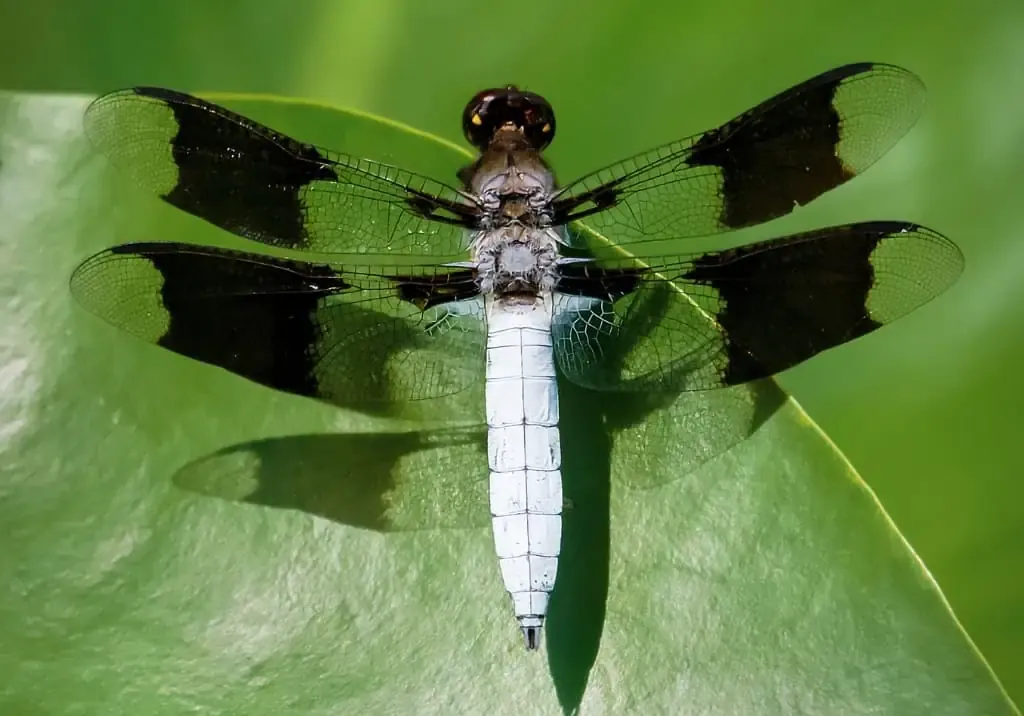
White Dragonfly Meaning
A white dragonfly may be interpreted as a symbol of peace, clarity, remembrance, or personal change, but these meanings belong to modern symbolism and individual belief rather than science. In nature, a dragonfly may look white because of normal species coloration, a waxy coating called pruinescence, its age or sex, reflected light, or the way a photograph was exposed.
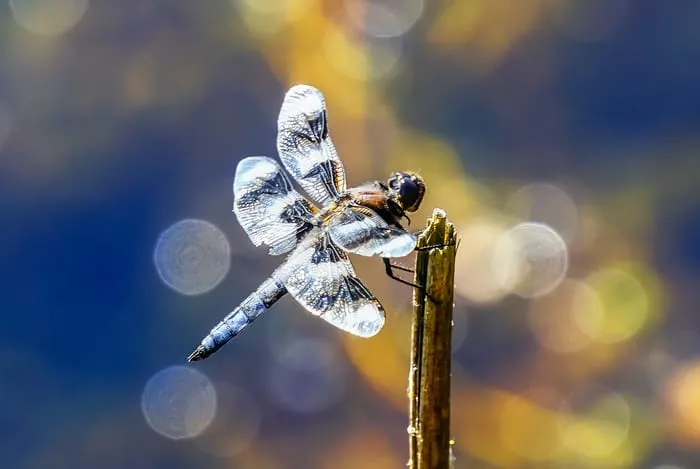
White Dragonfly Meaning at a Glance
There is no single, universal meaning attached to a white dragonfly. What the sighting means depends on whether you are asking a symbolic question or trying to identify a real insect.
What Can a White Dragonfly Symbolize?
In modern spiritual writing and personal symbolism, some people associate a white dragonfly with peace, emotional clarity, renewal, remembrance, or a quiet period of change. White may suggest simplicity or calm, while a dragonfly may be used as a metaphor for adaptability because it changes from an aquatic juvenile into a flying adult.
These interpretations may be emotionally meaningful, but they are not fixed messages contained in the insect itself. Seeing a white-looking dragonfly does not prove that a particular event is about to happen, that a decision is correct, or that the observer has received supernatural guidance.
Historical dragonfly symbolism is also more varied than many online summaries suggest. For example, the Metropolitan Museum of Art describes the dragonfly as a favored Japanese samurai emblem associated with resolve and victory. That is a documented cultural use of the dragonfly motif, but it does not establish a universal historical meaning specifically for a white dragonfly.
For broader context, see the guide to dragonfly symbolism and cultural interpretations .
Is White Dragonfly Symbolism Scientifically Proven?
No. Science can study a dragonfly’s pigments, waxes, behavior, development, habitat, and evolutionary history. It cannot demonstrate that an individual sighting carries a personal message, predicts good luck, or communicates instructions from a spiritual source.
This does not prevent someone from using the encounter as a private symbol. A person may choose to connect it with a memory, a life change, or a moment of reflection. The important point is to distinguish personal meaning from testable biological evidence.
Why Do Some Dragonflies Look White?
“White dragonfly” is a visual description, not one taxonomic group. Several different conditions can make a dragonfly appear white, pale gray, silver, or blue-white.
- Normal adult coloration: some species naturally develop pale areas on the abdomen, thorax, face, or wings.
- Sexual differences: mature males and females of the same species can have very different colors and patterns.
- Age-related change: an immature adult may look different from the fully mature form.
- Pruinescence: a waxy surface bloom can cover darker underlying colors and create a dusty white or pale-blue appearance.
- Teneral appearance: a newly emerged adult is often softer and paler before its body hardens and mature colors develop.
- Light and photography: glare, reflected sunlight, backlighting, white balance, and overexposure can make pale areas look much whiter than they did in the field.
- Unusual pigment development: abnormalities are possible, but they cannot be diagnosed reliably from a single image.
Because these explanations can overlap, observers should avoid naming a species from the word “white” alone. The dragonfly identification guide explains which structural features and field details are more useful.
What Is Pruinescence?
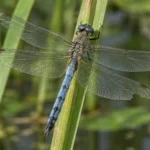
Pruinescence, also called pruinosity, is a frosted or powdery-looking coating on the outside of an insect’s cuticle. In dragonflies it is often produced by surface waxes. The coating scatters and reflects light, so an abdomen that was previously brown or dark may later look chalky white, gray, or pale blue.
The amount and location of pruinescence depend on the species, sex, and maturity of the individual. In some species it becomes more conspicuous as adult males mature. It can also be uneven or rubbed away, leaving darker patches where the underlying body color shows through.
Pruinescence should not be described merely as decorative powder. Research published in the Proceedings of the National Academy of Sciences found that wax-producing male dragonflies were associated with hot, dry environments and that the coating could help reduce overheating and water loss. Its function is not necessarily identical in every dragonfly species, however, and coloration may also contribute to communication or recognition.
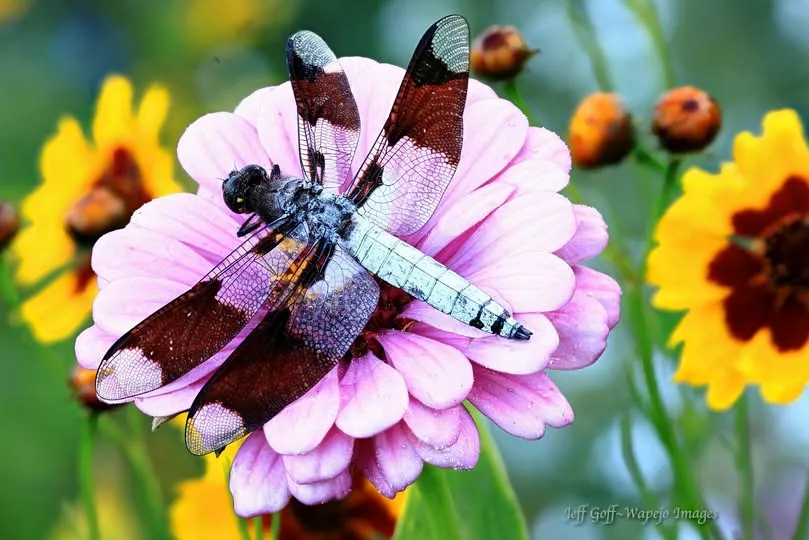
Are White Dragonflies Albino?
Usually, there is no reason to assume that a white-looking dragonfly is albino. Normal pruinescence and ordinary species coloration should be considered first.
The term “albinism” is also less straightforward in insects than it is often presented. Insect colors can be produced by several pigments, microscopic surface structures, waxes, and combinations of these mechanisms. A pale insect may therefore have reduced pigmentation without meeting a clear definition of complete albinism.
A photograph showing a pale abdomen, white face, or translucent wings is not evidence of albinism. Confirming a genuine pigment abnormality would require comparison with the normal age and sex of that species, examination of the entire insect, and ideally assessment by an experienced odonate specialist.
Dragonfly Species That May Look White
Common names can help narrow a search, but they are not proof of identity. Some “white” names refer only to one body part, one sex, or one stage of maturity.
| Species | Why it may look white | Important identification caution |
|---|---|---|
|
Common Whitetail Plathemis lydia | Mature males develop a conspicuous chalky white or blue-white abdomen. The pale appearance is associated with pruinescence. | Females are brown with pale abdominal markings, and young males do not initially look like fully mature males. Dark wing bands and body structure are also important. |
|
White Corporal Ladona exusta | Mature males can show extensive pale pruinescence and may look distinctly white or light gray. | It is a North American species with a more restricted eastern distribution than the Common Whitetail. Location and wing pattern should be checked before assigning the name. |
|
White-faced Meadowhawk Sympetrum obtrusum | A mature male has a conspicuous pale or white face. | It is not an all-white dragonfly. Mature males are primarily red and dark-colored, so this is a good example of why a common name can be misleading. |
| Other pruinose skimmers | Various skimmer species develop blue-white, gray, or silvery wax coatings on part of the thorax or abdomen. | Similar pale coatings occur in unrelated species. A white or blue-white abdomen alone is not diagnostic. |
The Common Whitetail is widespread across much of North America, and its mature male is one of the most plausible explanations for a prominently white-abdomened dragonfly in that region. Learn more in the dedicated Common Whitetail dragonfly guide .
Does a White Dragonfly Mean a Loved One Is Visiting?
Some people interpret a white dragonfly as a reminder of someone who has died, especially when the sighting occurs during grief, an anniversary, or a meaningful family moment. That association may offer comfort, but there is no scientific evidence that the insect is carrying a message from the deceased.
A balanced interpretation allows both ideas to remain separate: the dragonfly is a real animal behaving according to its biology, while the observer may give the encounter a private emotional meaning. It should not be presented as proof of contact with an afterlife or as a message that another person must accept.
What Should You Do After Seeing One?
You do not need to treat the sighting as a prediction. Instead, use it as an opportunity to observe the insect carefully and record details that may help with identification.
Repeated sightings often have an ordinary ecological explanation. A nearby pond may support a local population, adults may be emerging at the same time, or you may simply be paying closer attention after the first encounter. The dramatic change from aquatic juvenile to adult is explained in the dragonfly life cycle guide .
Frequently Asked Questions
What does a white dragonfly mean spiritually?
Some people associate it with peace, clarity, remembrance, renewal, or gentle personal change. These are modern symbolic interpretations rather than scientifically demonstrated messages.
Is seeing a white dragonfly a sign of good luck?
It may be treated as a positive symbol in personal or modern spiritual belief, but the sighting does not reliably predict luck, success, or a future event.
Are white dragonflies rare?
There is no single category called “white dragonflies.” Some normally colored species have common mature males with white or blue-white pruinescence, while a completely unpigmented individual would be a different and much more difficult claim to verify.
What is the most familiar white-looking dragonfly?
In much of North America, a mature male Common Whitetail, Plathemis lydia, is a likely candidate. It has a chalky pale abdomen and distinctive dark wing bands, but the full pattern and location should be checked.
Is a white dragonfly an albino dragonfly?
Not necessarily, and usually that should not be the first explanation. Normal waxy pruinescence, sex, age, species coloration, and photographic exposure are more appropriate possibilities to examine first.
Why did the dragonfly look blue-white instead of pure white?
Waxy pruinescence can scatter reflected light and appear chalky white, pale blue, silver, or gray depending on its thickness, the underlying body color, and the viewing conditions.
Why do I keep seeing white-looking dragonflies?
A local species may be common near suitable water, several adults may have matured at the same time, or your attention may have increased after the first sighting. Repeated encounters do not provide scientific evidence of a prediction or supernatural message.
Can sunlight make a dragonfly look white in a photograph?
Yes. Reflective wax, transparent wings, glare, bright backgrounds, overexposure, and automatic white-balance settings can make an insect look paler than it appeared in person.
Sources and Further Reading
- Odonata Central — A Checklist of North American Odonata
- Missouri Department of Conservation — Common Whitetail
- Illinois Department of Natural Resources — Common Whitetail
- Moore, Nalley and Hamadah — Dragonfly pruinescence, ecology and climate, Proceedings of the National Academy of Sciences
- Wisconsin Odonata Survey — White-faced Meadowhawk
- Maryland Biodiversity Project — White Corporal
- The Metropolitan Museum of Art — Dragonfly symbolism on a Japanese samurai helmet