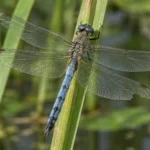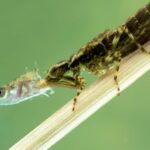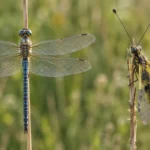
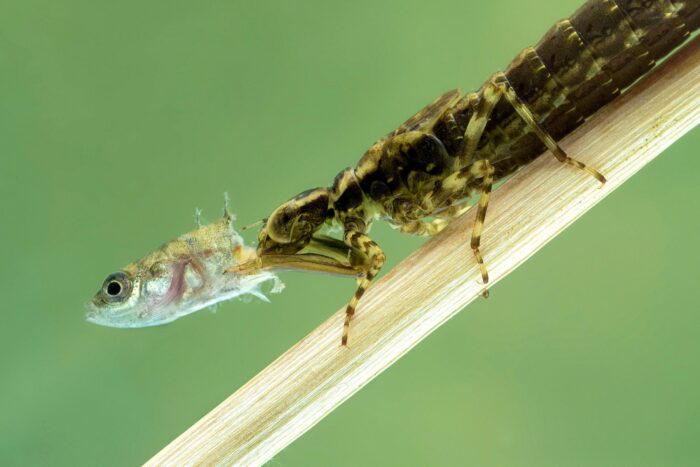
A dragonfly nymph in an aquarium can threaten baby fish, small fish, and aquarium shrimp. It is the aquatic young stage of a dragonfly and a natural predator—not a worm, parasite, or adult dragonfly. If you find one in a stocked tank, carefully remove it with a fine net or a small container, inspect plants and hiding places, and avoid using insecticides. Never release an unidentified aquarium organism into a local pond or stream.
An unexpected, six-legged insect in a fish tank can be difficult to identify. Dragonfly nymphs often resemble small, brown, armored creatures, and their habit of hiding among plants makes them easy to overlook. Here is how to recognize one, assess the risk to your aquarium animals, and deal with it responsibly.
What Does a Dragonfly Nymph Look Like in a Fish Tank?
A dragonfly nymph (also called a naiad or, informally, a dragonfly larva) lives underwater before developing into a winged adult. The exact body shape and size vary by species and growth stage, so no single measurement identifies every nymph.
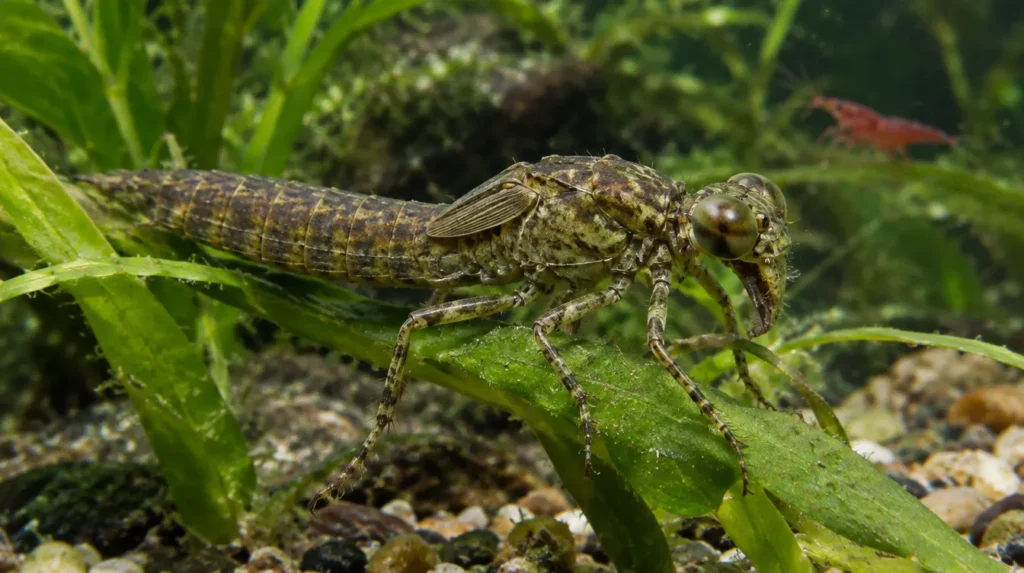
Look for a combination of these features:
- Six jointed legs attached to the thorax, rather than numerous legs running down the body.
- A relatively large head with prominent eyes, often wider than the front of the thorax.
- A segmented abdomen that may look broad, squat, elongated, or somewhat flattened.
- Brown, olive, gray, or mottled camouflage, although color alone is not reliable for identification.
- Developing wing pads on older nymphs, visible as short structures on the thorax rather than functional wings.
- A hinged, extendable lower lip (labium) that the nymph uses to seize prey. It may be folded beneath the head when the insect is resting.
A nymph may stay motionless on a leaf, driftwood, gravel, or the tank wall, then move abruptly. Some dragonfly nymphs can also propel themselves through water by expelling water from the rectal chamber. Neither behavior alone proves an identification.
For more about the anatomy and growth of these aquatic insects, see our guide to dragonfly larvae.
Dragonfly Nymph vs. Damselfly Nymph: Which Is in Your Aquarium?
Dragonflies and damselflies are related members of the insect order Odonata, but they are not the same group. Their aquatic nymphs are commonly confused in aquarium discussions.
| Feature | Dragonfly nymph (Anisoptera) | Damselfly nymph (Zygoptera) |
|---|---|---|
| Body | Often sturdier, broader, or more robust; some are elongated | Usually slender, with a narrower abdomen |
| End of abdomen | No three large, leaflike external tail gills | Usually three elongated, leaflike external gills |
| Breathing structures | Internal rectal gills | External caudal gills are typical |
| Hunting | Predatory, using a grasping labium | Also predatory, using a grasping labium |
| Aquarium concern | Can prey on appropriately sized shrimp, fry, and other small animals | Can also prey on small aquatic animals; not automatically harmless |
The tail is an especially useful clue. Three obvious leaflike appendages usually indicate a damselfly nymph, not a true dragonfly nymph. However, damselfly nymphs can lose these gills through injury, so use the full body form and other characters as well.
If you are uncertain, take clear photos from above and from the side, showing the entire body and tail. A regional aquatic-insect identification resource or an experienced local naturalist may be able to help; a blurry photo may only allow identification to order or family.
Will Dragonfly Nymphs Eat Aquarium Shrimp or Fish?
Yes, some dragonfly nymphs can eat aquarium shrimp and very small fish, particularly fry. Their risk depends on the nymph’s species and size, the size of the potential prey, and the aquarium environment. It would be misleading to claim that every nymph can catch every fish.
Dragonfly nymphs are sit-and-wait or active aquatic predators. When prey moves within reach, a specialized lower lip shoots forward and pulls it toward the mouthparts. In natural freshwater habitats, their prey can include aquatic insect larvae, small crustaceans, tadpoles, and small fish.
Risk to shrimp
Newly hatched shrimp and small juveniles are especially vulnerable because they may be small enough to capture. Larger nymphs may also threaten adult ornamental shrimp when the size and circumstances allow. If you maintain a shrimp-breeding tank, take an unidentified predatory nymph seriously, even if you have not directly observed it feeding.
Risk to fish fry and small fish
Newly hatched fry and very small fish may be vulnerable. Larger, healthy adult fish are not necessarily at risk from a small nymph; some fish may even eat dragonfly nymphs. Avoid adding a new predatory fish as a quick fix, however: doing so may create compatibility or stocking problems without solving the original identification issue.
What about missing shrimp or fry?
A nymph is one possible explanation, not proof of the cause. Shrimp and fry can disappear for many reasons, including filtration intake, tankmates, water-quality problems, normal hiding behavior, and losses during early development. Identify the animal and investigate the tank before attributing all losses to it.
To learn how diet changes between the aquatic and adult stages, read what dragonflies eat.
How Did a Dragonfly Nymph Get Into Your Aquarium?
Aquatic plants are one plausible route. Some dragonflies insert eggs into plant tissue; others release eggs into water or onto wet surfaces. Outdoor-grown plants can therefore carry eggs or small aquatic insects that go unnoticed until after the plants are added to an aquarium. A nymph can also arrive with water, debris, or other material transferred from an outdoor pond or container.
There is another possibility: if an aquarium or indoor pond is exposed to adult dragonflies, an adult female might lay eggs there. You cannot determine the exact entry route simply by finding one nymph.
The presence of a nymph does not mean the aquarium has spontaneously produced insects or that the nymph arrived as a flying adult hidden underwater. It developed from an egg laid in a suitable aquatic setting.
How to Remove a Dragonfly Nymph Safely
For a community tank, shrimp tank, or fry-rearing aquarium, targeted physical removal is a sensible first approach.
- Confirm the identification as far as possible. Photograph the insect through the glass before moving plants or decorations. Pay attention to the six legs, head, wing pads, and abdominal tip.
- Prepare a fine-mesh net or small cup. Use equipment dedicated to the aquarium and free from soaps, sprays, and chemical residues. A small cup can be gentler for collecting a larger specimen.
- Catch the nymph without chasing fish or shrimp. Move slowly and avoid uprooting large areas of the aquascape. If the insect hides in dense plants, gently move the leaves and guide it into the net or container.
- Hold it securely while you identify it and determine legal, responsible next steps. Use a covered, escape-resistant container suitable for temporary holding, with some aquarium water. Seek advice from a local wildlife authority or qualified aquatic-insect specialist if the species or permitted disposition is uncertain.
- Inspect the rest of the aquarium. Check the undersides of leaves, plant clumps, driftwood, substrate edges, and other hiding places. Finding one nymph does not prove there are more, but additional individuals or eggs are possible.
- Continue observing over time. Recheck after the next few feeding or maintenance sessions and after any recent plant introduction. There is no scientifically reliable number of days that guarantees all eggs or hidden nymphs have been detected.
Do not squeeze the insect with your fingers or handle it unnecessarily. Do not use copper treatments, household insecticides, or other broad-spectrum chemicals as a shortcut. Their effects on fish, ornamental invertebrates, plants, and beneficial aquarium organisms can be serious, and a chemical treatment is not needed merely because you have found one identifiable nymph.
Should you release it into a pond?
Not unless an appropriate local authority confirms that doing so is lawful and ecologically suitable. Aquarium plants and their hitchhikers may originate from outside your area. Even when an insect resembles a native species, appearances may not establish its identity or origin. Never transfer unknown aquarium organisms, tank water, or plants into natural waterways or storm drains.
If an adult dragonfly emerges indoors from a specimen associated with imported plants, the same precaution applies: do not automatically release it outdoors. Contact a local wildlife or invasive-species authority for guidance.
How to Prevent Dragonfly Nymphs From Arriving on New Plants
Prevention begins before a new plant enters your display aquarium.
- Inspect plants carefully. Look at roots, stem joints, leaves, and any water or debris accompanying the purchase. Small insects or embedded eggs may still be missed.
- Choose a reputable source. Sealed, laboratory-propagated tissue-culture plants can reduce exposure to many outdoor aquatic hitchhikers when packaging and handling remain uncontaminated. They do not remove every possible route of introduction to a tank.
- Consider a separate plant-observation container. Inspect new plants in a clean, isolated container before moving them into a shrimp or breeding aquarium. No brief quarantine period can be promised to detect every dragonfly egg because development differs among species and conditions.
- Avoid transferring wild pond material directly. Submerged vegetation, sediment, debris, and water can bring unexpected organisms into an indoor tank.
- Use caution with chemical plant dips. Compatibility depends on plant species and treatment, and dips may injure plants or fail to reach eggs embedded in tissue. Do not assume a universal recipe is safe or fully effective, especially for sensitive shrimp setups.
When in doubt, isolation and observation are more defensible than a promise that a particular dip or fixed number of days will make every plant completely free of aquatic insects.
Can a Dragonfly Nymph Live and Turn Into an Adult in an Aquarium?
Yes, a dragonfly nymph may survive and develop in an aquarium if conditions meet its needs, although development and survival depend on the species and environment. Dragonflies undergo incomplete metamorphosis: egg → aquatic nymph → winged adult. There is no pupal or chrysalis stage.
An older nymph has visible wing pads. When ready to emerge, it normally leaves the water, attaches to a suitable surface, and sheds its final nymphal skin. The empty skin is called an exuvia. An open aquarium can therefore allow an emerging dragonfly to enter the room. An aquarium without a suitable emergence surface may interfere with this transition.
This is another reason not to leave an unidentified nymph in a mixed-species display tank simply to see what happens. For the broader biology of this transformation, explore the dragonfly life cycle.
Is a Dragonfly Nymph Beneficial or Harmful?
In a natural pond, a dragonfly nymph is a normal part of the freshwater food web. It eats other aquatic animals and may itself become prey for fish or larger aquatic predators. Its presence is not evidence that a pond is infested with a harmful insect.
In a small, managed aquarium, the context changes. A predator that is ecologically valuable in a pond can be unwelcome in a carefully stocked shrimp-breeding or fry-rearing tank. The correct response is not to portray dragonflies as pests everywhere, but to manage an unexpected aquarium predator without damaging the tank or introducing it to another ecosystem.
Frequently Asked Questions
Can a dragonfly nymph kill cherry shrimp?
Potentially, yes. Small cherry shrimp are vulnerable to aquatic predators, and a sufficiently large dragonfly nymph may capture shrimp within its prey-size range. The actual risk depends on the nymph and shrimp sizes, cover, and conditions.
Can a dragonfly nymph kill a betta or guppy?
It is much more reasonable to worry about fry and very small fish than to assume a small nymph can kill a healthy adult betta or guppy. Large dragonfly nymphs can capture small fish, but the outcome depends on relative sizes and the particular species involved.
Do dragonfly nymphs eat snails?
Some aquatic odonate nymphs take a variety of small invertebrates, but their diet varies. Do not rely on a dragonfly nymph as a safe or selective method of controlling aquarium snails.
How many dragonfly nymphs can be hiding in one tank?
There is no fixed number. A single sighting could mean one animal or several. Inspect plants and hiding spots again instead of assuming either that the infestation is widespread or that the first individual is definitely the only one.
Will a dragonfly nymph die without water?
Dragonfly nymphs are aquatic and rely on their aquatic respiratory system. Do not leave one exposed to air while attempting identification or removal. Keep the animal secured appropriately while arranging informed handling guidance.
Can a dragonfly nymph bite humans?
Dragonfly nymphs do not sting. Their mouthparts can grasp prey, and handling a live insect can cause a defensive pinch or bite. There is no need to pick it up with bare fingers; use a net or container.
The Bottom Line
A dragonfly nymph in an aquarium is not inherently a sign of dirty water, but it is a real predatory insect. In tanks with ornamental shrimp, fry, or very small fish, careful removal is usually the prudent choice. Identify the organism using more than color, check recently introduced plants, avoid blanket chemical treatments, and never release an unidentified aquarium hitchhiker into local waterways.
How This Article Was Created
This article was prepared through a review of university extension material, insect-identification guidance, and aquatic invasive-species prevention recommendations. The article distinguishes well-established dragonfly biology from practical, precautionary aquarium advice. No personal aquarium experiment, field collection, or species-level identification of a reader’s specimen is claimed. Species-specific recommendations should be checked against qualified local guidance.
References
- North Carolina State University, General Entomology. Order Odonata. https://genent.cals.ncsu.edu/insect-identification/order-odonata/
- Iowa State University Extension and Outreach. Dragonflies and Damselflies. https://yardandgarden.extension.iastate.edu/encyclopedia/dragonflies-and-damselflies
- Clemson University Home & Garden Information Center. Dragonflies. https://hgic.clemson.edu/dragonflies/
- Missouri Department of Conservation. Damselfly Larvae. https://mdc.mo.gov/discover-nature/field-guide/damselfly-larvae
- Ask Extension. Pond Insect Larvae Identification (2024; discussion of aquatic plants as possible egg carriers). https://ask.extension.org/kb/faq.php?id=870536
- British Dragonfly Society. Frequently Asked Questions (imported pond plants and dragonfly/damselfly emergence). https://british-dragonflies.org.uk/odonata/frequently-asked-questions/
- U.S. Fish and Wildlife Service, Aquatic Nuisance Species Task Force. Get Involved (guidance for aquarium owners). https://www.fws.gov/program/aquatic-nuisance-species-task-force/get-involved
- Connecticut Department of Energy and Environmental Protection. Releasing Bait and Aquarium Pets. https://portal.ct.gov/DEEP/Invasive-Species/Releasing-Bait-and-Aquarium-Pets