Dragonfly Identification: How to Identify a Dragonfly
A dragonfly is best identified by combining several kinds of evidence: where and when it was seen, the type of water nearby, its size and behavior, the position of its eyes, markings on the thorax and abdomen, and details of the wings. A single feature—especially color—is rarely enough.
A Step-by-Step Dragonfly Identification Process
Do not begin by scrolling through pictures of every blue, red or green dragonfly on the internet. Begin with the observation itself. The following sequence helps prevent attractive but geographically impossible matches.
- Confirm that it is an odonate Look for two large compound eyes, four strongly veined wings, six legs, a muscular thorax and a long segmented abdomen. Robber flies, antlions and some other insects may look superficially similar.
- Decide: dragonfly or damselfly Use body build, eye spacing, wing shape, resting posture and flight together. Do not depend on the wings alone.
- Record country, region and precise habitat Note the nearest town or coordinates and whether the insect was beside a pond, lake, marsh, bog, temporary pool, canal, river or fast stream.
- Record the date and time of year Flight seasons vary with latitude, altitude, climate and annual weather. A date is useful only when compared with a regional atlas.
- Estimate size without catching it Compare its body length with a nearby leaf, reed, fence wire or other visible object. Avoid unsupported millimeter estimates from a distant photo.
- Observe flight and perching behavior Does it patrol continuously, glide over open water, dart from a repeated perch, hang vertically, sit on bare ground or remain high in trees?
- Examine the eyes Note whether the compound eyes meet, nearly meet or remain clearly separated. Record their apparent color, but allow for reflections.
- Examine the thorax Look for shoulder stripes on top, stripes or spots on the sides, metallic areas, pale panels and the color of the legs.
- Examine the abdomen Record whether it is slender, broad, flattened, clubbed or strongly tapered. Check patterns segment by segment instead of describing only the overall color.
- Examine the wings Check the width of the hindwing base, colored patches, bands, nodal marks, clear or tinted areas, and the small pterostigma near each wing tip.
- Consider sex, age and teneral condition Females, immature males and newly emerged adults may look very different from the mature male shown most prominently in a field guide.
- Compare only with documented regional species Use a current national or regional checklist, atlas or recording scheme. Do not select a visual match that is not known from your area.
- Record uncertainty and request verification Submit uncropped photographs, location, date and habitat to a regional recorder, museum, odonate group or moderated nature-recording platform.
Dragonfly vs. Damselfly
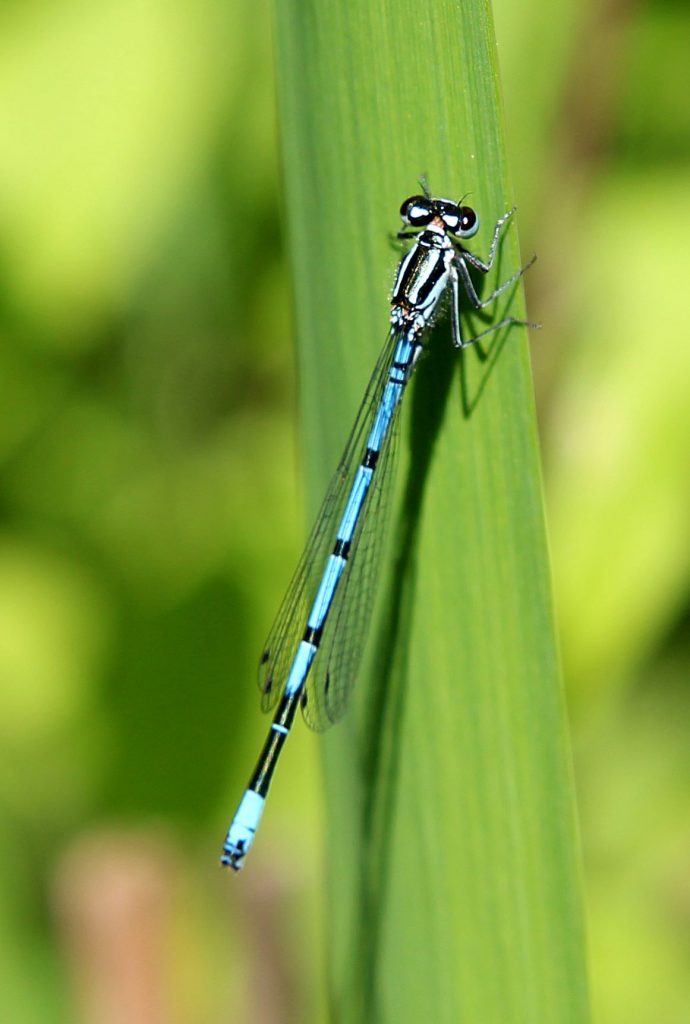
Dragonflies and damselflies belong to the insect order Odonata. Adult dragonflies are generally placed in the suborder Anisoptera, while damselflies form the suborder Zygoptera. The names refer partly to differences in wing form, but beginners should use a combination of features rather than treating one feature as an absolute test.
| Feature | Typical dragonfly | Typical damselfly | Important caution |
|---|---|---|---|
| Body | Usually robust, with a powerful thorax | Usually slender and delicate | Size overlaps, and some damselflies are broad-winged or relatively large. |
| Eyes | Often meet or nearly meet on top of the head | Usually clearly separated | Clubtails and petaltails are dragonflies with separated eyes. |
| Wing shape | Hindwings are usually broader at the base than forewings | Forewings and hindwings are more similar in shape | A clear dorsal photograph is more useful than a distant side view. |
| Resting wings | Usually held open or downward from the body | Often held together above the abdomen | Some damselflies hold their wings partly or widely spread. |
| Flight | Often fast, strong and sustained | Often lighter or more fluttering | Behavior changes with species, weather, temperature and disturbance. |
Start With Location, Date and Habitat
A photograph contains only part of an identification. The same-looking insect may have several relatives elsewhere in the world, while a visually convincing online match may not occur anywhere near the observation site. Country and region should therefore be recorded before a species name is considered.
Habitat can narrow the possibilities further. Record whether the water was still or flowing, permanent or temporary, open or shaded, fresh or brackish. Note surrounding vegetation, exposed mud, sandy banks, forest, bog, marsh or rocky streambed. Some species are strongly associated with particular breeding waters, although adults may hunt or mature away from water.
The date is equally important. Regional flight-period charts can exclude species that do not normally fly at that season, but dates should not be treated as rigid worldwide rules. Warm springs, droughts, elevation and unusual weather can shift emergence.
Body Size and Shape
Overall size is useful for separating a very large darner-like dragonfly from a small pond skimmer, but apparent size is easily distorted by camera distance. Include a nearby object for scale when possible, and describe the insect as small, medium or large relative to other dragonflies seen at the site.
Look beyond length. Is the abdomen narrow and almost parallel-sided, strongly tapered, flattened, broad near the base or enlarged near the tip? A widened tip can suggest a clubtail, but not every member of Gomphidae has an obvious club, and unrelated species may also appear swollen from certain angles.
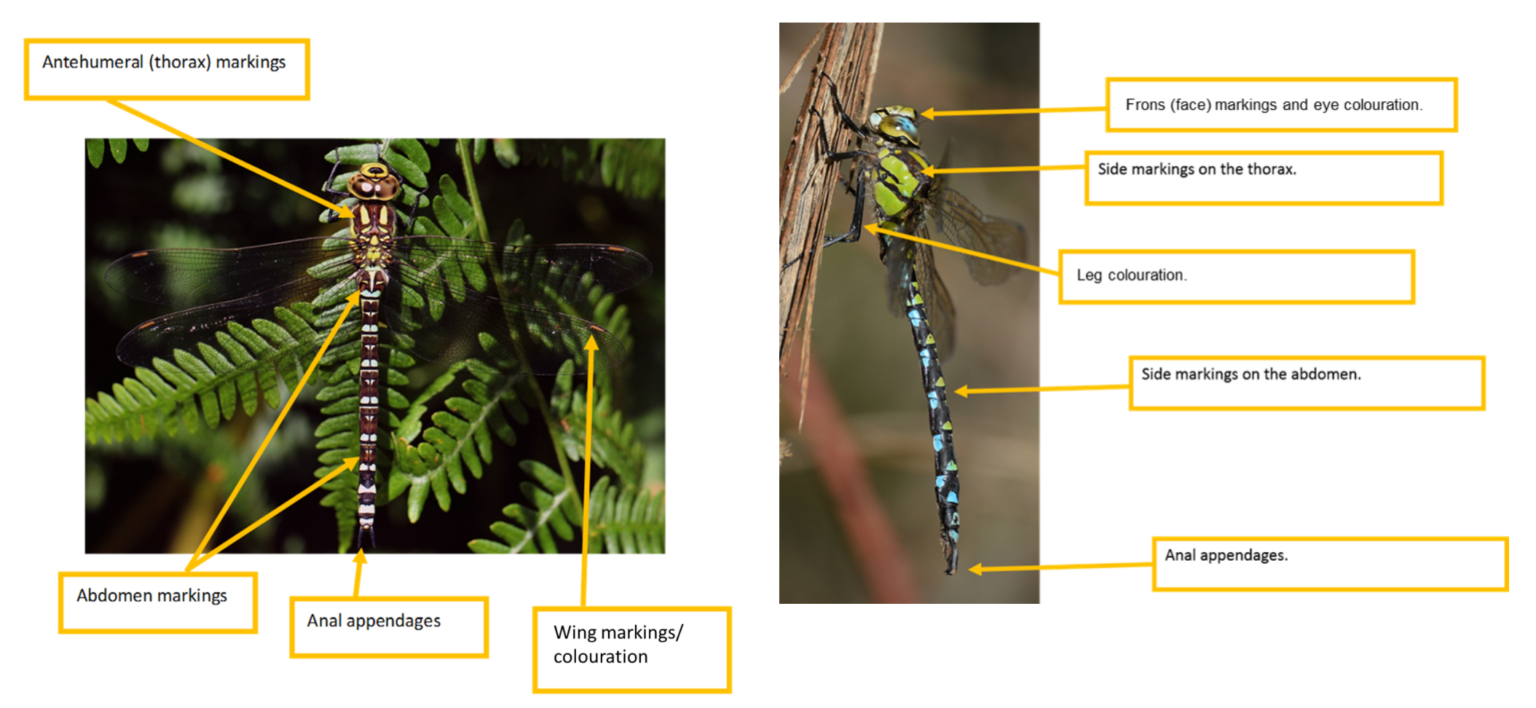
Overall size
Estimate size in context rather than from an isolated cropped image.
Abdominal shape
Record width, taper, flattening and any enlargement near the tip.
Anal appendages
The structures at the abdominal tip can separate similar species when clearly photographed.
Eyes and Head
Eye arrangement is one of the best features for separating the two major odonate groups, but it still requires care. Most damselflies have a clear gap between the compound eyes. The eyes of many dragonflies touch or nearly touch, yet clubtails and petaltails are important dragonfly exceptions.
Photograph the head from above and from the front when possible. Record eye color, the color of the face and frons, and any dark cross-lines or pale patches. Bright sky, vegetation and flash can reflect from the compound eyes, so a color visible in one photograph may not be the insect’s true color.
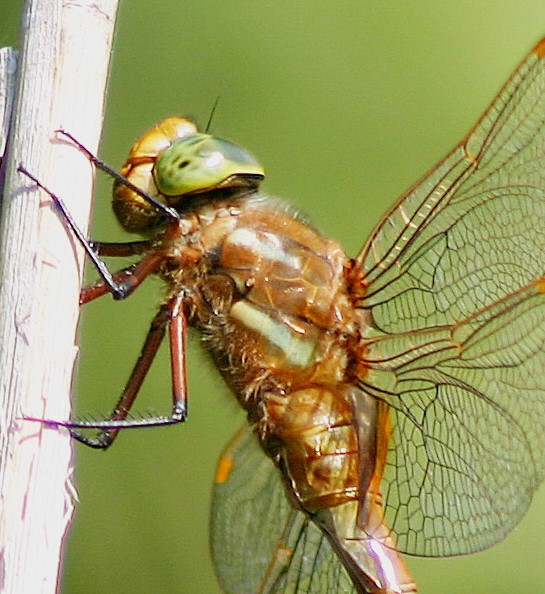
Thorax and Abdomen Markings
The thorax is the muscular middle part carrying the wings and legs. Check for paired shoulder stripes on top, broad or narrow stripes on the sides, isolated spots, metallic reflections and contrasting panels. Photograph both the upper surface and one complete side because important markings may be invisible from the other angle.
On the abdomen, avoid descriptions such as “blue dragonfly” or “brown tail.” Count visible abdominal segments from the base toward the tip and note where each mark begins and ends. A continuous stripe, paired spots, rings, side patches and a mark confined to one segment are different patterns even when their colors are similar.
Leg color and face color can distinguish close species, but they are often lost in underexposed photographs. Anal appendages at the abdominal tip may be essential for separating males of similar species. Some groups also require a clear view of reproductive structures on the underside of the abdomen.
Wings, Wing Patches and Pterostigma
Each adult odonate has two pairs of veined wings. For identification, photograph the entire wings rather than only the body. Compare the shape of the forewing and hindwing, especially the broader basal area of a typical dragonfly hindwing.
Record whether the wings are completely clear, uniformly tinted or marked with basal patches, bands, spots or dark tips. Check whether a patch occurs on all four wings or only the hindwings. Wing damage, glare and overlapping vegetation can create false marks, so use more than one photograph.
The pterostigma is the small thickened or colored cell near the leading edge of each wing tip. Its length, shape and color can be useful, although it is rarely sufficient by itself. Closely related species may also require details of wing venation that cannot be resolved in an ordinary phone photograph.
Sex, Age and Teneral Color
Many field guides emphasize mature males because they are bright and easy to illustrate. Females may be patterned differently, while immature males may initially resemble females and develop mature coloration later. A waxy coating called pruinescence can cover earlier markings and make the same individual appear blue, gray or white.
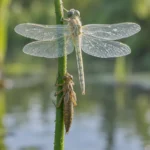
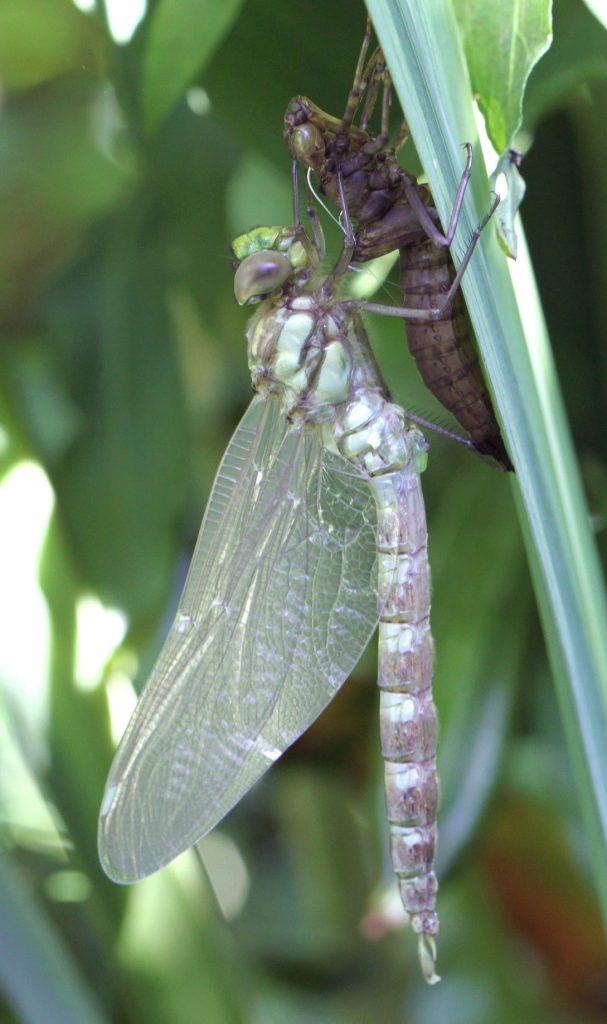
A newly emerged adult is described as teneral. Its body may be pale, its wings glossy and soft, and its final colors undeveloped. Older adults can also darken, fade, become worn or lose surface coatings. Camera white balance, shade, reflected vegetation and direct sunlight can further change the apparent color.
Major Dragonfly Family Groups
Family-level identification can be a realistic and useful outcome for a beginner. The following groups are widely used, but English common group names differ between regions and do not replace scientific family names. Taxonomy also changes as new research is published.
| Common group name | Scientific family | Beginner-level clues | Caution |
|---|---|---|---|
| Darners or hawkers | Aeshnidae | Often large, long-bodied and powerful, with eyes meeting broadly and frequent patrolling flight. | Color and thorax stripes vary greatly; many similar species require close views. |
| Clubtails | Gomphidae | Eyes are clearly separated; many have yellow, green or pale markings and an enlarged abdominal tip. | Not every species has a conspicuous club, and many are difficult to separate. |
| Skimmers | Libellulidae | A highly diverse group; many perch frequently and some have broad abdomens or bold wing patches. | No single body shape or color defines this large family worldwide. |
| Emeralds or baskettails | Corduliidae | Many are dark or metallic with bright green eyes and strong, sustained flight. | “Emerald” is used differently by regional guides and may also appear in damselfly common names. |
| Cruisers | Macromiidae | Often streamlined, strong-flying dragonflies associated with rivers, streams or lakes. | Family treatment and common-name usage may differ among taxonomic sources. |
| Petaltails | Petaluridae | Generally large dragonflies with separated eyes and specialized habitat associations. | They are geographically restricted and should be checked against a regional atlas. |
Other dragonfly families occur in different parts of the world. For a broader treatment of classification, diversity and representative families, use the dragonfly species guide. For photographed examples rather than taxonomy, see common dragonfly species.
How to Photograph a Dragonfly for Identification
One perfect portrait is less useful than a short series showing different structures. Take the widest contextual image first, then move slowly if the insect remains settled. Never sacrifice the insect’s safety for a closer photograph.
Dorsal view
Photograph the insect from above to show eye spacing, thorax stripes, abdominal pattern and all four wings.
Side view
Capture the face, side thorax, legs, abdominal depth and any underside structures.
Head and eyes
Keep both eyes sharp enough to assess whether they meet and to record face markings.
Thorax markings
Photograph both shoulder stripes and side panels whenever the angle allows.
Full abdomen
Do not crop off the tip; terminal appendages may be essential.
Wing bases
Show the attachment area and any basal tint, dark patch or amber coloration.
Wing tips and pterostigma
Keep the outer wings in focus and avoid cutting them off at the frame edge.
Location and date
Save coordinates or a precise locality and the complete observation date.
Habitat
Take one wider image showing the pond, stream, bank, vegetation or surrounding landscape.
- Do not hold or lift a dragonfly by its wings.
- Do not damage vegetation supporting an emerging adult.
- Do not move a teneral adult away from its exuvia for a cleaner photograph.
- Do not upload only one heavily cropped image when the original frame is available.
- Do not announce a rare regional record solely because an AI tool suggested a name.
Why Color Alone Is Not Enough
Blue, green, red, yellow, black and brown occur in many unrelated dragonflies. Several species may share the same general color within one region, while males and females of a single species may look strikingly different. Immature males can change color as they mature, and pruinescence can conceal the original pattern.
Photographic color is also unstable. Automatic white balance may make a brown insect look red, deep shade may turn green markings blue, and reflected sky can change the apparent color of the eyes. Use color as one recorded feature, then compare pattern position, body shape, wings, location, date and habitat.
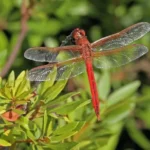
“A red dragonfly” is therefore a starting description, not an identification. A better field note would be: “medium-sized red dragonfly, clear wings with amber hindwing bases, pale pterostigma, perched repeatedly on low stems beside a sunny temporary pond in southern Taiwan in July.”
When Species-Level Identification Is Not Possible
Some dragonflies can be recognized from a clear dorsal and side photograph. Others belong to complexes in which species differ mainly in the shape of male anal appendages, female reproductive structures, facial markings, tiny abdominal details or wing venation. These characters may require a macro photograph, a specimen examined under appropriate scientific protocols, or confirmation by an experienced regional recorder.
A blurred insect in flight may support only “dragonfly.” A sharp photograph with separated eyes and a clubbed abdomen may support “clubtail.” A well documented observation may reach genus or species group without reaching species. That is not a failed identification; it is an accurate statement of what the evidence shows.
Confirmed
All required field marks are visible, the range and date fit, and a qualified regional source or reviewer supports the identification.
Probable
The visible characters strongly support one species, but one minor diagnostic feature is missing.
Possible
The species is plausible, but the photo or observation cannot exclude one or more close alternatives.
Unidentified
The evidence supports only Odonata, dragonfly, damselfly, family, genus or species group.
Do not increase confidence merely because several automated tools return the same picture match. Computer vision can suggest candidates, but the observer or reviewer must still test those candidates against range, season, habitat and diagnostic structures.
Regional Identification Resources
A global web page can teach the method, but species-level identification normally requires a resource created for the observation region. Prefer sources that state their geographic coverage, publication or update date, taxonomic treatment and record-verification process.
Regional field guides and atlases
Use current national or state/provincial guides with distribution maps, flight periods, sex and age variants, and similar-species comparisons.
Formal recording schemes
National societies, museums and local recorders can verify unusual observations and maintain documented regional checklists.
Odonata databases
Odonata Central and specialist societies provide records, checklists and regional expertise, particularly for the Americas.
Community identification platforms
Upload the original photos, exact date, location and habitat, then wait for evidence-based review rather than accepting the first automated suggestion.
Frequently Asked Questions
How can I identify a dragonfly from a photo?
Begin with the observation location and date. Then examine size, eye spacing, thorax markings, abdominal pattern, wing bases, wing patches and pterostigma. A dorsal view, side view and uncropped habitat image are much more useful than one close crop.
Can a dragonfly be identified by color?
Color can narrow the possibilities, but it cannot normally confirm a species by itself. Sex, maturity, pruinescence, age, lighting and camera white balance can all change apparent color.
Do all dragonflies rest with open wings?
Adult dragonflies usually hold their wings open or outward, but resting posture should be combined with body form, eye spacing and hindwing shape. Damselflies often fold their wings, yet some hold them partly or widely spread.
What is the easiest way to tell a dragonfly from a damselfly?
Use several features together. A typical dragonfly is robust, has hindwings broader at the base, flies strongly and often has eyes that meet. A typical damselfly is slender, has separated eyes and wings of more similar shape. Each simple rule has exceptions.
Why can an expert identify only the family or genus?
The photograph may not show the structures separating close species. Anal appendages, reproductive structures, face details or wing venation may be hidden or blurred. A broader identification is more reliable than an unsupported species name.
Can AI identify a rare dragonfly?
AI can generate candidates, but it cannot by itself validate a rare record. Compare the suggestion with a current regional checklist and obtain confirmation from a regional recorder, odonate society, museum specialist or experienced reviewer.
How do I identify a dragonfly nymph?
Nymph identification uses aquatic body shape, mouthparts, abdominal structures and other features that are different from adult identification. Use the dedicated dragonfly larvae guide rather than applying adult color and wing characters.
Sources and Further Reading
- British Dragonfly Society — Dragonfly or Damselfly? Basic comparison of Anisoptera and Zygoptera, including exceptions to common rules.
- British Dragonfly Society — Identification Help Guidance on flight period, distribution, habitat, age-related color changes and useful photograph angles.
- Dragonfly Society of the Americas Specialist organization supporting the study and documentation of Odonata in the Americas.
- Odonata Central Distribution records, checklists, identification resources and odonate data.
- World Odonata List — University of Puget Sound A regularly updated systematic list of living Odonata.
- Australian Museum — Dragonflies and Damselflies General institutional overview of Odonata biology and the two principal adult groups.
- iNaturalist — What Is an Identification? Guidance on identifying organisms only to the taxonomic level supported by the available evidence.
Regional species ranges, common names and flight periods change as new records and taxonomic revisions are published. Check the publication or update date of any field guide and use a formal national or regional Odonata atlas whenever one is available.