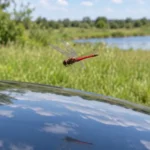
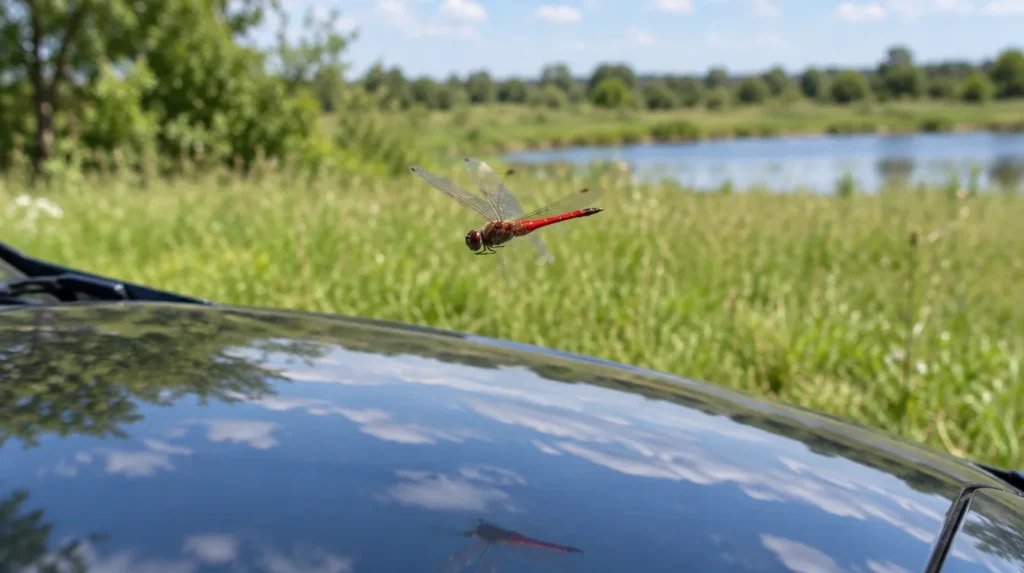
Most dragonflies that hover over a parked car are mistaking it for water. A clean, shiny, dark car reflects light in a way that looks, to a dragonfly’s eyes, very much like the surface of a pond. Males may patrol and defend the car as if it were a breeding site, and females of some species may even tap the hood with their abdomen and lay eggs on it. Those eggs cannot survive.
That is the main explanation, and it is well documented. A few other reasons also bring dragonflies close to cars: a car antenna can make a handy perch, and dragonflies that fly low across roads sometimes get hit. This article explains each of these, which cars and which dragonflies are most often involved, and whether you need to do anything about it.
The Short Answer: A Shiny Car Can Look Like Water
Dragonflies spend their larval life underwater, so adults need to find water to mate and lay eggs. Many species, especially skimmers and their relatives, find water partly by looking at how light is reflected from a surface.
When sunlight bounces off a flat water surface, the reflected light becomes partly polarized. Put simply, more of the light waves vibrate in one direction, horizontally, than in others. Humans cannot see this without special filters, but many water-dependent insects can. Researchers call the tendency to be drawn toward horizontally polarized light positive polarotaxis.
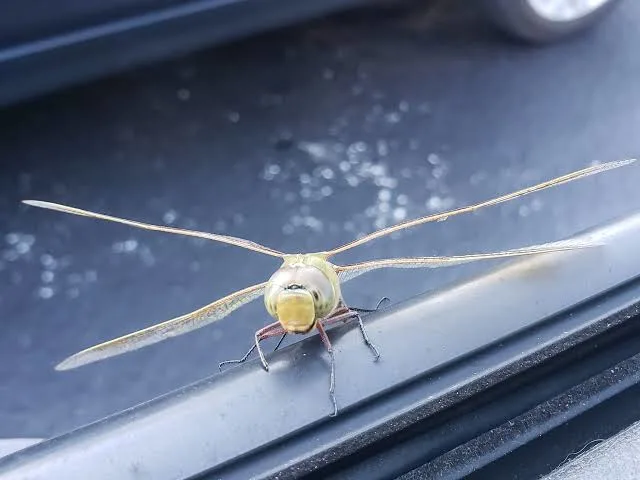
Water is not the only surface that does this. Smooth, shiny, dark surfaces reflect strongly polarized light too, and car paint is one of them. In a field case published in 2005, Hansruedi Wildermuth and Gábor Horváth measured the hood of a shiny dark green car and found it reflected strongly, horizontally polarized light. They concluded that the car body closely mimicked the optical signal of a flat, dark pool of water.
Earlier experiments point the same way. In field tests summarized in that paper, dragonflies were drawn to shiny plastic sheets, Perspex and glass, but not to aluminium foil, which does not reflect horizontally polarized light. A 1998 study by Horváth, Bernáth and Molnár went further and found that dragonflies chose crude oil over water in multiple-choice tests, because oil reflects even more strongly polarized light.
In other words, the dragonfly is not interested in the car itself. It is responding to a signal that, in nature, almost always means “water is here.”
What Dragonflies Actually Do Over Cars
People notice several different behaviors. They all fit the same explanation, because they are the same things dragonflies do over real water.
Patrolling and guarding the car
Males of many skimmer species claim a stretch of water and defend it against rivals while waiting for females. The 2005 study described exactly this over a parked car in southern France. A male broad-bodied chaser (Libellula depressa) circled over the hood and roof in loops about 10 to 100 cm (4 inches to 3 feet) above the paint, chased off a rival male, and kept returning to the car. The nearest suitable breeding water was at least 1 kilometer away.
Similar reports exist for other skimmers. The same paper mentions territorial males of the scarlet dragonfly (Crocothemis erythraea) over car roofs in Spain, including dozens of males at one car park.
Touching the surface
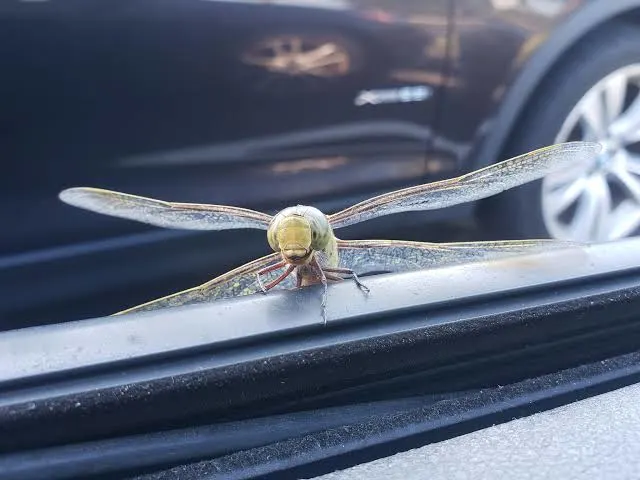
Over water, dragonflies often dip down and touch the surface. Over a car, they may tap the paint, windshield or roof the same way. In a cemetery in Hungary, darters (Sympetrum) were seen repeatedly touching polished black gravestones with the underside of the body, a behavior the researchers linked to the same water-seeking response (Horváth and colleagues, 2007).
Laying eggs
Some female dragonflies drop or tap their eggs onto open water rather than inserting them into plants. Females of these species sometimes do the same on cars. Published examples include:
- A female vagrant darter (Sympetrum vulgatum) laid about 50 eggs on the metallic green hood of a car (Günther 2003, as summarized by Horváth and colleagues, 2007).
- A female neon skimmer (Libellula croceipennis) in a parking lot in Austin, Texas, made repeated egg-laying thrusts against the windshields of parked cars about 40 to 60 meters from a creek (Neck 1976).
- In Darwin, Australia, flocks of dragonflies that lay eggs on open water laid them on the shiny surfaces of new vehicles in an importer’s yard. The species present were thought to include the wandering glider (Pantala flavescens), though no adults were collected (Watson 1992).
A pair flying joined together over a car is another clue. In some dragonflies, including many darters, the male stays attached while the female lays eggs, and tandem pairs were seen circling over black gravestones in the Hungarian study.
Which Cars Attract Dragonflies Most?
The surface matters more than the brand or model. The best “fake ponds” are:
- Shiny rather than dull. Glossy, freshly cleaned paint reflects more polarized light than dusty or matte paint.
- Flat and roughly horizontal. Hoods, roofs and trunk lids act like a water surface. Vertical doors reflect light differently and are much less convincing.
- Dark-colored. Black and other dark paints usually reflect light with a higher degree of polarization.
A 2006 study by György Kriska and colleagues in Hungary measured car paint and found that black and red car hoods reflected strongly, horizontally polarized light, while white and yellow paint reflected only weakly polarized light. In the same study, shiny black and red test sheets attracted far more water insects than white or yellow sheets. That experiment counted mainly water beetles and water bugs, not dragonflies, so its numbers should not be read as dragonfly results. The authors noted that a preference for red in some water-associated insects, including dragonflies, could not be ruled out.
Dark color is a strong tendency, not an absolute rule. A Brazilian research team reported that dark cars were more affected by dragonfly eggs than white or metallic ones. But in the Darwin vehicle yard, pale new vehicles were especially affected. The lighting, viewing angle, finish and species probably all play a part.
Windshields and other glass can also attract dragonflies. Researchers have reported darters laying eggs on glass panes and plastic sheets, and the neon skimmer in Texas targeted windshields.
Which Dragonflies Are Involved?
Almost all published car reports involve the skimmer family, Libellulidae. These include chasers and skimmers (Libellula), darters (Sympetrum), the scarlet dragonfly (Crocothemis) and gliders (Pantala). Many of these species patrol open water and lay eggs by tapping them onto the surface, so a shiny surface fits neatly into their normal routine.
The wandering glider is a good example. It often uses temporary pools and puddles, and observers in North America have described it hovering over car hoods and patrolling parking lots. If you see many dragonflies over a parking lot in late summer, they may be gliders. Learn more in our wandering glider profile.
You can’t identify a dragonfly from this behavior alone, though. Darker species and brightly colored ones both do it, and males and females of one species may look quite different. To put a name on the dragonfly over your car, note the location, date, size, body shape and markings, then use our dragonfly identification guide.
Other Reasons Dragonflies Hang Around Cars
Water mimicry explains the patrolling, tapping and egg-laying. A few other situations also bring dragonflies near vehicles.
A car antenna makes a good perch
Many skimmers and chasers hunt from a perch. They sit on a twig or stem, dart out to grab a flying insect and come back to the same spot. A thin, upright car antenna has the right shape for this. Len Fisher, answering a reader’s question for BBC Science Focus, suggested that these dragonflies also tend to pick bright, light-colored objects as perches.
Heat can limit this. In the 2005 study, the male broad-bodied chaser repeatedly tried to land on the car’s metal antenna but pulled away, apparently because it was too hot. It settled on the black plastic knob at the tip instead.
A dragonfly “following” your car
It can look as if a dragonfly is chasing your car. Sometimes it is simply a territorial male treating the car as its patch of “water.” In the 2005 case, when the car was slowly backed away, the male followed it over the roof for about 30 meters before giving up.
Dragonflies flying across or along a road at the same moment a car passes can also seem to be following it.
Dragonflies and roads
Roads near wetlands can be dangerous for dragonflies. A study published in 2011 by Daniel Soluk and colleagues counted dragonflies killed by vehicles along roads near wetland areas. Estimated losses ranged from about 2 to 35 dragonflies per kilometer per day. The common whitetail (Plathemis lydia) and the widow skimmer (Libellula luctuosa) made up most of the dead, largely because they flew low over the road, typically under about 2 meters. The black saddlebags (Tramea lacerata) also flew low but was killed far less often, possibly because it is more agile.
This is not the same as being attracted to cars. These dragonflies were crossing or hunting over roads near their breeding sites, and passing traffic struck them. You can read more about two of these species in our common whitetail and widow skimmer profiles.
Can Dragonfly Eggs Damage Car Paint?
Sometimes, yes. In Darwin, eggs that dried onto vehicles in hot autumn sun etched the paint, and the marks could not be polished out. Japanese baked-enamel finishes held up better than the local acrylic and enamel finishes, according to Watson (1992).
In Brazil, researchers at the University of São Paulo studied similar damage reported by car makers around São Paulo. According to the São Paulo research foundation’s magazine, Pesquisa FAPESP, small round stains, about 5 millimeters across, appeared a few hours after eggs were laid. The team found that at the high temperatures a car body can reach in strong sun, the eggs produced an acid that damaged the clear protective coat. Car plants responded by spraying water over vehicles after dragonfly flights and, in one case, covering stored cars with plastic sheets.
For an ordinary car owner, this is uncommon. Most people who see dragonflies over a car will never find eggs on it. If you do notice tiny specks on the hood after watching a female tap the paint, rinsing them off before they bake on in hot sun is a sensible precaution. Once the paint is etched, washing will not undo it.
Is It Bad for the Dragonflies?
For the eggs, yes. Eggs laid on a car have no water to develop in, and they dry out and die. In the normal life cycle, eggs hatch in water into aquatic nymphs, which later emerge as winged adults. There is no pupal or chrysalis stage. See our dragonfly life cycle guide for the full sequence.
Researchers describe surfaces like shiny cars, black plastic sheets, oil pools, asphalt and polished gravestones as possible ecological traps. An ecological trap is a place that sends an animal a “good habitat” signal but leads to poor survival or failed breeding. Kriska and colleagues also noted that water insects stranded on hot car surfaces may die from dehydration. The wider problem, sometimes called polarized light pollution, affects many water-breeding insects, not only dragonflies.
A single car in a driveway is unlikely to matter much to a local dragonfly population. Large expanses of shiny dark surfaces near wetlands are more of a concern for researchers.
Does a Dragonfly on Your Car Mean Something?
Biologically, a dragonfly over your car is responding to light, not to you. It has most likely mistaken the car for water or found a convenient perch.
Many people still find these encounters meaningful, and dragonflies carry rich symbolic associations in different cultures. If that side of the question interests you, our article on what it means when a dragonfly visits you covers common interpretations, kept separate from the biology. If one has landed on you rather than your car, see why dragonflies land on people.
What to Do When Dragonflies Visit Your Car
- Leave them alone. Dragonflies are harmless to the car’s occupants and will not sting. They will move on when the car moves, gets dusty or cools down. Our article are dragonflies dangerous? covers safety in more detail.
- Don’t swat or catch them. Handling can damage their wings.
- Rinse off any eggs you see. This mainly protects your paint. The eggs cannot survive on the car either way.
- Park in the shade if it keeps happening. Shade reduces both the bright reflections and the heat that bakes eggs onto paint.
- Give them real water. A pond with open water and plants at the edges gives local dragonflies a place where their eggs can actually develop. See do dragonflies live near ponds? and our dragonfly habitat guide.
Frequently Asked Questions
Why do dragonflies hover over my car?
Most likely because your car’s shiny hood or roof reflects light the way water does. Male dragonflies may guard it as a breeding territory, and females may try to lay eggs on it.
Are dragonflies attracted to red cars?
Red and black car paint can reflect strongly polarized light, and a 2006 study found red and black surfaces attracted many water insects. That study did not count dragonflies, but its authors said a red preference in dragonflies could not be ruled out. Dark, shiny, flat surfaces seem to matter more than any single color.
Why are there so many dragonflies over the parking lot?
A large lot full of shiny cars can look like a scatter of small pools. Some species, such as the wandering glider, sometimes appear in large numbers and use temporary water, which may make them especially likely to investigate parked cars.
Will dragonfly eggs hatch on my car?
No. Dragonfly eggs need water to develop. Eggs laid on a car dry out and die.
Can dragonfly eggs ruin car paint?
They can, but it is uncommon. Reports from Australia and Brazil describe eggs that dried in hot sun etching small marks into car finishes. Rinsing fresh eggs off promptly reduces the risk.
Are dragonflies attracted to car headlights?
The documented attraction is to shiny surfaces reflecting daylight, not to headlights. Most dragonflies are active in the daytime. See when are dragonflies most active?
How This Article Was Checked
This article was fact-checked against published research and specialist sources listed below. Behaviors, measurements and numbers are tied to the species, places and studies they come from. Dragonfly behavior over cars has been studied mainly through individual field reports and a small number of experiments, so it should not be assumed that every species or every car will behave the same way. No field observations or experiments were carried out for this article.
References and Further Reading
- Wildermuth, H. & Horváth, G. (2005). Visual deception of a male Libellula depressa by the shiny surface of a parked car (Odonata: Libellulidae). International Journal of Odonatology 8(1): 97–105. https://arago.elte.hu/sites/default/files/DragonflyHonda_IJO.pdf
- Kriska, G., Csabai, Z., Boda, P., Malik, P. & Horváth, G. (2006). Why do red and dark-coloured cars lure aquatic insects? The attraction of water insects to car paintwork explained by reflection–polarization signals. Proceedings of the Royal Society B 273: 1667–1671. https://doi.org/10.1098/rspb.2006.3500