Are Dragonflies Dangerous?
No. Dragonflies are not dangerous to people during normal encounters. They do not have a stinger, they do not hunt humans, and they have no reason to attack someone walking through a garden or standing beside a pond.
Dragonflies are predators, but their prey consists of other appropriately sized animals, mainly insects as adults and a wider range of small aquatic prey during the nymph stage. A large adult may try to use its jaws defensively if it is caught and held, but that is very different from a dragonfly deliberately attacking a person. University and wildlife sources consistently describe dragonflies as harmless to people.

At a Glance
| Question | Answer |
|---|---|
| Are dragonflies dangerous to humans? | No, not in normal encounters. |
| Do dragonflies sting? | No. They do not have a stinger. |
| Can dragonflies bite? | They have jaws for eating prey and a restrained individual may try to pinch defensively. |
| Do dragonflies attack people? | No. Humans are not their prey. |
| Are dragonfly nymphs dangerous? | No, although large nymphs should still be handled as little as possible. |
| Are dragonflies dangerous to pets? | They are generally considered harmless to pets. |
| Should you pick up a dragonfly? | Usually not. Observation is safer for both you and the insect. |
Why Do Dragonflies Look Dangerous?
A dragonfly has several features that can make it seem more threatening than it really is.
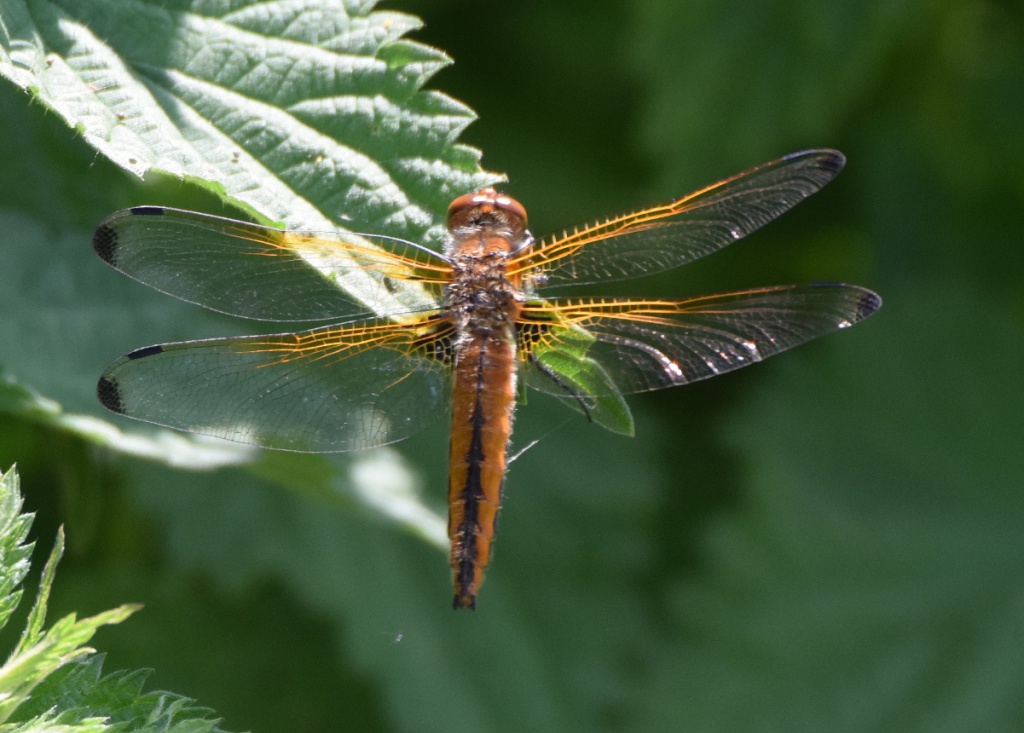
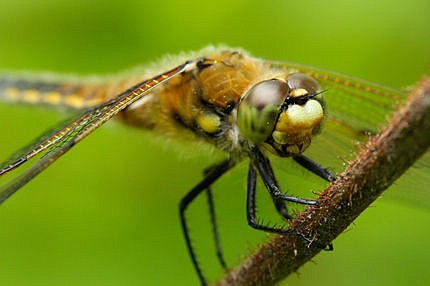
Its head is dominated by large compound eyes. Its legs carry spines that help form a basket around captured prey. Its mouth includes strong mandibles for cutting and chewing other insects. Many species are also exceptionally fast and direct fliers.
Those features make a dragonfly an effective insect predator, not a predator of humans.
Adult dragonflies capture flying insects, while their aquatic nymphs use specialized mouthparts to seize small animals underwater. The British Dragonfly Society describes dragonfly larvae as predators of animals such as insect larvae, crustaceans, worms, snails, tadpoles, and small fish, depending on the species and size of the individual.
Seeing a dragonfly catch another insect can therefore look surprisingly aggressive. The important distinction is that the behavior is directed at prey small enough for the dragonfly to capture and eat.
For more background on their feeding behavior, see our guide to what dragonflies eat.
Can a Dragonfly Hurt a Human?
Under ordinary circumstances, a dragonfly flying around you is not going to hurt you.
Problems are most likely to arise only when a dragonfly is physically restrained. Large dragonflies have functional jaws, and wildlife authorities note that a large individual can deliver a noticeable defensive pinch when handled. The Missouri Department of Conservation describes this as something that may occur when large species are handled while emphasizing that dragonflies cannot harm people in normal encounters.
That distinction matters.
A dragonfly using its jaws while trapped in someone’s hand is attempting to escape. It is not behaving toward the person as prey.
If you simply watch a dragonfly perched on vegetation, flying above a pond, or hunting through a garden, there is little reason to worry.
For the narrower question of mouthparts and defensive biting, see our guide to whether dragonflies bite.
Do Dragonflies Sting?
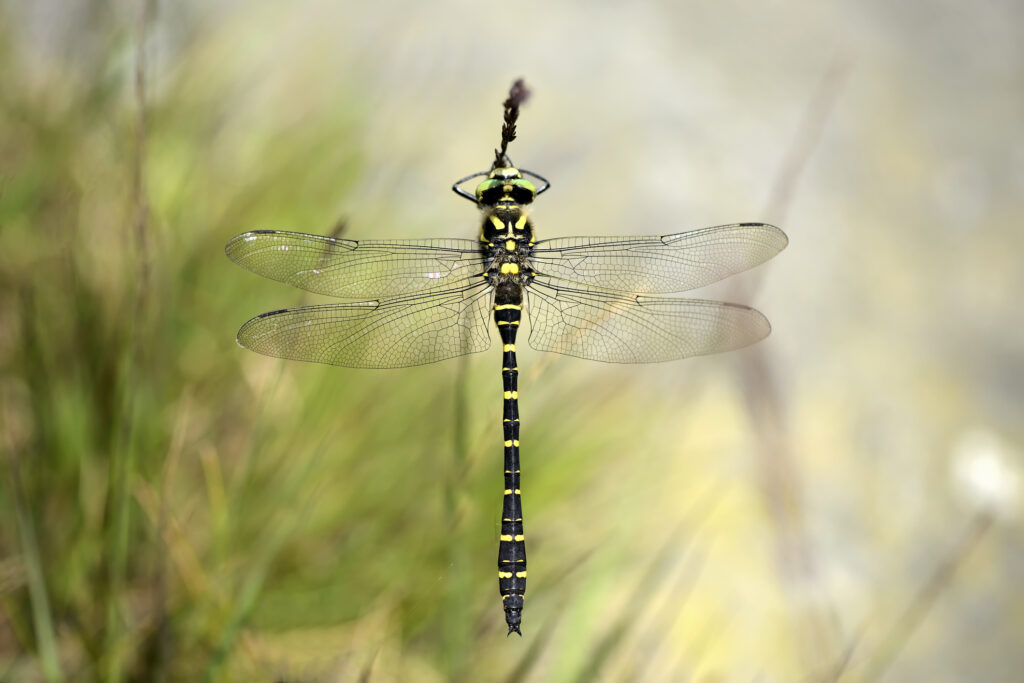
No. Dragonflies do not have a stinger like a bee or wasp.
The British Dragonfly Society specifically notes that dragonflies do not use their egg-laying structures as stingers. Old names such as “horse-stinger” are folklore rather than descriptions of dragonfly anatomy.
This is one of the easiest dragonfly myths to clear up.
A female dragonfly may have structures at the end of her abdomen associated with reproduction and egg laying, but seeing a pointed-looking abdomen does not mean the insect carries a venomous stinger.
Will a Dragonfly Attack You?
Dragonflies do not normally attack people.
They are highly visual aerial predators, so their flight can sometimes appear unusually deliberate. One may suddenly change direction, hover nearby, repeatedly pass through the same patch of air, or chase another insect close to you.
That does not mean the dragonfly has identified you as a target.
Dragonflies are adapted to intercept moving insect prey. Their predatory behavior is directed toward insects rather than humans, and university entomology resources describe them as insects that do not attack people.
If one flies close to your face while you are outside, the safest interpretation is usually much less dramatic than it feels: a fast-flying insect is moving through the same space you happen to occupy.
There is no need to swat at it.
What If a Dragonfly Lands on You?
A dragonfly landing on your clothing, arm, hat, or nearby object is not preparing to bite.
It may simply have chosen a convenient temporary perch.
Dragonflies frequently use exposed perches from which they can watch their surroundings, rest, defend a territory, or look for prey. If one lands on you, remaining still and allowing it to leave is generally better than grabbing it.
The main situation that can turn a harmless encounter into a defensive one is restraint.
Trying to close your fingers around a large dragonfly gives the insect a reason to struggle. Its jaws evolved for feeding, and if they can reach your skin, the dragonfly may attempt to use them while escaping.
Are Large Dragonflies More Dangerous?
A large dragonfly can look much more intimidating than a small skimmer or darter, but greater size does not turn it into a dangerous animal.
Large species simply have larger mouthparts.
Wildlife sources acknowledge that some large dragonflies may give a noticeable pinch when handled, but they still describe dragonflies as harmless to people.
This is a useful example of the difference between being capable of causing a minor physical sensation and being dangerous.
A large insect does not automatically represent a significant human health risk.
Even unusually large dragonflies are predators of other animals in their ecological size range, not humans.
Are Dragonfly Larvae Dangerous?
Dragonfly larvae, often called nymphs or naiads, look very different from adults.
They live underwater and are active predators. Instead of chasing prey through the air, a dragonfly nymph uses a specialized extendable lower lip, or labium, to seize prey rapidly. Depending on species and size, prey can include aquatic insects and other small freshwater animals.
That predatory equipment still does not make dragonfly nymphs dangerous to people.
A large nymph that is picked up or restrained may defend itself, which is one reason unnecessary handling is best avoided. More importantly, frequent handling can injure or stress the animal.
If you find one while pond dipping, examining it briefly in an appropriate container is preferable to squeezing it between your fingers.
You can learn more about their appearance and aquatic life in our guide to dragonfly larvae.
Are Dragonflies Dangerous to Children?
Dragonflies do not become more dangerous simply because a child is nearby.
For children observing insects outdoors, the more useful lesson is to watch rather than grab.
A dragonfly resting on a plant can be examined from a short distance. Its wings, eyes, abdomen, and behavior are easier to appreciate when the animal is undisturbed, and there is no need for direct handling.
If a child is worried because a dragonfly is flying nearby, explain that the insect is hunting much smaller prey rather than chasing people.
The same rule works for adults: observation creates almost no conflict between the dragonfly and the observer.
Are Dragonflies Dangerous to Dogs or Cats?
Dragonflies are generally not considered harmful to pets. Iowa State University Extension specifically describes dragonflies and damselflies as doing no harm to people, pets, crops, landscape plants, or houses.
A curious dog or cat may chase a flying dragonfly, but that does not mean the insect is attacking the animal.
Whenever possible, preventing pets from repeatedly catching wildlife is still sensible. Dragonflies have delicate wings and can easily be injured even when the pet itself is in no danger.
What About Dragonflies Around Ponds and Swimming Areas?
Seeing many dragonflies around a pond, lake, marsh, ditch, or slow-moving stream is normal.
Dragonflies are strongly connected to freshwater because their immature stages are aquatic. Adults may travel away from water to feed, but many return to suitable freshwater habitats for reproduction.
Their presence near water therefore does not mean the area has suddenly become dangerous.
In fact, someone standing near a productive pond may simply be standing in excellent dragonfly habitat.
Learn more about where dragonflies live.
Are Dragonflies Dangerous Because They Eat Other Predators?
Dragonflies can attack surprisingly large insect prey, and larger species may even take other dragonflies.
That sometimes leads to dramatic descriptions of dragonflies as “deadly hunters” or exceptionally dangerous insects.
These descriptions confuse predatory ability with danger to humans.
An animal can be extremely effective at hunting organisms within its normal prey range while posing essentially no threat to a person.
Dragonflies are a good example. Their eyes, flight control, spiny legs, and jaws form an efficient hunting system for insect-sized prey. None of those adaptations makes humans part of their food chain.
Why Were Dragonflies Once Considered Dangerous?
Fear of dragonflies is much older than modern entomology.
Traditional English names include expressions such as horse-stinger and devil’s darning needle. Similar folklore has suggested that dragonflies sting livestock or somehow sew people’s eyes, ears, or mouths.
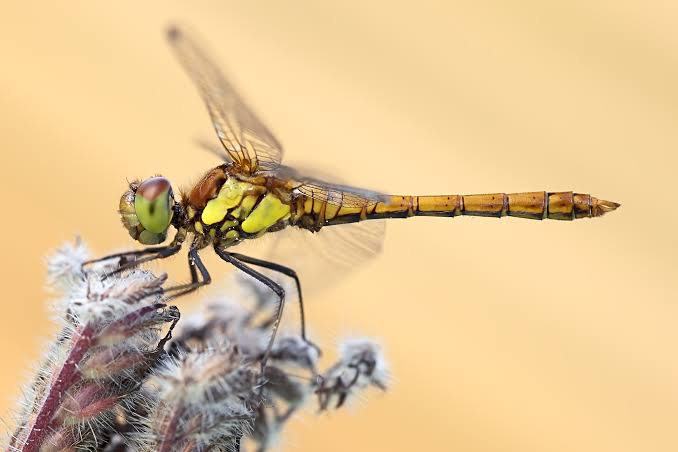
Their appearance probably helped these stories survive. A large dragonfly has an elongated abdomen, prominent jaws, rapid flight, and a habit of appearing suddenly around people and animals near water.
But the folklore does not match the insect’s anatomy.
The British Dragonfly Society specifically rejects the idea that dragonflies sting and notes that their egg-laying structures are not used as stingers.
Old names are culturally interesting. They should not be treated as biological evidence.
What Should You Do If a Dragonfly Flies Around You?
Usually, nothing.
There is no reason to run from it, spray it, swat it, or try to kill it.
Allow the insect room to fly. If it lands nearby, observe it without grabbing the wings or abdomen. If a dragonfly accidentally enters a building, opening a door or window and giving it a clear route outside is preferable to repeated handling.
The simplest safety rule is also the best rule for the dragonfly:
Watch it rather than catch it.
That keeps an already low-risk encounter from becoming a defensive one and lets you observe the animal behaving naturally.
FAQ
Are dragonflies dangerous to humans?
No. Dragonflies are generally harmless to humans. They do not hunt people or have a stinger. A large individual may attempt to pinch with its jaws if caught and restrained, but normal outdoor encounters pose little risk.
Can a dragonfly sting you?
No. Dragonflies do not possess a stinger like bees or wasps. The British Dragonfly Society also notes that their egg-laying structures are not used for stinging.
Why would a dragonfly bite someone?
A dragonfly may try to use its jaws defensively if it is captured or held. Its jaws are normally used to process insect prey, not to attack humans. Avoid restraining wild dragonflies unnecessarily.
Are dragonfly nymphs dangerous to people?
No. Dragonfly nymphs are aquatic predators of relatively small animals, not people. Large individuals have functional mouthparts and should be handled minimally, both to avoid defensive contact and to protect the nymph.
Are dragonflies dangerous to dogs?
Dragonflies are generally considered harmless to pets. Iowa State University Extension includes pets when describing dragonflies and damselflies as organisms that do no harm.
Should I be worried if there are many dragonflies in my yard?
Usually not. Adults commonly gather where food and suitable habitat are available, particularly around gardens, ponds, wetlands, and other areas with abundant insects. Their presence does not indicate a danger to people.
References and Further Reading
- Iowa State University Extension and Outreach — “Dragonflies and Damselflies.” Describes dragonflies and damselflies as harmless to people and pets and explains their ecological role.
- British Dragonfly Society — “Frequently Asked Questions.” Covers dragonfly biting, the absence of a stinger, folklore, and Odonata biology.
- Missouri Department of Conservation — “Dragonflies.” Notes that dragonflies cannot sting and that large individuals may give a pinching bite when handled without representing a danger to people.
- British Dragonfly Society — “Life Cycle and Biology.” Explains the predatory feeding structures and prey of aquatic dragonfly larvae.
- University of Kentucky Entomology — “Insects and Relatives Which Are NOT Harmful.” Describes dragonflies as beneficial predators that do not attack people.