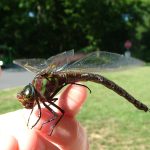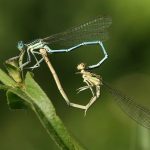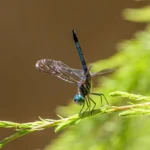
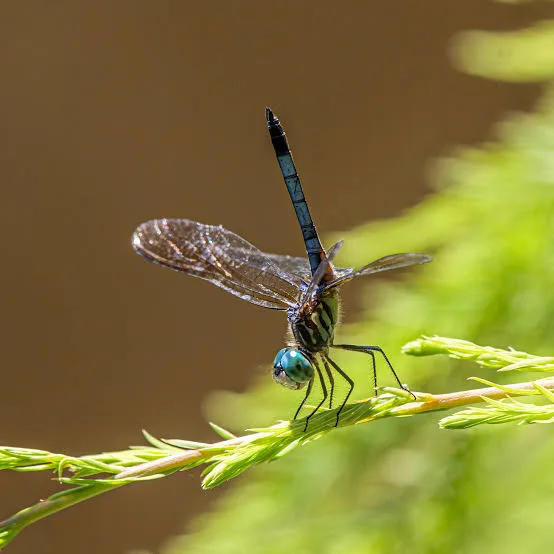
Dragonflies point their “tails” (abdomens) straight upward primarily to keep from overheating on hot, sunny days. Entomologists call this handstand-like position the obelisk posture. By aiming the tip of its abdomen directly toward the sun, a perched dragonfly exposes as little of its body surface as possible to direct solar radiation. Depending on the species, temperature, and nearby insects, a raised abdomen can also act as a territorial warning to rival males or a posture adjustment for warming up when the sun is low.
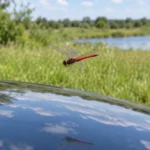
If you walk beside a sunny pond in midsummer, you have probably noticed a dragonfly resting on the tip of a reed or twig with the back half of its body tilted skyward like a miniature flagpole. While the posture can look defensive, the insect is not preparing to sting. Instead, you are usually watching one of the insect world’s clearest examples of behavioral temperature control.
First, Is It Really a Tail?
In everyday conversation, people refer to the long rear section of a dragonfly as its tail. Anatomically, however, that structure is the insect’s abdomen. As explained in our core guide to dragonfly anatomy and basic facts, every adult dragonfly has three distinct body regions: the head, the wing-bearing thorax, and a slender, 10-segmented abdomen.
The abdomen contains the digestive tract, reproductive organs, and breathing spiracles—and it has no stinger. Because the 10 segments are connected by flexible membranes, a perched dragonfly can raise, lower, or angle its abdomen like a lever to control how much sunlight hits its body.
The Primary Reason: Cooling Down With the Obelisk Posture
Dragonflies are ectotherms, meaning their internal temperature depends heavily on surrounding air temperatures and solar radiation. While a dragonfly needs warm flight muscles inside its thorax to take off and chase prey, intense midday sunshine combined with metabolic heat from flying can push its internal temperature toward dangerous levels.
Rather than abandoning a prime waterside hunting perch to hide in deep shade, many perched dragonflies adopt the obelisk posture—named after tall, tapering stone monuments.
1. Minimizing Sun Exposure
When a dragonfly perches horizontally under a high midday sun, solar rays strike the entire length of its back. Raising the abdomen until the tip points directly at the sun reduces the illuminated surface area to a fraction of its normal size.
2. Shading the Thorax
Many skimmer dragonflies simultaneously droop their four wings forward and downward while lifting the abdomen. This forward wing tilt helps shade the muscular thorax or blocks heat reflection from the ground and water.
3. Tracking the Sun’s Rays
The obelisk posture is not always strictly vertical. As the afternoon sun moves across the sky, a dragonfly will often tilt its raised abdomen slightly off-vertical so the tip remains aligned parallel to the incoming sunbeams.
Scientific Evidence From Thermoregulation Studies
Biologists have tested whether pointing the abdomen upward genuinely lowers heat gain. In a foundational study on dragonfly thermoregulation published in Ecological Monographs (May, 1976), researcher Michael L. May observed wild dragonflies under full sun and tested captive individuals under controlled 250-watt heat lamps.
As radiant heat increased, dragonflies such as the Blue Dasher (Pachydiplax longipennis) progressively elevated their abdomens toward the heat source and lowered them again once shade was restored. Thoracic temperature measurements confirmed that aligning the body parallel to the sun’s rays significantly reduced passive solar heating.
Why “Perchers” Use This Posture Much More Than “Fliers”
Not all true dragonflies (suborder Anisoptera) perform the obelisk posture. Entomologists commonly divide adult dragonflies into two functional behavioral groups based on how they hunt and regulate body heat:
| Behavioral Group | Typical Families & Examples | Activity Pattern | Primary Cooling Strategy |
|---|---|---|---|
| Perchers | Skimmers (Libellulidae) and many Clubtails (Gomphidae) | Spend most of their active hours resting on twigs, reeds, rocks, or bare ground, making short flights to intercept prey or chase rivals. | Adjust body orientation to the sun (obelisk posture), droop wings, press against cooler substrates, or move to shade during extreme heat. |
| Fliers | Darners (Aeshnidae) and Emeralds (Corduliidae) | Patrol continuously on the wing for long periods and rarely land in open sun during active hunting hours. | Cool via moving air during flight (convective cooling), shift to shaded patrol routes, or regulate internal hemolymph (insect blood) circulation between thorax and abdomen. |
Because perchers sit still on exposed pond-side stems where wind is light and solar radiation is intense, postural adjustments are their most efficient way to stay cool without giving up their territory. Among the common dragonfly species you are most likely to see in the obelisk posture are the Blue Dasher, Meadowhawks (genus Sympetrum), Amberwings (genus Perithemis), Dropwings (genus Trithemis), and the Halloween Pennant (Celithemis eponina).
Other Reasons a Dragonfly Points Its Abdomen Upward
Although heat avoidance is the best-known reason for a skyward abdomen, temperature is not the only factor. Field studies show that dragonflies also raise or tilt their abdomens for communication, warming, and balance.
1. Territorial Threat Displays Between Males
In several skimmer species, lifting the abdomen is a visual warning directed at competing males. Classic field observations by Clifford Johnson (1962) on the territorial behavior of Pachydiplax longipennis (the Blue Dasher) demonstrated that mature males raise their abdomens to display the bright, powdery pale-blue coating (pruinescence) on their upper abdominal segments when another male approaches a defended perch.
Because a male Blue Dasher uses an elevated abdomen for both cooling and territorial signaling, you may see two neighboring males flicking their abdomens upward even during moderately warm weather or brief cloud cover.
2. Solar Basking to Warm Up (The Opposite Angle)
In cool morning air or late afternoon light, a perched dragonfly needs to absorb solar heat rather than block it. To warm its flight muscles, the insect tilts its abdomen upward or downward so that its body sits perpendicular (broadside, at a 90-degree angle) to the low sunbeams.
3. Mechanical Balance and Reproductive Postures
- Landing counterbalance: When a dragonfly lands on a thin grass stem swaying in the breeze, it may briefly lift its abdomen to stabilize its center of gravity.
- Mating refusal or readiness: During courtship and tandem interactions, some female Odonata arch or raise the tip of the abdomen to signal that they are not receptive to mating, while receptive individuals bend the abdomen forward beneath the body to form the copulatory wheel.
How to Read This Behavior in the Field
Paying attention to posture and habitat context is a practical part of how to identify a dragonfly and understand its behavior. Next time you spot a dragonfly pointing its tail upward, check three details:
- Time of day and sun height: Obelisk cooling typically peaks between late morning and mid-afternoon on bright, calm, hot days.
- Wing position: If the abdomen points toward the sun while the wings are pushed forward and down over the thorax, the insect is almost certainly managing heat load.
- Social interactions: If the dragonfly raises its abdomen briefly right after chasing another dragonfly or returning to a contested reed, territorial display is playing a role.
Frequently Asked Questions
Is a dragonfly trying to sting when it points its tail up?
No. Dragonflies do not possess stingers at any stage of life and cannot sting humans or pets. The raised structure is the insect’s abdomen, and pointing it toward the sky is a harmless behavior used to reduce sun exposure or signal territory to other dragonflies.
Do both male and female dragonflies use the obelisk posture?
Yes. Laboratory heating experiments and field observations confirm that both males and females raise their abdomens to reduce solar heat gain when exposed to high temperatures. However, observers see males performing the posture more frequently along open pond edges because males spend hours perched in full sun defending breeding territories, whereas females often stay in surrounding vegetation until they return to water to mate and lay eggs.
Do damselflies also point their tails upward in the sun?
The dramatic vertical obelisk posture is characteristic of true dragonflies (suborder Anisoptera), especially percher species in the skimmer family (Libellulidae). Damselflies (suborder Zygoptera) are smaller, slender-bodied Odonata that usually regulate temperature by shifting between sunlit leaves and shaded stems rather than holding a vertical handstand in open midday sun.
At what temperature do dragonflies start pointing their tails at the sun?
There is no single air-temperature threshold for all dragonflies because internal body temperature depends on species size, color, wind speed, and solar intensity. In field studies of North American skimmers such as the Blue Dasher, obelisk posturing commonly appears when sunny ambient air temperatures reach the upper 80s to 90s °F (around 30–35 °C) and internal thoracic temperatures approach 95–104 °F (35–40 °C).
Sources & Scientific References
- Corbet, P. S. (1999). Dragonflies: Behavior and Ecology of Odonata. Cornell University Press.
- Johnson, C. (1962). A study of territoriality and breeding behavior in Pachydiplax longipennis Burmeister (Odonata: Libellulidae). The Southwestern Naturalist, 7(3/4), 191–197.
- May, M. L. (1976). Thermoregulation and adaptation to temperature in dragonflies (Odonata: Anisoptera). Ecological Monographs, 46(1), 1–32.
- Paulson, D. (2011). Dragonflies and Damselflies of the East. Princeton University Press.