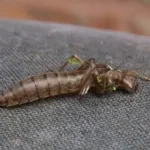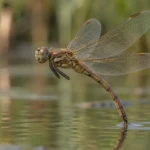
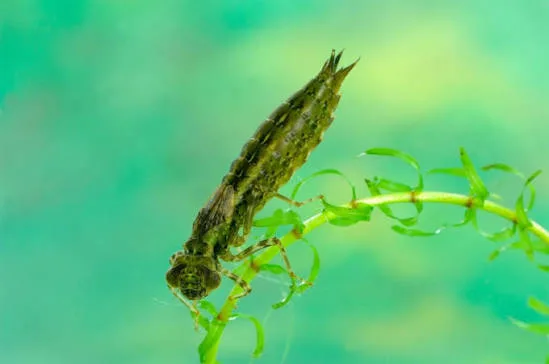
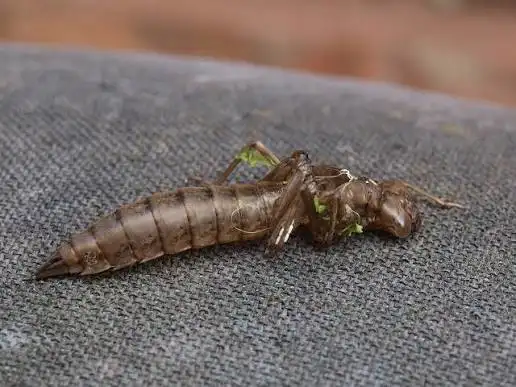
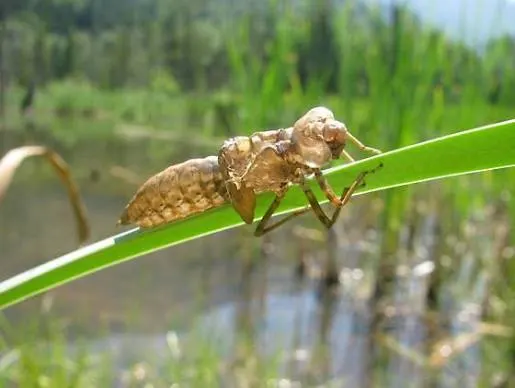
Finding an empty, dragonfly-shaped skin clinging to a reed or a dock post is one of the most rewarding discoveries near water. That papery shell is an exuvia: the last larval skin left behind when the aquatic nymph crawled out of the water and the adult dragonfly emerged from it.
You can usually identify a dragonfly exuvia to suborder (dragonfly or damselfly) with the naked eye, and often to family by checking three things: the tip of the abdomen, the shape of the folded lower lip (the “mask”), and the antennae. Getting to species is a different job. It normally needs a hand lens or microscope, a larval key written for your region, and a record of where, when and on what the skin was found. Color is not a reliable clue.
What a dragonfly exuvia is
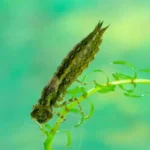
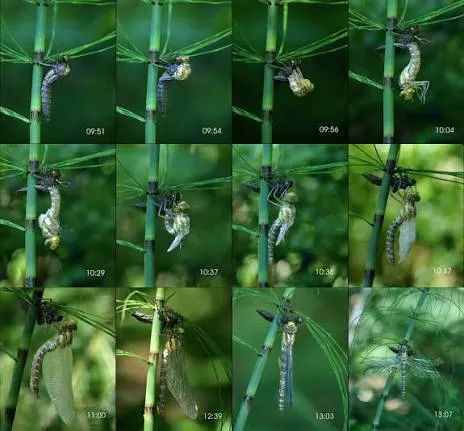
Dragonflies develop in three stages: egg, aquatic nymph (larva), and adult. There is no pupa or chrysalis. The nymph lives underwater, molting its skin several times as it grows. When the final-stage nymph (the final instar) is ready, it climbs out of the water onto a plant stem, rock, bank, or other support. Its skin splits along the back of the thorax, and the adult pulls itself out, leaving the empty skin behind. You can follow that sequence in more detail in our guide to the dragonfly life cycle and our walkthrough of how a larva becomes a dragonfly.
A few terms will make the rest of this guide easier:
- Exuvia (plural exuviae): the shed skin. Many naturalists also use “exuviae” for a single skin.
- Labium or mask: the hinged lower lip that the nymph shoots forward to catch prey. On an exuvia it is folded under the head.
- Teneral adult: a newly emerged adult. It is pale, soft, and shiny, and its wings are not yet hardened.
Because the exuvia is a copy of the final-stage nymph’s outer skeleton, it keeps most of the features used to identify nymphs. In fact, the Wisconsin Odonata Survey notes that exuviae are often easier to identify than younger nymphs, because they come from the final molt, when the key features are fully developed.
First, make sure it is an empty Odonata skin
Before you work through dragonfly features, confirm what you are holding. An empty dragonfly or damselfly exuvia usually shows:
- A split along the back of the thorax, sometimes running onto the head. This is the exit hole the adult used.
- Thin white threads hanging from inside the split. These are the linings of the breathing tubes (tracheae), pulled out during emergence.
- A folded mask under the head instead of visible chewing jaws.
- Six legs and short wing pads on top of the thorax.
- Legs often locked onto the support, sometimes so firmly that the skin stays put after rain.
If the animal has no split, moves, or is still in the water, it is a live nymph, not an exuvia. Leave it alone. Our page on what dragonfly nymphs look like covers live nymphs.
Shed skins that are not from dragonflies
Two common lookalikes are worth ruling out:
- Cicada skins are often found on tree trunks and fences, sometimes far from water. They have thick, enlarged front legs built for digging, and no folding mask.
- Stonefly skins are common on rocks beside streams. They have two long tail filaments and no folding mask.
Step 1: Dragonfly or damselfly?
Dragonflies and damselflies both belong to the order Odonata, but they are separate groups. True dragonflies are Anisoptera, and damselflies are Zygoptera. Their exuviae are usually easy to tell apart once you look at the tip of the abdomen.
Dragonfly (Anisoptera) exuvia
- Abdomen ends in a short, pointed cluster of five parts, often called the anal pyramid
- No external gills, because dragonfly nymphs breathe through gills inside the rectum
- Body stout, broad, or long and torpedo-shaped
Damselfly (Zygoptera) exuvia
- Abdomen ends in three flat, leaf-like gills (caudal lamellae)
- Body slender, often very thin
- Usually smaller and more delicate than most dragonfly exuviae
Watch for broken tails. Damselfly gills can be lost, crushed, or shriveled on an old exuvia. A slim skin with a damaged or blunt tail tip may still be a damselfly, so check the body shape too before deciding.
Step 2: Check the shape of the mask
For dragonfly exuviae, the mask is the most useful family-level clue. Look at it from the side and from below. You will see one of two basic shapes:
- Flat mask: lies flat under the head like a folded plate. The face stays visible from the front.
- Spoon-shaped mask: deep and scoop-like, with large side plates (palps) that curve up and cover much of the face, like a visor.
A flat mask points toward darners (called hawkers in Britain) or clubtails. A spoon-shaped mask points toward skimmers, emeralds, spiketails, or cruisers. The mask on a dry exuvia is brittle, so look rather than pry it open. If you need to examine it closely, softening the skin with a little water first reduces the chance of breaking it.
Step 3: Look at the antennae, legs, and head
Once you know the mask shape, a few more features narrow down the family:
- Antennae: darner antennae are slender and thread-like, usually with six or seven segments. Clubtail antennae have only four segments, with a broad, flattened third segment and a tiny fourth one.
- Feet: in clubtails, the front and middle feet (tarsi) have two segments. In darners, they have three. You will need a hand lens to count them.
- Legs and head shape: cruiser nymphs have very long, spidery legs and a small, upcurved horn on the front of the head.
- Palps of the mask: spiketails and goldenrings have large, jagged, interlocking teeth along the edges of the mask’s palps.
Common dragonfly families at a glance
The table below covers families found in North America and Europe. It is a starting point, not a key. Some genera break the general pattern, and features can be hard to see on a damaged skin.
| Family | Common names | Mask | Other clues | Where the nymphs usually live |
|---|---|---|---|---|
| Aeshnidae | Darners (N. America), hawkers and emperors (Britain) | Flat | Long, streamlined body; slender antennae with 6–7 segments; front and middle feet with 3 segments | Among plants in ponds, lakes, and slow water; some in streams |
| Gomphidae | Clubtails | Flat | Short 4-segmented antennae with a broad third segment; front and middle feet with 2 segments | Burrowing in sand, silt, and debris of rivers and lakes |
| Cordulegastridae | Spiketails (N. America), goldenrings (Britain) | Spoon-shaped | Large, jagged, interlocking teeth on the mask palps; small eyes raised on the head | Buried in sand and silt of small, clean streams |
| Macromiidae | Cruisers | Spoon-shaped | Small horn on the front of the head; very long, spidery legs | Rivers and large lakes |
| Corduliidae and Libellulidae | Emeralds; skimmers, chasers, and darters | Spoon-shaped | The two families are very similar as nymphs. Separating them reliably needs magnification and a regional key | Ponds, marshes, bogs, lakes, and slow streams |
Two examples from our species pages show how this works in practice. The Golden-ringed Dragonfly (Cordulegaster boltonii) belongs to Cordulegastridae, so its exuvia has a spoon-shaped mask with jagged palps. The Common Clubtail (Gomphus vulgatissimus) is a gomphid, so its exuvia has a flat mask and short, club-like antennae.
Step 4: Use size, shape, and abdominal details
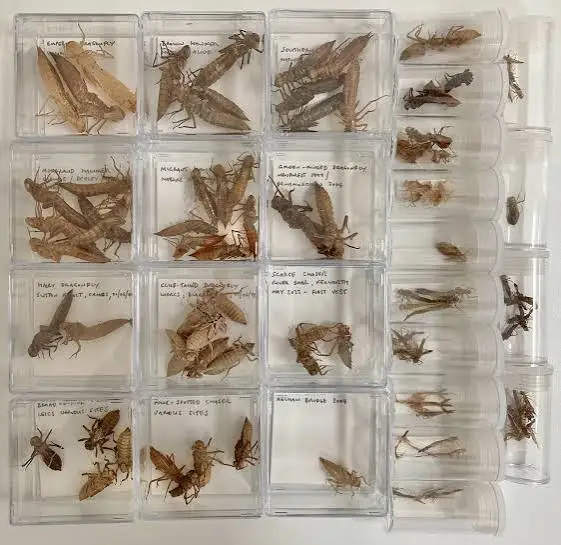
Size helps narrow the options, but only within a known local species list. As a regional example, an exuvia identification sheet from the Wildlife Trust for Bedfordshire, Cambridgeshire and Northamptonshire gives these approximate lengths for British species:
- Emperor Dragonfly (Anax imperator): over 5 cm
- Southern and Brown Hawkers: about 4–5 cm
- Chasers and Black-tailed Skimmer: about 2–3 cm, with a broad body
- Common Darter: about 1.5 cm
- Most small damselflies: about 1–2 cm, very slender
These figures apply to those British species only. Use a guide for your own region before comparing measurements. Beyond overall size, regional keys often use details such as spines on the sides or back of the abdomen, the shape and length of the parts in the anal pyramid, and fine features of the mask.
Step 5: Record where and when you found it
Context does a lot of the work in exuvia identification. A skin found on a sandy riverbank in early summer suggests different candidates from one found high on a cattail stem at a weedy pond. Before you remove anything, note:
- Location, including country, state or county, and the specific site
- Date
- Type of water: pond, lake, bog, marsh, slow river, fast stream
- What the skin was attached to: plant stem, tree trunk, rock, bank, dock, wall
- Height above the water and distance from the shoreline
- Whether you saw a teneral adult nearby
Emergence sites vary between species. The Wildlife Trust sheet notes that exuviae are usually found near the water’s edge, from a few centimeters to about 60 cm above the surface, but some species travel several meters from water before emerging. A local checklist of species, combined with the emergence date and the water type, can rule out many candidates before you even look at the mask. For more on how habitat shapes which species occur, see our dragonfly habitat guide.
A nearby adult is not proof. An adult dragonfly perched near an exuvia did not necessarily come from it. Adults can fly in from other sites, and several species may emerge from the same pond.
Can you tell male from female?
Sometimes. In some species, the underside of the abdomen shows traces of developing reproductive structures. Females may show a rudimentary ovipositor near the tip of the abdomen, while males may show small marks where the adult genitalia will form, on the second and third segments and near the tip. These traces are not obvious in every species and can be hard to see on a dirty or damaged skin, so treat sexing as a bonus rather than a required step.
How to photograph an exuvia for identification
If you plan to ask a local recording group or an online community for help, a single side-on photo is rarely enough. Useful views include:
- Top view of the whole skin, showing the overall shape and abdominal spines
- Underside view, showing the mask and any sex traces
- Side view of the head, showing whether the mask is flat or spoon-shaped
- Close-up of the antennae
- Close-up of the abdomen tip
- A scale, such as a ruler, in at least one photo
Include the date, location, and habitat notes with your photos. Without them, even an experienced person may only be able to suggest a family.
Collecting and storing exuviae responsibly
Collecting an empty skin does not harm the dragonfly, which has already left. Still, a few precautions keep the activity safe for wildlife and useful for science:
- Leave teneral adults alone. A freshly emerged dragonfly is soft and vulnerable. Wait until it flies off before collecting its skin.
- Ask permission before collecting on nature reserves and other protected land.
- Moisten before removing. Exuviae become brittle as they dry, and legs snap off easily. The Wildlife Trust sheet suggests splashing a little water on the skin so it becomes flexible, then gently sliding it off its support.
- Store exuviae dry in small, tight-closing containers, one per container, with a label giving the date, location, and support. Don’t store them in alcohol, which makes them soft and battered, and don’t pack them with damp grass, which can lead to mold.
- Stay safe near water. Riverbanks and pond edges can be slippery or unstable.
Why exuviae matter to dragonfly recorders
Exuviae are more than curiosities. Adult dragonflies can travel some distance from where they grew up, so seeing an adult at a pond does not prove that the species breeds there. An exuvia shows that at least one nymph completed its development at that site. The British Dragonfly Society’s proof-of-breeding criteria list exuviae under “confirmed” breeding, while a teneral adult at suitable water counts only as “probable.”
Exuviae surveys can also turn up species that are rarely seen as adults. The catch is timing. A 2006 study at small wetlands in Rhode Island, published in Northeastern Naturalist, found that exuviae disappeared at an exponential rate, with most lost within the first few weeks. Wind, rain, and rising water remove them, so searches work best during the local emergence season.
Common identification mistakes
- Judging by color. Exuviae are mostly shades of tan, brown, or gray, and their color changes with drying, mud, and algae. Structure matters far more than color.
- Calling a damselfly a dragonfly because its tail gills broke off.
- Using a key from another continent. Families are shared across regions, but species are not. Choose a key written for your area.
- Assuming species-level certainty from one photo. Many species need features that only show under magnification.
- Calling the exuvia a pupa or cocoon. Dragonflies have no pupal stage. The skin is a larval exoskeleton.
Where to go next for species-level identification
Once you have the family, a regional key is the next step. In North America, Kenneth J. Tennessen’s Dragonfly Nymphs of North America: An Identification Guide (Springer, 2019) covers larvae across the continent. In Britain, the British Dragonfly Society publishes field guides to the larvae and exuviae of British species. Local dragonfly recording schemes and natural history societies can also help confirm difficult specimens and add your record to the local dataset.
If you are curious about the nymph stage as a whole, our dragonfly larvae hub explains how nymphs live, hunt, and grow underwater. For identifying the adults themselves, start with our dragonfly identification guide.
Frequently asked questions
Is an exuvia a dead dragonfly?
No. It is an empty skin. The adult dragonfly climbed out of it through the split on the back and flew away. Nothing living is left inside.
How long does an exuvia last?
It depends on weather, exposure, and the species. Wind, rain, and rising water can remove exuviae quickly, while some stay attached much longer. Survey guidance and field research both suggest that most are lost within a few weeks of emergence.
Can I identify a dragonfly exuvia from a photo?
Often to suborder and sometimes to family, if the photos clearly show the mask, antennae, and abdomen tip. Species-level identification from photos is possible for some distinctive species in well-studied regions, but many need a specimen under magnification.
Why are there white threads coming out of the skin?
They are the shed linings of the tracheae, the air tubes insects use for breathing. The linings are pulled out with the rest of the old skin when the adult emerges.
Is it legal to collect exuviae?
Rules vary by country and by site. Collecting an empty skin is generally treated differently from collecting a living animal, but protected areas and nature reserves may still require permission. Check the local rules before you collect.
Sources and further reading
- British Dragonfly Society. Proof of Breeding criteria.
- Wildlife Trust for Bedfordshire, Cambridgeshire and Northamptonshire. Monitoring and Research topic sheet: Dragonfly Exuviae.
- Wisconsin Odonata Survey. Getting Started.
- Macroinvertebrates.org. Aeshnidae larvae and Gomphidae larvae.
- University of New Hampshire Stream Key. Cordulegastridae.
- Australian Faunal Directory. Macromiidae (cruisers).
- U.S. Geological Survey publication record. Persistence of dragonfly exuviae on vegetation and rock substrates. Northeastern Naturalist 16(1): 141–147, 2009.
- Tennessen, K. J. (2019). Dragonfly Nymphs of North America: An Identification Guide. Springer.