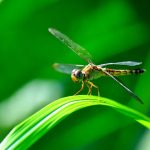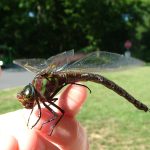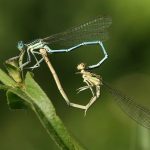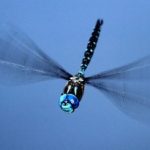
Not on their own. Dragonflies can be a good sign, especially when you see several different species over a season and find evidence that they are breeding in the water. But many common dragonflies tolerate warm, murky, nutrient-rich water, and some live and develop in ponds that are measurably polluted. A single dragonfly flying over a pond tells you very little about its water quality, and nothing at all about whether that water is safe for people to drink or swim in.
The more useful question is not “Are there dragonflies?” but “Which dragonflies, how many kinds, and are they actually breeding here?” This article explains why, and what a dragonfly sighting can and cannot tell you.
The Short Answer
Dragonflies are a reasonable clue, not a water test.
A pond is more likely to be in good ecological condition when:
- you see a variety of dragonfly and damselfly species across the season, not just one or two common kinds;
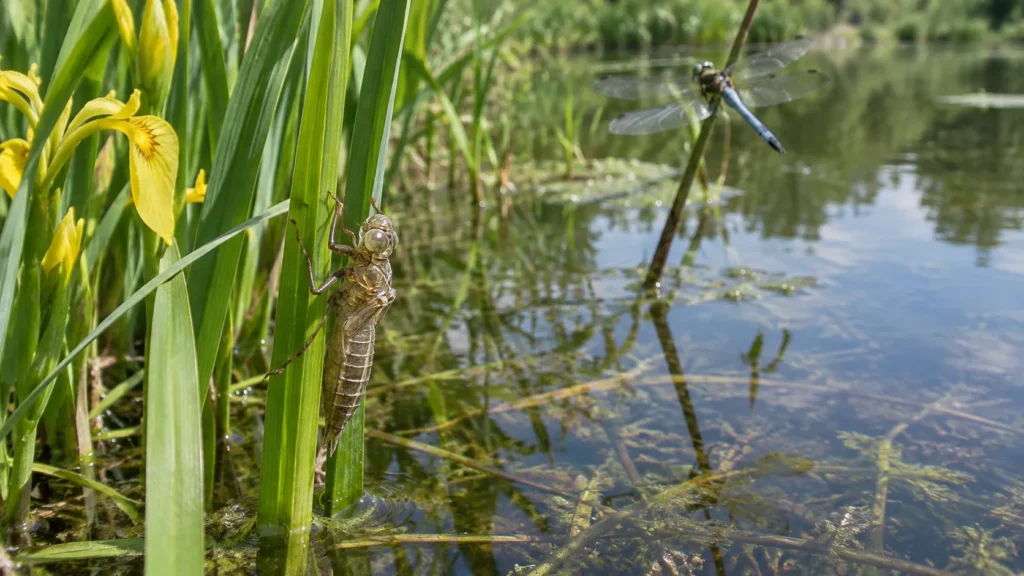
- you find shed larval skins (exuviae) on plant stems at the water’s edge, which shows dragonflies completed their development there;
- some of the species present are known to be sensitive to habitat change in your region.
A dragonfly sighting proves much less when:
- you see one adult flying past (adults travel and hunt well away from where they bred);
- the only species present are widespread, tolerant pond generalists;
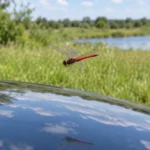
- the “water” is a puddle, a pool cover, a shiny car or another reflective surface.
Why People Link Dragonflies With Clean Water
The idea has a real scientific basis. Dragonflies spend most of their lives underwater as nymphs (also called larvae), often for months and in some species for several years, before emerging as flying adults. You can read more about this stage in our guide to dragonfly larvae and the full dragonfly life cycle.
Because nymphs are tied to one water body for that long, a population that breeds successfully in a pond reflects conditions over time rather than on a single day. Ecologists take advantage of this. Researchers have used dragonfly and damselfly communities (the insect order Odonata) to assess freshwater habitat quality, and in South Africa, researchers at Stellenbosch University developed a Dragonfly Biotic Index that scores sites based on which species are present.
So the scientific version of the claim is roughly this: the mix of dragonfly species breeding at a site can reveal a lot about its condition. The popular version, “dragonflies mean clean water,” drops the most important parts of that sentence.
Why One Dragonfly Doesn’t Prove the Water Is Clean
Adult dragonflies travel away from water
Adult dragonflies are strong fliers. They hunt over meadows, gardens, forest edges and roads, sometimes far from where they emerged, and some species migrate. An adult over your pond may simply be feeding there. Seeing a dragonfly near water does not show that it bred in that water. Our dragonfly habitat guide covers where adults go between visits to water.
Specialist recording groups treat this carefully. Under the British Dragonfly Society’s breeding criteria, adults simply being present at a site is the lowest level of evidence. Even a female laying eggs only counts as probable breeding. The only evidence the society treats as confirmed proof of successful breeding is an exuvia, the empty skin left behind when a nymph climbs out of the water and emerges as an adult.
Many dragonflies tolerate poor water
“Dragonfly” covers thousands of species with very different needs. Some are sensitive to pollution, low oxygen, sediment or altered flow. Others are generalists that do well in disturbed, nutrient-rich or artificial water bodies.
This shows up clearly in freshwater biomonitoring tools. In a widely used North American stream index developed by William Hilsenhoff for organic pollution, each insect family gets a tolerance value from 0 (found only in high-quality water) to 10 (highly tolerant). The dragonfly and damselfly families land all over that scale:
| Group | Family | Hilsenhoff family tolerance value (0 = sensitive, 10 = tolerant) |
|---|---|---|
| True dragonflies (Anisoptera) | Gomphidae (clubtails) | 1 |
| Aeshnidae (darners) | 3 | |
| Cordulegastridae (spiketails) | 3 | |
| Macromiidae (cruisers) | 3 | |
| Corduliidae (emeralds) | 5 | |
| Libellulidae (skimmers) | 9 | |
| Damselflies (Zygoptera) | Calopterygidae (broad-winged damselflies) | 5 |
| Coenagrionidae (narrow-winged damselflies) | 9 | |
| Lestidae (spreadwings) | 9 |
Two cautions apply to this table. First, it was built for organic pollution in Wisconsin streams and works at the family level, so it is a rough guide rather than a verdict on any individual species. Second, tolerance values vary by region. The Macroinvertebrates.org identification resource lists skimmer (Libellulidae) nymph tolerance anywhere from 4 to 10 depending on the region, and notes that some skimmer species tolerate low oxygen, high alkalinity and even brackish water.
The pattern still matters for the question in this article. The skimmers include many of the most familiar pond dragonflies, which means the dragonflies you are most likely to see in a backyard are often among the more tolerant ones.
Simple stream-survey keys used in schools and volunteer programs reflect this too. A Penn State biotic index lesson places dragonfly and damselfly nymphs in its middle group, “moderately tolerant” taxa, not alongside the organisms treated as signs of the cleanest water.
Dragonflies can live in measurably polluted ponds
Two studies show this directly.
In eastern Ontario, Canada, researcher Paul Catling studied dragonflies and damselflies in a sequence of six sewage-lagoon cells near Embrun, where water quality improved from the first cells to the last. Odonates lived throughout the system. Species diversity in the final, cleaner cells was about twice that in the cells receiving wastewater, and some species were associated with the poorer-quality cells, including the common green darner (Anax junius) and two damselflies, Enallagma civile and Ischnura verticalis. In other words, these insects were living and breeding in partly treated sewage, and the clearer signal came from how many species were present and which ones, not from presence alone.
In Norway, a 2019 study sampled darner nymphs (Aeshna species) from highway sedimentation ponds, which collect road runoff, and from natural ponds. In all three sedimentation ponds, sediment levels of zinc and nickel exceeded environmental quality standards, and two of them held high levels of PAHs, a group of combustion-related pollutants. Darner nymphs were living in those ponds, but they showed significantly more DNA damage than nymphs from the natural ponds.
Both studies point the same way: dragonflies can survive, and sometimes breed, in water that no one would call clean.
Dragonflies can be fooled by surfaces that aren’t water at all
Many dragonflies locate water partly by detecting horizontally polarized light reflected from its surface. Shiny, dark surfaces can reflect light in a similar way. In choice experiments, Hungarian researchers Gábor Horváth and colleagues found that dragonflies were more attracted to crude oil than to water, and earlier work described oil lakes left in the Kuwaiti desert after 1991 trapping large numbers of water-seeking insects, including dragonflies.
The same effect explains dragonflies patrolling over cars, dark plastic sheeting and other glossy surfaces. A dragonfly hovering over something is not even proof that it is water, let alone clean water.
How Scientists Actually Use Dragonflies to Judge Water
When dragonflies are used as indicators, the method looks very different from glancing at one insect:
- Species-level identification. Because tolerance varies so much within the group, researchers identify each species rather than just counting “dragonflies.” Identifying a dragonfly reliably depends on several features, not color alone; see our dragonfly identification guide.
- Community, not individuals. The South African Dragonfly Biotic Index combines each species’ geographic distribution, its threat status and its sensitivity to human-caused habitat change. According to its developers, when a freshwater system deteriorates, the community shifts from sensitive specialists toward generalists that are far less particular, and the site’s total score falls.
- Repeated surveys. Long-term work summarized by Jason Bried shows how much sampling effort matters. At two sites surveyed over many years, adult records kept adding new species even after 18 years, while exuviae surveys found fewer species overall but leveled off within a few years. Rare species are easily missed with limited sampling.
- Evidence of breeding. Exuviae and nymphs show that a species is completing its life cycle in that water, not just visiting.
- Other measurements. Biological indicators are usually combined with chemical and physical measurements, such as dissolved oxygen, nutrients and suspended solids, rather than replacing them.
What Dragonflies at Your Pond Can (and Can’t) Tell You
If you have a garden pond or a local pond you visit often, dragonflies can still be a useful, low-cost clue when you read them carefully. Our article on whether dragonflies live near ponds explains why ponds attract them in the first place.
Stronger signs of a healthy pond
- Several dragonfly and damselfly species appear over the season, rather than one or two.
- You find exuviae clinging to reeds, irises or other stems just above the waterline in late spring and summer. Emergence is covered in our larva-to-dragonfly video guide.
- Nymphs turn up when you gently look through pond plants or sediment. Our guide to what dragonfly babies look like will help you recognize them.
- Species that local recording groups describe as habitat-sensitive are present.
Weaker signs
- A single adult flying through, or hunting over the pond and leaving.
- Only widespread, tolerant species, year after year.
- Dragonflies attracted to a small, temporary or artificial water source that can’t support nymph development.
Keep dragonflies and damselflies separate when you record what you see. Both belong to the order Odonata, but damselflies (Zygoptera) are not true dragonflies (Anisoptera), and they have their own range of tolerances. In the Ontario sewage-lagoon study, for example, two of the species associated with poorer water were damselflies.
Clean Enough for Dragonflies Is Not the Same as Safe for People
Even a pond with a rich, healthy dragonfly community can contain bacteria, parasites, toxins from algal blooms or chemicals that matter for human health. Dragonfly biology says nothing about those risks.
Never treat dragonflies as evidence that water is safe to drink, swim in or give to pets. If you need to know whether water is safe, rely on proper testing or guidance from your local water or public health authority.
How to Check Your Pond’s Water More Reliably
If you want a better picture of your pond’s condition than dragonflies alone can give:
- Look at the whole invertebrate community. Biotic indexes use many groups of water animals, not just dragonflies. The UK’s Field Studies Council, for example, describes mayfly nymphs as typical of clean, well-oxygenated water and as sensitive to pollution, while some fly larvae, such as bloodworm midge larvae, can live in heavily polluted water.
- Use simple test kits. Basic kits for dissolved oxygen, nitrate, phosphate and pH can show problems that insects won’t reveal.
- Join or consult a local monitoring program. Many regions have volunteer stream and pond monitoring schemes or dragonfly recording groups that use standardized methods and can help with identification.
- Record over time. Notes on which species appear, when, and whether you find exuviae are far more informative than a single visit.
Frequently Asked Questions
Does seeing dragonflies mean the water is clean?
Not by itself. Some dragonflies are sensitive to pollution, but many common species tolerate poor or disturbed water, and adults often hunt away from where they bred. Variety of species and evidence of breeding, such as exuviae, are much better clues than one sighting.
Can dragonflies live in polluted water?
Yes. Studies have found dragonflies and damselflies living in sewage lagoons in Ontario and darner nymphs living in highway runoff ponds in Norway, where the nymphs showed more DNA damage than those from natural ponds.
Are dragonflies bioindicators?
Yes, when used properly. Scientists use dragonfly and damselfly communities to assess freshwater habitat quality, but that requires identifying species, knowing their tolerances, surveying repeatedly and usually combining the results with other measurements.
Which dragonflies are most sensitive to pollution?
It depends on the species and region. In Hilsenhoff’s family-level stream index, clubtails (Gomphidae) are rated as sensitive, while skimmers (Libellulidae) are rated as highly tolerant. Regional guides and local recording groups give the most reliable information on sensitive species where you live.
Is a pond with lots of dragonflies safe to swim in or drink?
No. A healthy dragonfly community says nothing about bacteria, algal toxins or chemicals that affect human health. Use proper water testing or official guidance.
Do damselflies indicate clean water too?
The same caution applies. Damselflies are used in biomonitoring alongside dragonflies, and their tolerance also varies. In Hilsenhoff’s index, broad-winged damselflies are rated moderately tolerant, while narrow-winged damselflies and spreadwings are rated highly tolerant.
How This Article Was Checked
This article was fact-checked against published research and specialist sources listed below. Tolerance values, study findings and numbers are tied to the indexes, places and studies they come from, and they should not be read as fixed rules for every dragonfly species or region. No field surveys, water tests or experiments were carried out for this article. Learn more about how we research dragonflies.
References and Further Reading
- Bried, J. T. (2022). Odonata as indicators of pollution, habitat quality, and landscape disturbance. In Dragonflies and Damselflies: Model Organisms for Ecological and Evolutionary Research (2nd ed.). Oxford University Press. https://doi.org/10.1093/oso/9780192898623.003.0026
- British Dragonfly Society. Proof of breeding criteria. https://british-dragonflies.org.uk/wp-content/uploads/2022/02/BDS-Proof-of-Breeding-criteria.pdf
- Catling, P. M. (2005). A potential for the use of dragonfly (Odonata) diversity as a bioindicator of the efficiency of sewage lagoons. The Canadian Field-Naturalist 119(2): 233–236. https://www.canadianfieldnaturalist.ca/index.php/cfn/article/view/111
- Field Studies Council. Water pollution (14–16 biology resource). https://www.field-studies-council.org/resources/14-16-biology/pollution/water-pollution/
- Hilsenhoff, W. L. (1988). Rapid field assessment of organic pollution with a family-level biotic index. Journal of the North American Benthological Society 7(1): 65–68.
- Horváth, G., Bernáth, B. & Molnár, G. (1998). Dragonflies find crude oil visually more attractive than water: multiple-choice experiments on dragonfly polarotaxis. Naturwissenschaften 85: 292–297. https://doi.org/10.1007/s001140050503
- Macroinvertebrates.org. Family Libellulidae (larva). https://www.macroinvertebrates.org/taxa-info/odonata-larva/libellulidae
- Meland, S., Gomes, T., Petersen, K. et al. (2019). Road related pollutants induced DNA damage in dragonfly nymphs (Odonata, Anisoptera) living in highway sedimentation ponds. Scientific Reports 9: 16002. https://doi.org/10.1038/s41598-019-52207-4
- Penn State, ecosystems.psu.edu. Biotic Index lesson plan. https://ecosystems.psu.edu/outreach/youth/sftrc/lesson-plan-pdfs/bioticindex.pdf/@@download/file/BioticIndex.pdf
- Simaika, J. P. & Samways, M. J. (2009). An easy-to-use index of ecological integrity for prioritizing freshwater sites and for assessing habitat quality. Biodiversity and Conservation 18: 1171–1185. https://doi.org/10.1007/s10531-008-9484-3
- Stellenbosch University. News article on the Dragonfly Biotic Index. https://www.su.ac.za/en/node/1517
- Discover Magazine (1996). Dragonfly death traps. https://www.discovermagazine.com/environment/dragonfly-death-traps