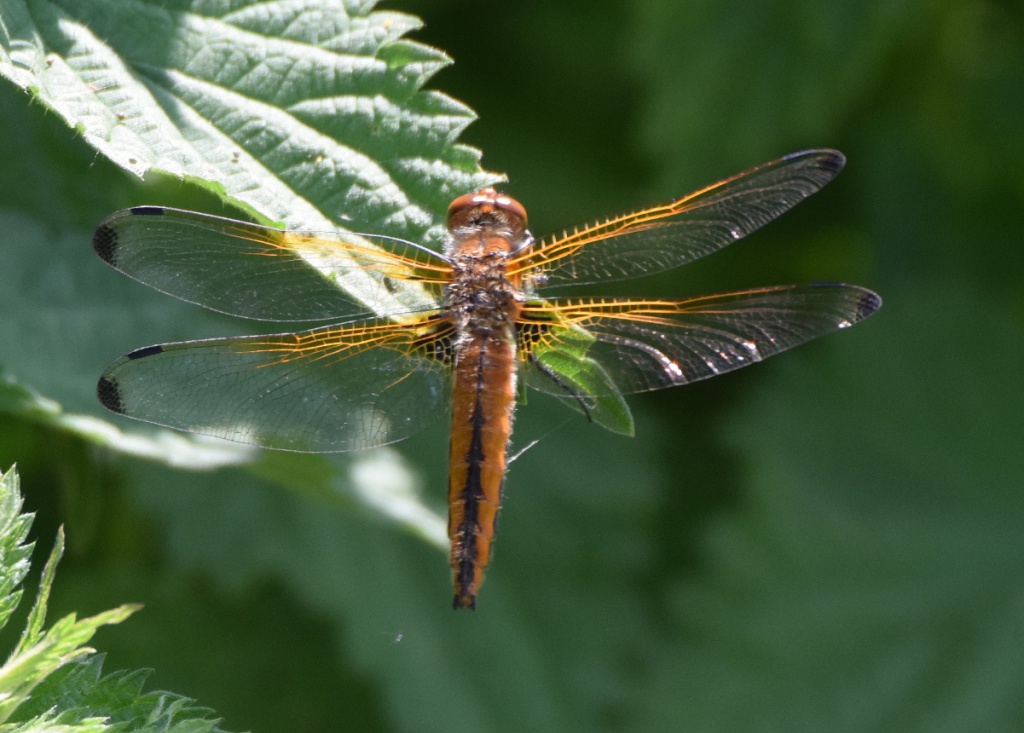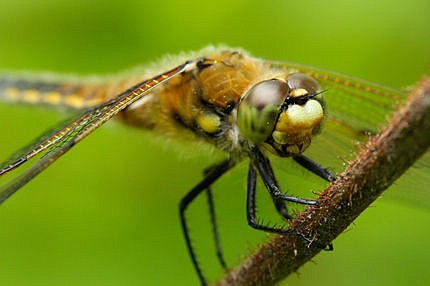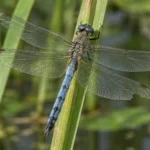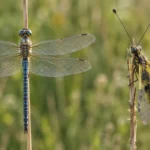
The best-supported candidate for the largest living true dragonfly by maximum reported wingspan is the giant hawker, Tetracanthagyna plagiata. Females have been reported with wingspans of approximately 163–165 millimetres, or about 6.4–6.5 inches. However, the giant petaltail, Petalura ingentissima, is often called the world’s largest dragonfly because of its exceptionally long, heavy-looking body. The often-repeated 19-centimetre record belongs to a damselfly, not a true dragonfly. [1] [2] [3]
Asking “What is the largest dragonfly in the world?” sounds simple, but the answer changes depending on what is measured. Wingspan, body length, body mass and overall wing area can produce different winners. Older books and websites also sometimes use the word “dragonfly” for every member of the order Odonata, even though dragonflies and damselflies are separate groups.
This fact-checked comparison separates true dragonflies from damselflies, distinguishes measured specimens from repeated maximum claims and explains why two different species are regularly described as the world’s largest dragonfly.
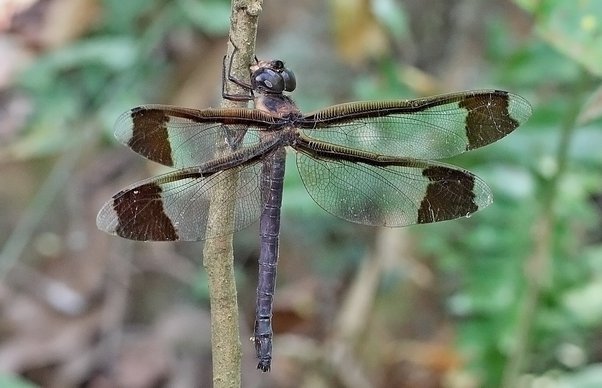
The world’s largest dragonflies at a glance
| Size category | Species | Reported size | Important distinction |
|---|---|---|---|
| Largest living true dragonfly by reported maximum wingspan | Tetracanthagyna plagiata | About 163–165 mm wingspan | A true dragonfly in the suborder Anisoptera; females are substantially larger than males. [1] [3] |
| Largest true dragonfly by overall dimensions | Petalura ingentissima | About 160–162 mm wingspan and up to approximately 125 mm long | A particularly long and bulky Australian dragonfly. Some authoritative museum sources call it the world’s largest dragonfly species. [2] [3] |
| Largest living odonate by wingspan | Megaloprepus helicopter damselfly | Up to about 190 mm in older literature; 173 mm was the largest in one review of 53 specimens | It belongs to the damselfly suborder Zygoptera, not the true dragonfly suborder Anisoptera. [3] [5] |
| Largest known dragonfly-like fossil insect | Meganeuropsis permiana | Estimated wingspan of about 710 mm | An extinct griffinfly, not a modern dragonfly and not a member of the living order Odonata as narrowly defined. [3] [8] |
Largest living true dragonfly by wingspan: the giant hawker
The giant hawker, Tetracanthagyna plagiata, is a large Southeast Asian dragonfly in the family Aeshnidae. Singapore’s National Parks Board describes it as the largest dragonfly in Southeast Asia and reports that females may reach a wingspan of up to 165 millimetres. Males are smaller, with reported hindwing lengths of 67–75 millimetres and total body lengths of approximately 93–100 millimetres. [1]
Its known range is centred on Sundaland, including parts of Peninsular Malaysia, Singapore, Borneo, Sumatra and nearby regions of Southeast Asia. It is associated with shaded forest streams and freshwater swamp forest. Adults may forage around dawn and dusk, and females insert eggs into soft or decaying wood beside streams. [1] [4]
What specimen records actually show
Maximum figures should not be confused with the size of every individual. A National University of Singapore report documented preserved female specimens with a hindwing span of about 143 millimetres. Earlier Singapore collection records included specimens around 123–145 millimetres, showing that real individuals vary substantially. [4]
Keith Wilson’s 2009 review for the Worldwide Dragonfly Association listed a maximum wingspan of approximately 163 millimetres and a body length near 100 millimetres for female Tetracanthagyna plagiata. This is the principal evidence behind its claim as the widest-winged living true dragonfly. [3]
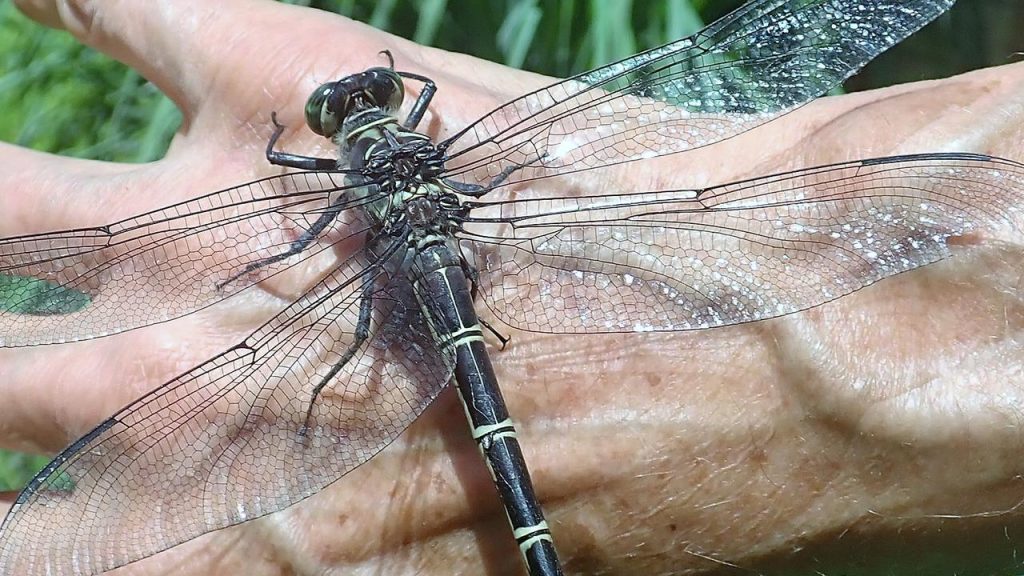
Is the giant hawker also the heaviest dragonfly?
The species is frequently described as the heaviest living odonate, particularly because adult females are broad-bodied and robust. A 2009 scientific report traced this statement to older odonatological literature. [4]
However, an exact weight such as “7 grams” should be treated cautiously. Publicly accessible sources do not provide a modern, standardized weighing survey covering enough giant hawkers and giant petaltails to establish a reliable species-wide weight record. For that reason, it is safer to say that female giant hawkers are often regarded as among the heaviest living odonates, rather than presenting one exact weight as settled fact.
What do giant hawker larvae eat?
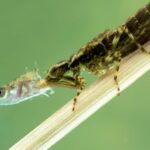
Researchers described final-stage giant hawker larvae collected from small, slow-moving forest streams in Singapore. In captivity, the larvae accepted live shrimp and small fish. The study supports the view that these unusually large larvae are powerful aquatic predators, but captive feeding observations should not be interpreted as a complete list of everything they eat in the wild. [9]
Why the giant petaltail is also called the world’s largest dragonfly
The giant petaltail, Petalura ingentissima, lives in a limited area of northeastern Queensland, Australia. The Natural History Museum in London describes it as the world’s largest dragonfly species and reports a wingspan of about 16 centimetres and a body length of up to approximately 12.5 centimetres. [2]
Wilson’s size review gave a maximum wingspan of approximately 162 millimetres. In a collection of roughly 100 specimens examined in Queensland, the largest measured individual had a body length of 116 millimetres and a wingspan of 155 millimetres, although unusually large females may exceed those measurements. [3]
The difference between 162 millimetres for the giant petaltail and 163–165 millimetres for the largest giant hawker records is very small. More importantly, the petaltail has a longer and heavier-looking body. This explains why reputable sources can reach different conclusions without necessarily contradicting the underlying measurements:
- Maximum wingspan: Tetracanthagyna plagiata has a slight advantage in published upper measurements.
- Body length and overall dimensions: Petalura ingentissima is exceptionally long and bulky.
- Body mass: there is not enough standardized public measurement data to assign a precise, uncontested weight record.
Petalura ingentissima, the giant petaltail of northeastern Queensland, is not the same species as Petalura gigantea, the giant dragonfly associated with peat swamps in New South Wales and southeastern Queensland. Petalura gigantea has been listed as endangered in New South Wales, but that conservation information should not be attached to P. ingentissima. [7]
Is the 19-centimetre helicopter insect a dragonfly?
Not in the strict taxonomic sense. The blue-winged helicopter insects of the genus Megaloprepus belong to the damselfly suborder Zygoptera. True dragonflies belong to Anisoptera. Both groups are members of the order Odonata, which is why general-interest sources sometimes place them together.
Older scientific literature reports a wingspan of up to approximately 190 millimetres for Megaloprepus caerulatus. However, Wilson’s 2009 review noted that the largest of 53 examined specimens produced an estimated total wingspan of about 173 millimetres. The frequently repeated 190–191 millimetre figure may represent a rare extreme, a differently measured specimen or an older estimate that is difficult to reproduce. [3] [5]
These helicopter damselflies are remarkable forest specialists. Their large wings and slow, controlled flight help them move through tropical forest understories, where members of the group have been observed taking spiders and other small prey from webs. Their larvae develop in small water-filled tree cavities rather than ordinary open ponds. [5]
A 2022 taxonomy update changed the picture
Older references treated Megaloprepus as a genus containing a single widespread species. A 2022 taxonomic revision used morphology and earlier genetic findings to recognize four species: M. caerulatus, M. latipennis, M. brevistigma and the newly described M. diaboli. [6]
This matters because old measurements and distribution statements may have combined specimens that are now assigned to different species. The safest modern wording is therefore that the genus Megaloprepus contains the living odonates with the longest wings, while avoiding the assumption that every historical 19-centimetre record belongs to one broadly distributed species.
What did the largest specimen investigations find?
53 helicopter damselflies
A specimen review cited in 2009 found a maximum estimated wingspan of 173 mm among 53 Megaloprepus specimens, below the widely repeated 190–191 mm claim. [3]
About 100 giant petaltails
Among roughly 100 Queensland specimens, the largest measured individual reached 116 mm in body length and 155 mm in wingspan. [3]
Singapore giant hawkers
Museum and field records included giant hawkers around 123–145 mm, while published maximum estimates for exceptional females reach 163–165 mm. [1] [4]
Why the results vary
Maximum species figures are based on rare large individuals. Sex, specimen condition and measurement method can all change the reported result.
Why dragonfly size records are difficult to compare
A single number rarely tells the whole story. Researchers and field guides may use several different measurements:
- Total wingspan: the distance from one wingtip to the opposite wingtip when the wings are fully spread.
- Hindwing length: the measurement of one hindwing, which is sometimes doubled and adjusted for thorax width to estimate total span.
- Total body length: the distance from the front of the head to the tip of the abdomen.
- Wing area: a broad-winged species can have more total wing surface without having the longest wingspan.
- Body mass: affected by sex, maturity, feeding condition, preservation and whether a female is carrying eggs.
Female giant hawkers and giant petaltails are generally larger than males. Museum specimens can also shrink, bend or lose their natural resting position after preservation. A measurement taken from a pinned specimen may therefore differ from an estimate made from a living individual or photograph.
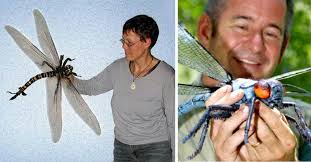
What was the largest dragonfly-like insect ever?
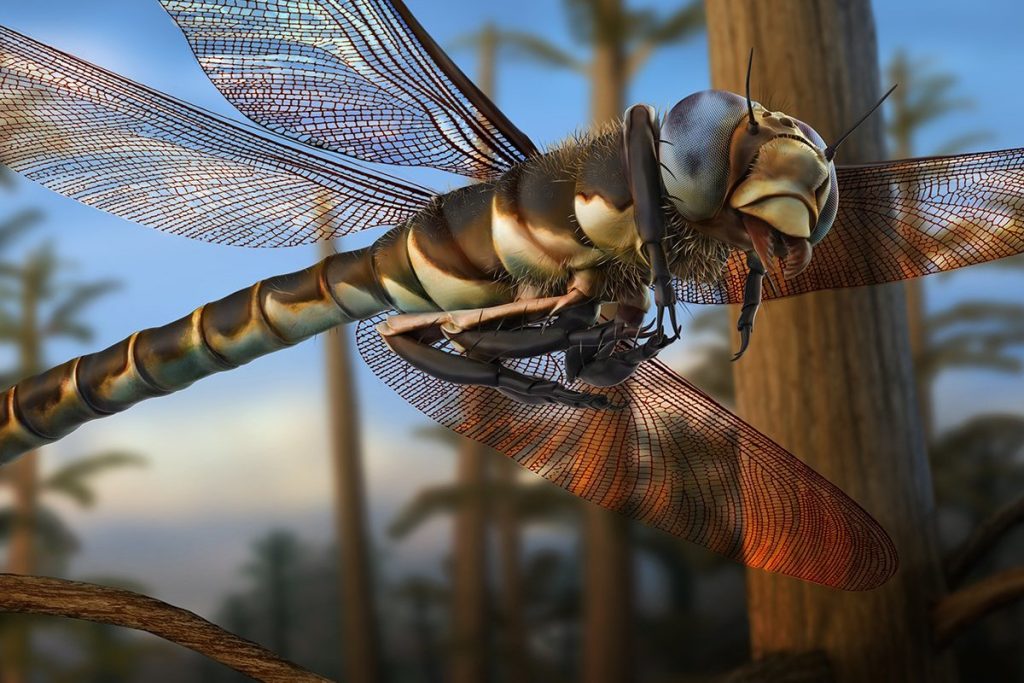
Fossil griffinflies were far larger than any living dragonfly. Meganeuropsis permiana, from the Permian Period, has been reconstructed with a wingspan of approximately 710 millimetres, or about 28 inches. [3] [8]
Despite their dragonfly-like appearance, griffinflies belonged to an extinct lineage often called Meganisoptera. They were related to the broader dragonfly lineage but were not modern dragonflies. Calling Meganeuropsis the “largest dragonfly ever” is therefore useful as informal shorthand, but taxonomically imprecise.
Scientists have proposed several explanations for the gigantic size of Paleozoic flying insects. Higher atmospheric oxygen may have made it easier for large insects to supply their tissues with oxygen. The absence of modern aerial predators may also have reduced pressure to remain small and highly manoeuvrable. These explanations remain hypotheses rather than a single conclusively proven cause. [8]
Some websites identify the Jurassic species Cymatophlebia suevica as the largest true fossil dragonfly and repeat a wingspan of 235 millimetres. Because that exact maximum is difficult to trace to an accessible, specimen-based primary measurement, it is not presented here as a settled record. The better-documented 710-millimetre Meganeuropsis figure is clearly labelled as belonging to a griffinfly rather than a modern dragonfly.
Dragonfly, damselfly or griffinfly?
| Group | Classification | Typical appearance | Example in this comparison |
|---|---|---|---|
| True dragonflies | Odonata: Anisoptera | Usually robust-bodied, with broad hindwings and wings held open at rest | Tetracanthagyna plagiata and Petalura ingentissima |
| Damselflies | Odonata: Zygoptera | Usually more slender, with similarly shaped forewings and hindwings | Megaloprepus |
| Griffinflies | Extinct Meganisoptera | Large Paleozoic insects resembling dragonflies but belonging to a separate extinct lineage | Meganeuropsis permiana |
Frequently asked questions
What is the largest dragonfly in the world?
The giant hawker, Tetracanthagyna plagiata, is the strongest candidate by maximum published wingspan among living true dragonflies, reaching approximately 163–165 millimetres. The giant petaltail, Petalura ingentissima, is often called the largest based on its overall body dimensions.
Is there really a dragonfly with a 19-centimetre wingspan?
An odonate approaching that size has been reported, but it is a helicopter damselfly in the genus Megaloprepus, not a true dragonfly. A specimen review found a maximum of about 173 millimetres among 53 specimens, while older literature reports up to approximately 190 millimetres.
How large is Tetracanthagyna plagiata?
Exceptional females have been reported with wingspans of approximately 163–165 millimetres. Documented museum and field specimens are often smaller, commonly falling in the 140-millimetre range.
Which is larger: the giant hawker or the giant petaltail?
The giant hawker has a slightly larger published maximum wingspan. The giant petaltail has a longer and more massive overall body, so the answer depends on whether wingspan or total dimensions are being compared.
Was Meganeuropsis a giant dragonfly?
It resembled a dragonfly and belonged to the wider evolutionary radiation of dragonfly-like insects, but it was a griffinfly in the extinct group Meganisoptera. It was not a modern member of Odonata.
Can giant dragonflies hurt people?
Dragonflies do not have stingers and do not hunt people. A large individual may use its jaws defensively if it is handled roughly, but normal encounters pose little risk. Learn more in our guide to whether dragonflies bite .
Why are female dragonflies often larger than males?
In many species, larger female body size can provide more space for egg production. The degree of size difference varies by species, but it is especially relevant when comparing giant hawkers and giant petaltails because record-sized individuals are usually females.
How this article was researched
This update compared government species records, museum explanations, specimen-based reports and specialist odonatology publications. Maximum reported measurements were separated from measurements of documented individual specimens.
Exact claims that could not be supported by a traceable source were removed. In particular, the previous 7-gram weight statement was not retained, and conservation information for Petalura gigantea was separated from information about Petalura ingentissima.
Scientific names are italicized, true dragonflies are distinguished from damselflies and fossil griffinflies are not presented as members of modern Odonata.
Sources and further reading
- National Parks Board Singapore. Tetracanthagyna plagiata species profile . Includes reported female wingspan, male measurements, habitat and ecological notes.
- Natural History Museum, London. Dragonflies: The Ultimate Hunters . Includes the giant petaltail’s approximate wingspan, body length and Queensland distribution.
- Wilson, K. D. P. 2009. “Dragonfly Giants,” Agrion 13(1), pages 29–31 . Worldwide Dragonfly Association specimen and literature review.
- Leong, T. M. and Tay, S. L. 2009. Encounters with Tetracanthagyna plagiata in Singapore, with an observation of oviposition . Nature in Singapore 2:115–119.
- Groeneveld, L. F. et al. 2007. Convergent evolution of gigantism in damselflies of Africa and South America? . Molecular Phylogenetics and Evolution.
- Feindt, W. et al. 2022. The damselfly genus Megaloprepus: revalidation and delimitation of species-level taxa . Zootaxa 5115(4).
- New South Wales Government. Giant dragonfly Petalura gigantea endangered species listing .
- Natural History Museum, London. Griffinflies: The Earliest Flying Insects .
- Orr, A. G., Ngiam, R. W. J. and Leong, T. M. 2010. The larva of Tetracanthagyna plagiata, with notes on its biology and comparisons with congeneric species . International Journal of Odonatology.