Dragonfly biology guide
Dragonfly Life Cycle: From Egg to Aquatic Nymph to Adult
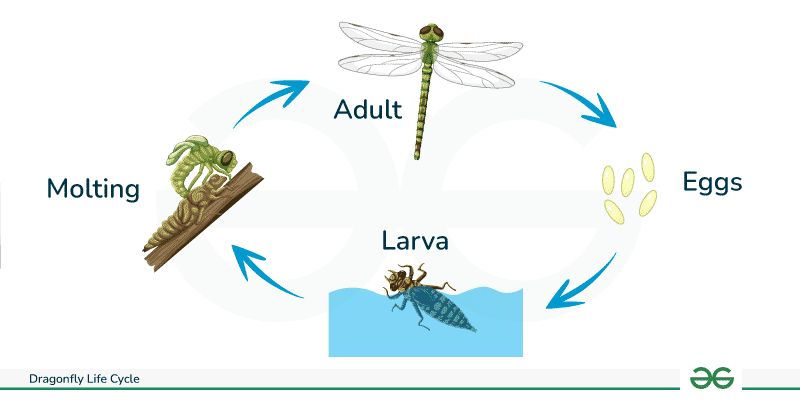
A dragonfly develops through three main stages: egg, aquatic nymph and adult. It undergoes incomplete metamorphosis, so there is no pupal stage. After repeated underwater molts, the final-instar nymph climbs out of the water and completes its last molt. The pale, soft teneral adult then expands and hardens its wings before maturing, feeding, mating and laying eggs to begin the cycle again.
Dragonfly Life Cycle at a Glance
Dragonflies are insects in the order Odonata. Their development is usually summarized as three main stages: an egg, an aquatic larva called a nymph or naiad, and a winged adult. Emergence, the prolarva and the teneral adult are important parts of the story, but they are not additional main life-cycle stages.
| Part of the cycle | Where it occurs | What happens | Timing |
|---|---|---|---|
| Egg | In water, plant tissue, wet sediment or material close to water | The embryo develops. Hatching may be immediate within the season or delayed by environmental conditions or diapause. | Often days to weeks, but some eggs remain unhatched for months or through an unfavorable season. |
| Aquatic nymph | Ponds, lakes, marshes, streams and other suitable freshwater habitats | The nymph feeds, grows and passes through a series of instars separated by molts. External wing pads become increasingly visible. | From a relatively short growing season in rapidly developing species to several years in slow-developing species. |
| Emergence | On vegetation, rocks, banks or other supports above the water | The final-instar nymph leaves the water and completes its final molt. The abandoned skin is the exuvia. | Usually completed over a period of hours, with substantial variation among species and conditions. |
| Teneral adult | Initially near the emergence site, then often away from the water | The wings expand, the cuticle hardens and adult coloration develops. | Initial hardening takes hours; full coloration and reproductive maturity commonly require longer. |
| Mature adult | Around feeding areas, shelter and breeding habitat | The adult hunts flying insects, matures, mates and lays eggs. | Commonly days to weeks, but adult longevity varies greatly among species and individuals. |
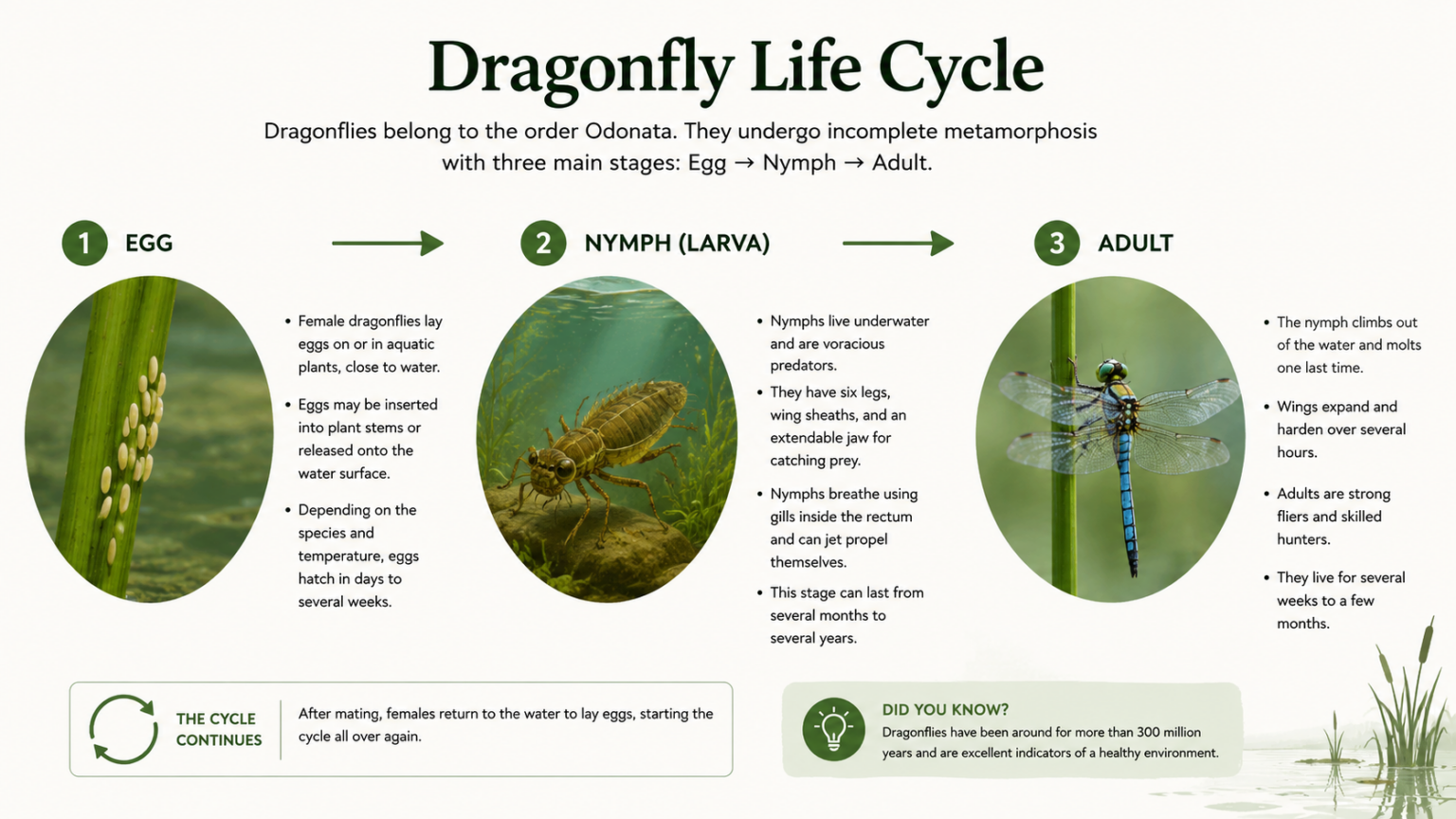
Original Dragonfly Life Cycle Diagram
Editorial diagram specification: redraw these seven connected steps as an original, accessible illustration. The diagram should identify only egg, nymph and adult as the three main stages and should not include a pupa.
Stage 1: Egg
The next generation begins when a mature female deposits fertilized eggs in a place that gives the hatchlings access to suitable freshwater habitat. “Dragonfly eggs are laid in water” is a useful first explanation, but it does not describe every species accurately. Different dragonflies use different egg-laying structures, movements and substrates.
Egg laying and oviposition
Egg laying is called oviposition. In some species, a female is accompanied or guarded by a male. A pair may remain connected in tandem, or the male may fly nearby. Other females lay without a male attached. The exact behavior depends on the species and should not be treated as a universal rule.
Endophytic oviposition
In endophytic egg laying, the female uses a specialized ovipositor to insert eggs into plant tissue or another soft substrate. Depending on the species, eggs may be placed in living or decaying vegetation, wet wood, mud or material close to the waterline.
This method is especially associated with darners and several other odonate groups, but the substrate and behavior differ among species.
Exophytic oviposition
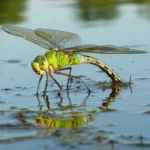
In exophytic egg laying, eggs are released outside plant tissue. A female may touch or dip the end of her abdomen against the water, scatter eggs over a wet surface, or release them above the water so they settle into the habitat.
Some exophytic eggs are surrounded by a gelatinous material that can help them adhere to a surface. This method is common among many skimmers, chasers and related dragonflies.
There is no dependable egg number that applies to all dragonflies. Reproductive output varies with species, female size, condition, mating history, the number of laying visits and environmental circumstances. A species-specific study is needed before quoting an egg total.
Egg development and delayed hatching
After an egg is laid, temperature, oxygen, moisture and the developmental strategy of the species influence what happens next. Some eggs hatch during the same warm period. Others delay development or hatching until conditions become more suitable. In seasonal climates, eggs of some species remain dormant through winter or a dry period.
A programmed pause in development is called diapause. Delayed hatching is useful when immediate emergence would place a tiny larva in cold, dry or otherwise unsuitable habitat. Not every delayed egg is behaving in exactly the same physiological way, so “diapause” should be used only when supported for the species.
Where does the prolarva fit?
In many dragonflies, the hatchling first appears in a compact form known as a prolarva, sometimes called a pronymph in older or alternative terminology. Its appendages may initially be enclosed or held close to the body. The prolarval period can be extremely brief, particularly when hatching occurs underwater, and the first molt may follow quickly.
If an egg was laid above the water, the prolarva may wriggle or drop toward the aquatic habitat before molting into a more recognizable nymph. The prolarva is therefore best explained as an early larval form or transition—not as a separate fourth main stage in every simplified life-cycle diagram.
Stage 2: The Aquatic Nymph
The wingless juvenile is usually called a dragonfly nymph, larva or naiad. It lives underwater and grows through a succession of instars. For many species, this is the longest part of the life cycle.
Dragonfly nymphs occupy many kinds of freshwater habitat, including ponds, marshes, lakes, slow channels, fast streams and temporary pools. A species adapted to buried stream sediment does not necessarily develop like one living among pond plants. The habitat influences temperature, oxygen, prey, predators and the length of the available growing season.
A dragonfly nymph has six legs, developing wing pads, large eyes in many groups and a hinged, extendible labium used to capture prey. Unlike damselfly nymphs, dragonfly nymphs do not have three leaf-like external gills at the end of the abdomen. They exchange gases through structures in a rectal chamber and can move water through that chamber.
The nymph is an active predator, but this pillar page does not repeat a complete prey list or hunting guide. Read Dragonfly Larvae: Aquatic Life and Ecology for the underwater stage, or see What Do Dragonflies Eat? for the diets of nymphs and adults.
For identification features and the difference between a young dragonfly and a miniature adult, visit What Do Dragonfly Babies Look Like?.
How Dragonfly Nymphs Grow
Instars and repeated molts
An insect with a rigid outer skeleton cannot enlarge continuously. As a dragonfly nymph grows, it periodically sheds its old cuticle. The form between two molts is called an instar, while the time spent in that form may be called a stadium.
There is no single molt total for every dragonfly. A major review of published Odonata records found eight to eighteen larval stadia among the documented dragonfly species, with most dragonfly and damselfly records falling between ten and sixteen. The number still varied between species, within species and sometimes among individuals from the same egg batch.
Sources may also count the prolarva, larval stadia and final molt differently. For that reason, statements such as “every dragonfly molts exactly twelve times” should not be used.
Wing-pad development
Young nymphs do not possess functional wings, but the external wing pads become progressively larger during later instars. These pads contain the developing adult wing structures. They should not be described as tiny working wings, and the nymph does not fly underwater.
The final instar
The last nymphal form is the final instar. Before emergence, its adult structures are already developing beneath the larval cuticle. Physiological changes prepare the insect to stop relying only on aquatic respiration, leave the water and complete the final molt in air.
Temperature and seasonal cues can help coordinate this transition. Some species emerge in a relatively concentrated seasonal period, whereas others emerge over a longer interval. Weather, water level, geographic location and species biology can all affect the date.
Stage 3 Begins with Emergence
Emergence is the transition from the aquatic nymph to the winged adult. It is not a pupal stage. It is the dragonfly’s final molt.
When ready, the final-instar nymph moves into shallow water or toward a suitable exit. It may climb a plant stem, rock, tree root, bridge support, bank or another stable surface. The distance and timing vary. Some dragonflies emerge in daylight, while others commonly begin in darkness or around dawn.
What happens during the final molt?
- The nymph secures its legs to a support above the water.
- The larval cuticle splits, usually around the thorax.
- The adult pushes its thorax, head and legs out of the old skin.
- It may pause while its legs gain enough strength to hold the body.
- The abdomen is withdrawn from the remaining larval skin.
- Fluid pressure helps expand the folded wings and lengthen the abdomen.
- The wings dry and the new cuticle begins to harden before the first flight.
The visible sequence can take hours rather than seconds. The precise duration depends on species, temperature, weather and the point used to define the beginning and end of emergence.
Watch the sequence on The Process of a Larva Becoming a Dragonfly. The dedicated page provides the visual detail without requiring this life-cycle guide to duplicate the full emergence description.
What is an exuvia?
An exuvia is the empty outer skin left after an arthropod molts. The plural is exuviae. A dragonfly exuvia often remains attached to a stem, rock, wall or other emergence support after the adult has flown away.
Exuviae are valuable evidence because they show that a dragonfly completed its aquatic development at that site. Researchers and naturalists can sometimes identify them to species or species group by examining their structure. An empty exuvia is not a dead adult dragonfly and should not be called a chrysalis.
The Teneral Adult Stage
A newly emerged adult is described as teneral. It already belongs to the adult stage, but its body is not yet fully hardened. The wings are initially crumpled and soft; they expand as fluid moves through their veins and tissues. The abdomen also lengthens as the adult takes its final shape.
A teneral dragonfly may look much paler than a mature individual. Its new cuticle has not completed hardening and darkening, and adult pigments or surface coloration may not yet be fully expressed. This is why identifying a teneral dragonfly only by color can be unreliable.
The first flight may be weak or brief. During this period, rain, wind, falls, failed wing expansion and predators can be especially dangerous. A dragonfly with permanently misshapen wings after the tissues harden cannot later molt again to replace them; the emergence molt is its last.
The Mature Adult Stage
After the wings and cuticle harden, the dragonfly becomes a stronger flier. Many individuals move away from the immediate emergence site while they feed and continue maturing. Depending on the species, adults may use woodland edges, meadows, clearings, marshes, shorelines and other productive feeding areas.
Sexual maturity does not necessarily occur at the instant the first flight begins. Over the following period, adult coloration, reproductive tissues and behavior continue to develop. Mature males of some species return to breeding water and defend territories, patrol routes or search for females. Other species use less territorial mating systems.
During mating, the pair forms the characteristic odonate wheel position. Afterward, the female deposits eggs using the oviposition method of her species. Egg laying connects the mature adult back to the first stage and completes the life cycle.
For a closer look at where each stage lives, see Dragonfly Habitat. For adult longevity and the difference between life-cycle duration and adult lifespan, visit How Long Does a Dragonfly Live?.
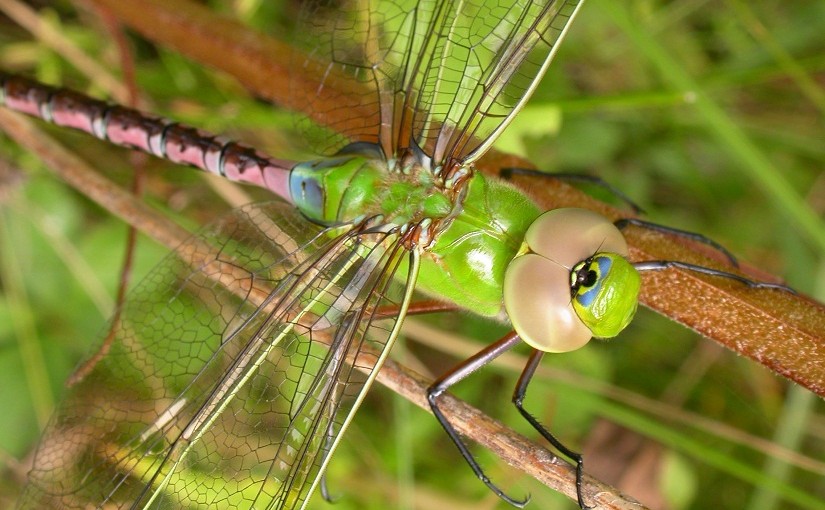
How Long Does the Whole Dragonfly Life Cycle Take?
There is no single total that applies to all dragonflies. The complete cycle can progress relatively quickly in favorable conditions or extend across several years when larval development is slow or interrupted by seasonal dormancy.
Even members of the same species may not develop at an identical rate. Individuals experience different temperatures, prey supplies, competition, water conditions and seasonal opportunities. Published life-history data should therefore be attached to a named species, population and location whenever possible.
This egg-to-adult timing graphic is deliberately not drawn to scale. It does not imply that each part occupies a fixed share of a dragonfly’s life.
What changes the development rate?
Univoltine, semivoltine and multivoltine in simple language
Scientists use the word voltinism to describe how many generations are completed within a year or how many years one generation requires. These labels describe populations under particular conditions, not an unchangeable rule for every individual everywhere.
Incomplete Metamorphosis Explained
Dragonflies are described as hemimetabolous insects, meaning they undergo incomplete metamorphosis. The juvenile and adult live in very different environments and look substantially different, but development does not include a true pupa between them.
In a butterfly, extensive transformation occurs inside a pupa. In a dragonfly, adult structures develop gradually through the nymphal instars, and the final transition occurs during the last molt above water. The comparison is useful only for explaining the absence of a pupa; it should not replace the actual dragonfly sequence.
Dragonfly vs. Damselfly Life Cycle
Dragonflies and damselflies both belong to Odonata. Both have egg, aquatic nymph and adult stages, and neither has a pupal stage. They may also share terms such as prolarva, final instar, emergence, exuvia and teneral adult.
Dragonflies
- Nymphs are usually more robust in shape.
- Nymphs breathe using structures inside a rectal chamber.
- The abdomen does not end in three leaf-like external gills.
- Species occupy habitats ranging from still ponds to flowing streams.
Damselflies
- Nymphs are generally more slender.
- Most have three external caudal lamellae at the abdomen tip.
- The lamellae participate in gas exchange and may aid movement.
- Their development times must not be copied automatically into dragonfly articles.
Timing reported for a British damselfly, tropical pond species or migratory darner should not be presented as the normal duration for every Odonata species. Even closely related species can use different seasonal strategies.
Dragonfly Life Cycle for Kids
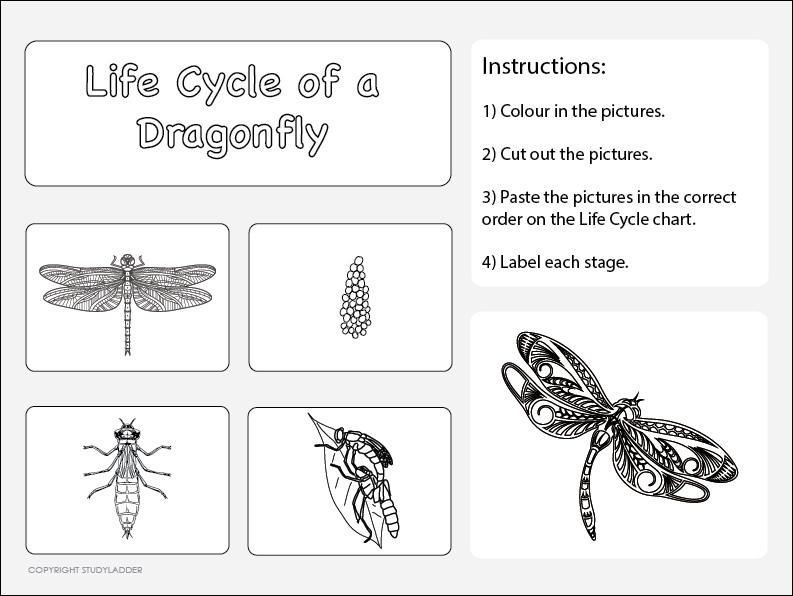
A dragonfly has three main parts in its life story. It starts in an egg, grows as a water-living nymph and finally becomes a flying adult. It does not make a chrysalis.
The empty skin left on a plant is called an exuvia. The new adult is pale and soft at first. Its wings must expand and harden before it can fly normally.
Frequently Asked Questions
Do dragonflies have a pupa?
No. Dragonflies undergo incomplete metamorphosis. The final-instar nymph leaves the water, sheds its larval skin and emerges directly as a winged adult. There is no chrysalis or true pupal stage.
How long do dragonflies stay underwater?
There is no universal duration. Some fast-developing species complete aquatic growth in weeks or months, while slow-developing species remain nymphs for several years. Species, water temperature, latitude, altitude, season, food and habitat all influence the result.
How many times does a dragonfly nymph molt?
Published records do not support one fixed number. A major review reported eight to eighteen larval stadia among documented dragonfly species, with most Odonata records between ten and sixteen. Authors may count the prolarva and final molt differently, and totals vary even within a species.
What happens during dragonfly emergence?
The final-instar nymph climbs above water and anchors itself. Its larval skin splits, the adult pulls free, expands its abdomen and wings, and waits for its new cuticle to strengthen. The abandoned larval skin remains as an exuvia.
What is a dragonfly exuvia?
An exuvia is the empty larval skin left after the final molt. It may remain attached to vegetation, rocks, banks or human-made structures near the water. It is evidence that a dragonfly successfully developed and emerged at that location.
Why are newly emerged dragonflies pale?
A newly emerged or teneral adult has a soft, incompletely hardened cuticle. Its mature pigments and surface coloration may not yet be fully expressed. As the body hardens over the following period, the appearance often becomes darker or more intense.
Do dragonflies live for only one day?
No. Even when the winged adult lives for a relatively short period, it has already spent much longer developing as an egg and aquatic nymph. The entire dragonfly life cycle normally lasts far longer than one day.
Continue Exploring Dragonfly Biology
Sources and Further Reading
- British Dragonfly Society — Life Cycle and Biology — egg-laying strategies, prolarva, larval development, emergence and exuviae, with timing examples that should be interpreted in a British context.
- University of Florida IFAS — Dragonflies and Damselflies — Odonata biology, oviposition terminology, aquatic nymphs and adult emergence.
- Corbet, P. S. — Stadia and Growth Ratios of Odonata: A Review — peer-reviewed analysis of larval stadia and variation within and among species.
- Natural History Museum — Dragonflies: The Ultimate Hunters — accessible overview of prolarvae, aquatic nymphs, emergence and the absence of a pupal stage.
- Australian Museum — Dragonfly Life Cycle — educational explanation of the egg, larval and adult stages.
- U.S. National Park Service — Common Green Darner — a clearly identified species example covering endophytic egg laying, instars, emergence, exuvia and the teneral condition.
- Odonata Central — distribution, seasonality, records and identification resources for dragonflies and damselflies in the Western Hemisphere.
- Dragonfly Society of the Americas — research, education and conservation resources concerning Odonata.