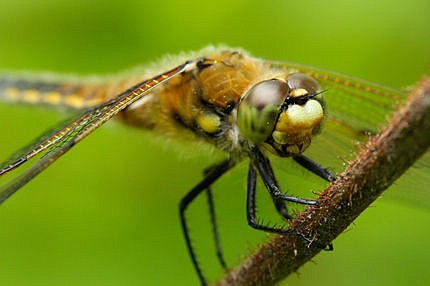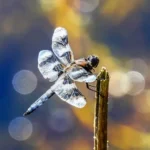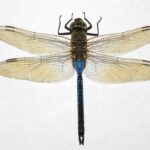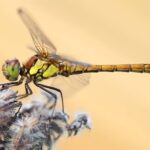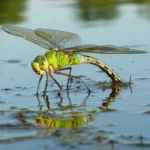
If you have ever walked past a sunny pond in summer, you have probably seen a dragonfly flash over the water like a tiny living helicopter. It may pause on a reed, dart after a small insect, or patrol the same stretch of shoreline again and again.
So, do dragonflies live near ponds? Yes, many dragonflies are strongly connected to ponds and other freshwater habitats. Adult dragonflies often hunt, mate, defend territories, and lay eggs around ponds. Even more importantly, their young — called nymphs or naiads — actually live underwater before they become the winged adults we recognize.
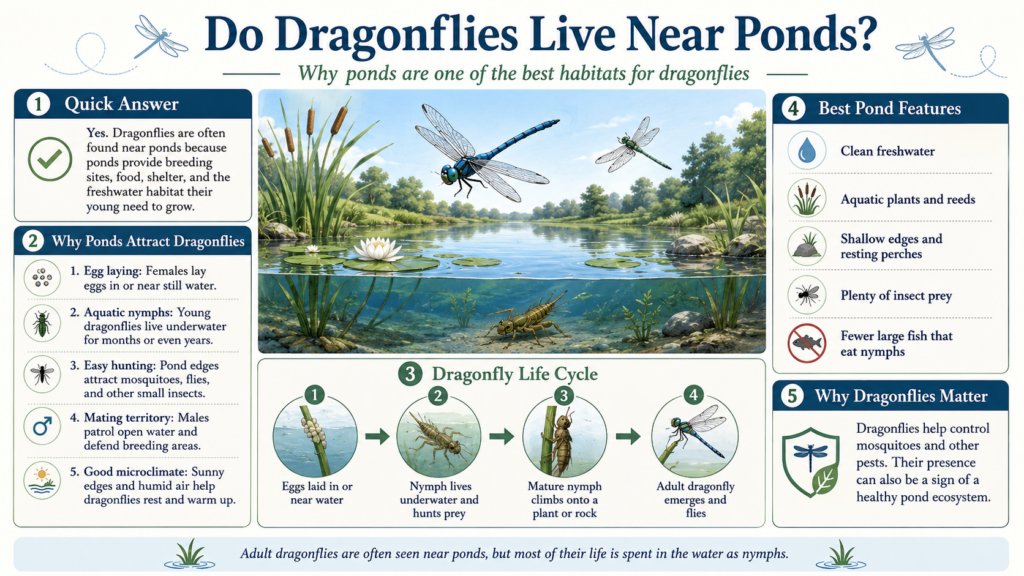
Dragonflies are not just visiting ponds by accident. For them, a pond can be a nursery, hunting ground, mating arena, and safe place to complete one of the most fascinating life cycles in the insect world. Adult dragonflies are commonly found near ponds, lakes, and streams, while their larvae live in freshwater among plants, rocks, and other sheltered places.
Do Dragonflies Live Near Ponds?
Dragonflies often live near ponds because ponds provide the freshwater environment they need to reproduce and survive. While adult dragonflies can sometimes fly far from water, they usually return to ponds, lakes, marshes, streams, or slow-moving rivers for breeding and egg-laying.
The connection is simple: dragonflies begin life in water.
A female dragonfly lays her eggs in or near water. Depending on the species, she may dip her abdomen into the pond surface, place eggs into aquatic plants, deposit them in mud, or use plant stems and wet debris near the waterline. After the eggs hatch, the young dragonflies live as aquatic nymphs. They remain underwater for months, and in some species, even years, before emerging as adults. The British Dragonfly Society describes the three main life stages as egg, larva, and adult, with larvae spending much of their life feeding and growing in aquatic habitats.
That is why ponds are such reliable places to see dragonflies. If the water is reasonably clean, has enough vegetation, and supports small aquatic prey, it may also support dragonfly nymphs.
Why Are Dragonflies So Often Found Around Ponds?
Dragonflies are drawn to ponds for several overlapping reasons. A pond is not just “water” to a dragonfly. It is a complete habitat with breeding sites, food, shelter, warm basking spots, and places for young dragonflies to emerge.
1. Ponds Provide Breeding and Egg-Laying Sites
The most important reason dragonflies stay close to ponds is reproduction.
Adult females need water or wet vegetation to lay their eggs. Some species deposit eggs directly into the water. Others insert eggs into plant tissue, mud, rotting wood, or vegetation close to the pond edge. Once those eggs hatch, the larvae need a stable aquatic environment where they can feed and grow.
This is why still or slow-moving freshwater habitats are so attractive to dragonflies. A pond with shallow edges, aquatic plants, reeds, and sheltered margins can offer many suitable egg-laying spots.
2. Dragonfly Nymphs Grow Underwater
Many people think of dragonflies as fast-flying adult insects, but they spend a major part of their lives underwater.
Dragonfly nymphs are aquatic predators. They live among pond plants, mud, rocks, and submerged material, waiting for prey. Their diet can include aquatic insect larvae, worms, small crustaceans, tadpoles, and sometimes even small fish. The Australian Museum notes that dragonfly larvae live in streams, lakes, and ponds among plants and rocks, feeding on insects in the water, worms, and occasionally tadpoles and small fish.
This underwater stage is one reason ponds matter so much. Without healthy freshwater habitat, dragonflies cannot complete their life cycle.
3. Pond Edges Help Dragonflies Transform Into Adults
When a dragonfly nymph is ready to become an adult, it does not simply grow wings underwater. It climbs out.
A mature nymph crawls up a plant stem, rock, log, or muddy bank. There, it splits open its old outer shell, known as the exuvia, and emerges as an adult dragonfly. Its wings are soft at first, so it must rest while its body expands and hardens.
Pond margins with emergent vegetation are especially useful for this stage. Clemson University’s Home & Garden Information Center explains that nymphs crawl out of the water onto vegetation before adults emerge from the exuvia.
This is why a pond with a completely bare edge is less useful than one with reeds, rushes, native shoreline plants, or gently sloped margins.
4. Ponds Concentrate Flying Insects
Adult dragonflies are skilled aerial hunters. They catch mosquitoes, midges, flies, gnats, and other small flying insects.
Ponds naturally attract many of these insects. Warm water, wet soil, aquatic vegetation, and shoreline plants create a busy food web. For a dragonfly, that means the pond edge is a good place to hunt.
This does not mean dragonflies will eliminate every mosquito in a yard, but they are part of a natural predator system. Adult dragonflies eat flying insects, while nymphs may feed on aquatic insect larvae in the water.
5. Males Use Ponds as Territories
If you watch dragonflies near a pond, you may notice one dragonfly flying back and forth over the same area. This is often a male defending a territory.
Male dragonflies patrol sections of open water, shoreline, or vegetation where females may arrive to lay eggs. A good pond territory may offer sunlight, egg-laying sites, perches, and open flight space. Other males may be chased away.
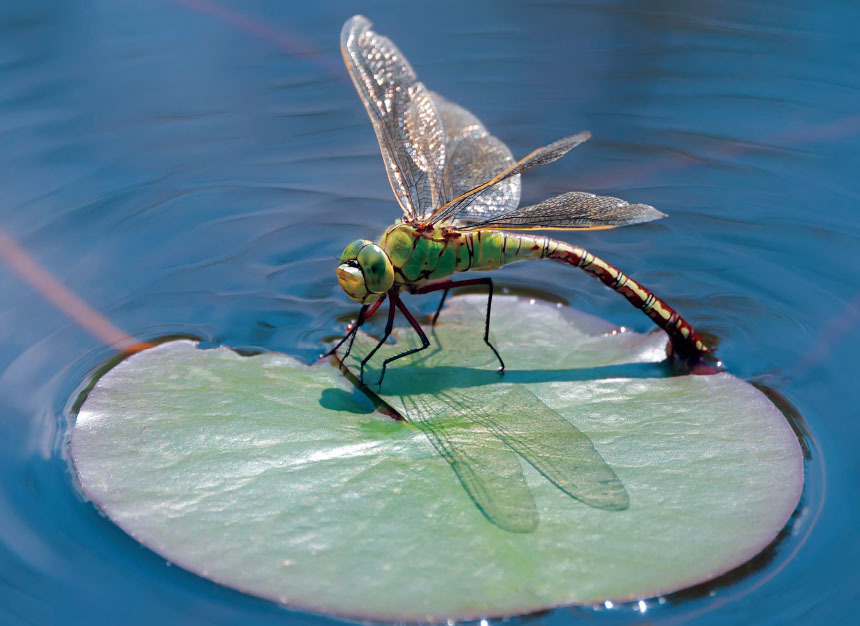
For dragonflies, a pond is not only a nursery. It is also a meeting place for courtship and mating.
6. Ponds Create a Helpful Microclimate
Dragonflies are active in warm, sunny conditions. Pond edges often provide exactly the kind of microclimate they need.
Sunlit stones, reeds, logs, and bare branches give dragonflies places to perch and warm up. Shaded vegetation offers cooler resting areas. Water also helps moderate humidity and temperature around the shoreline.
This mix of sun, moisture, shelter, and open air makes ponds especially attractive during warm months.
The Dragonfly Life Cycle in a Pond
A dragonfly’s pond life usually follows a pattern like this:
- Adult males patrol the pond.
They defend territories over open water, near vegetation, or along the shoreline. - Females arrive to mate and lay eggs.
Eggs may be placed in water, aquatic plants, mud, or wet plant material. - Eggs hatch into aquatic nymphs.
These young dragonflies live underwater and look very different from adults. - Nymphs hunt and grow.
They feed on aquatic prey and molt several times as they develop. - Mature nymphs climb out of the water.
They use emergent plants, rocks, logs, or pond banks as emergence surfaces. - Adults emerge and fly away.
After their wings harden, they begin hunting, mating, and eventually returning to water to continue the cycle.
This is why a healthy pond can support dragonflies year after year. The adults you see flying over the water may have started life in that same pond months or years earlier.
Do All Dragonflies Need Ponds?
Not all dragonflies depend specifically on ponds, but almost all dragonflies are tied to freshwater in some way.
Some species prefer ponds and small lakes. Others are more common around streams, rivers, marshes, wetlands, canals, or temporary pools. The exact habitat depends on the species. Some like still water with floating plants. Others prefer flowing water, sandy bottoms, shaded streams, or open marshes.
So the better answer is: dragonflies need freshwater habitats, and ponds are one of the most common and important places where people notice them.
If you see dragonflies around a pond, that usually means the pond is offering at least some of the resources they need.
Are Dragonflies a Sign of a Healthy Pond?
Dragonflies can be a good sign, especially when you see a variety of species and regular activity around the pond. Their presence suggests the pond may have enough prey, vegetation, and suitable water conditions to support part of their life cycle.
However, one or two adult dragonflies flying past does not prove the pond is perfectly healthy. Adults are mobile and may travel from nearby wetlands or water bodies. Nymphs are a stronger sign that the pond is actually supporting dragonfly development.
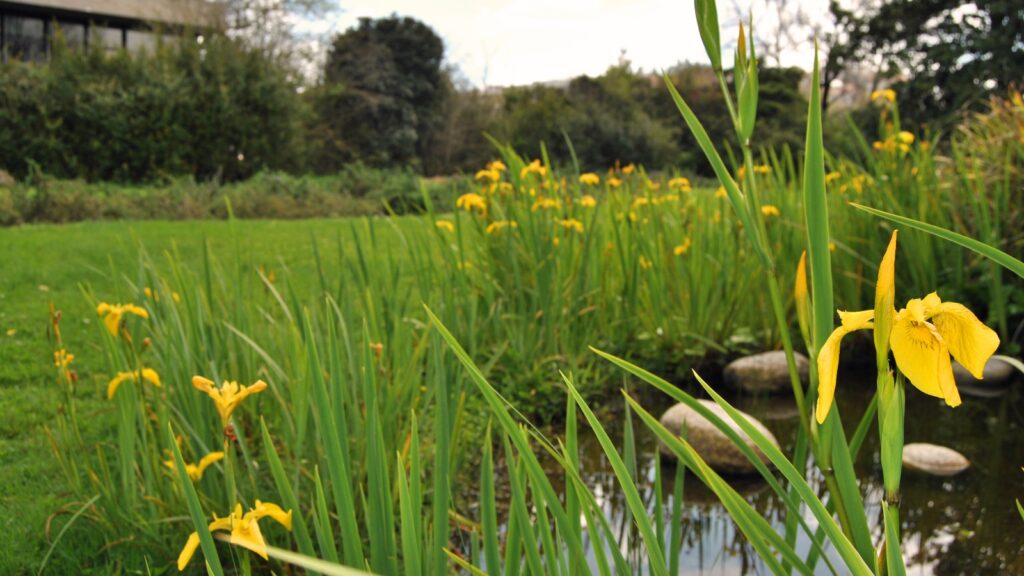
Water quality matters. Research on pond and wetland systems has found that dragonfly communities can be affected by water pollution, including elevated chloride and metals in some stormwater ponds. Conservation guidance also treats odonates — the insect order that includes dragonflies and damselflies — as useful indicators of aquatic habitat condition and biodiversity.
In simple terms, a pond with clean water, native plants, limited chemical runoff, and varied edges is much more likely to support dragonflies than a polluted, overmanaged, or fish-heavy pond.
How to Make a Pond More Dragonfly-Friendly
If you have a garden pond, wildlife pond, or small natural water feature, you can make it more attractive to dragonflies by focusing on habitat rather than decoration alone.
Add Native Pond and Shoreline Plants
Dragonflies need plants for egg-laying, shelter, hunting, and emergence. Native marginal plants, reeds, rushes, sedges, and floating-leaved plants can all help create structure around the pond.
Avoid turning the entire edge into bare stone or concrete. A natural-looking margin with different plant heights is much more useful for dragonflies.
Provide Emergence Surfaces
Mature nymphs need something to climb when they leave the water. Plant stems, sticks, rocks, logs, and sloped banks can all work.
This is especially important because the emergence stage is delicate. If a nymph cannot climb out safely, it may fail to become an adult.
Keep the Water Clean
Avoid pesticides, herbicides, and chemical runoff near the pond. These can harm aquatic insects and disrupt the pond food web.
A slightly “wild” pond is often better for dragonflies than a perfectly polished one. Some leaf litter, submerged stems, and marginal vegetation can provide cover for nymphs and other small pond life.
Be Careful With Fish
Fish may eat dragonfly nymphs, especially in small ponds. Large ornamental fish such as koi can make it harder for dragonfly larvae to survive.
This does not mean a pond with fish can never attract dragonflies, but a wildlife pond with fewer fish, shallow plant-filled edges, and hiding places will usually be more favorable.
Leave Sunny Perches
Adult dragonflies like to perch in sunny spots. A few exposed stems, branches, stones, or wooden edges near the pond can give them places to rest and watch for prey.
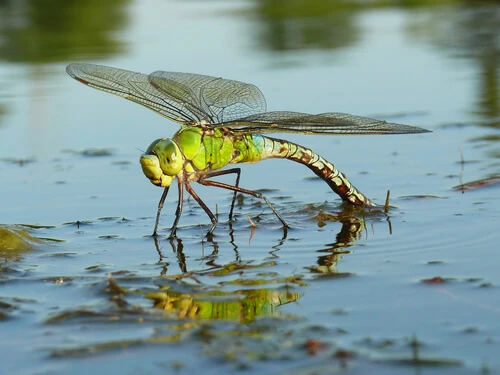
A dragonfly-friendly pond does not need to look messy. It just needs structure: clean water, plants, shelter, sun, and safe edges.
Dragonflies vs. Damselflies Around Ponds
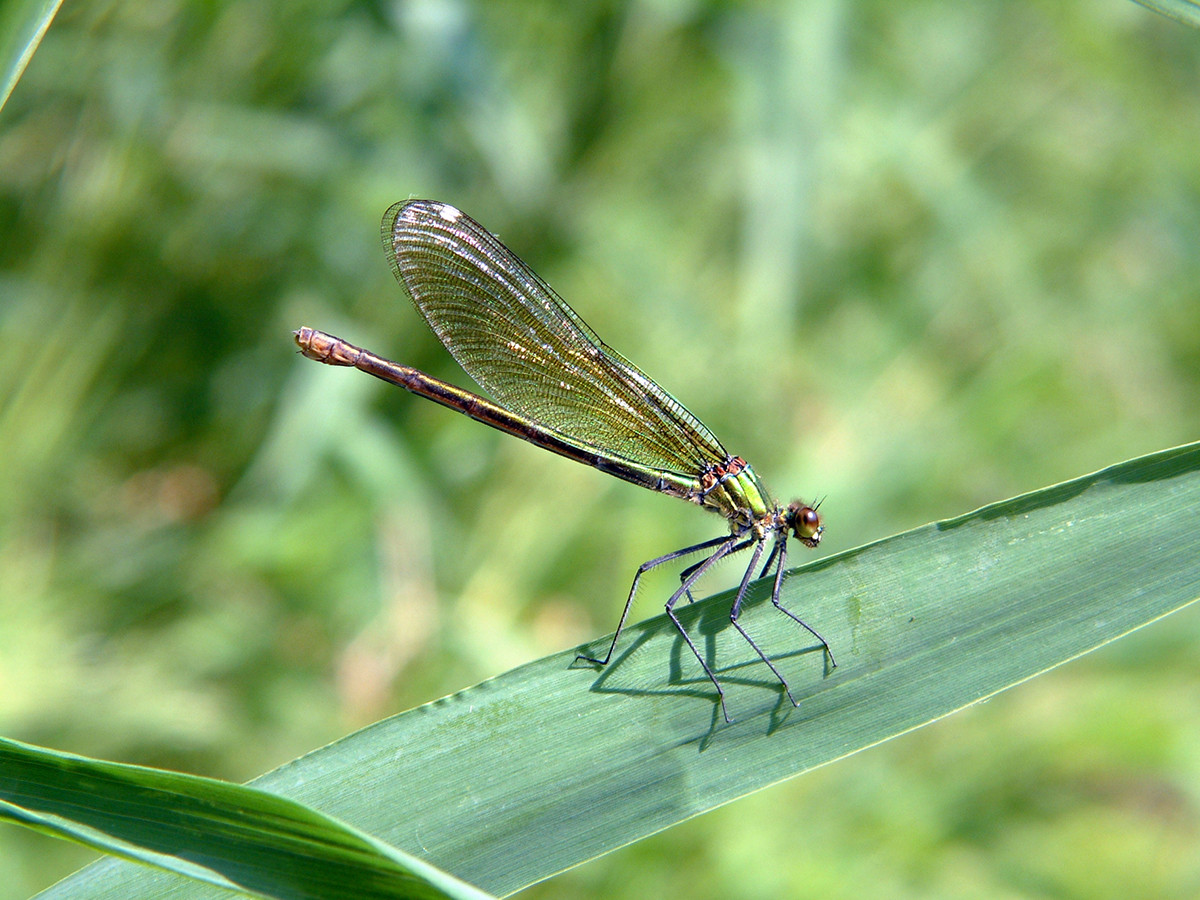
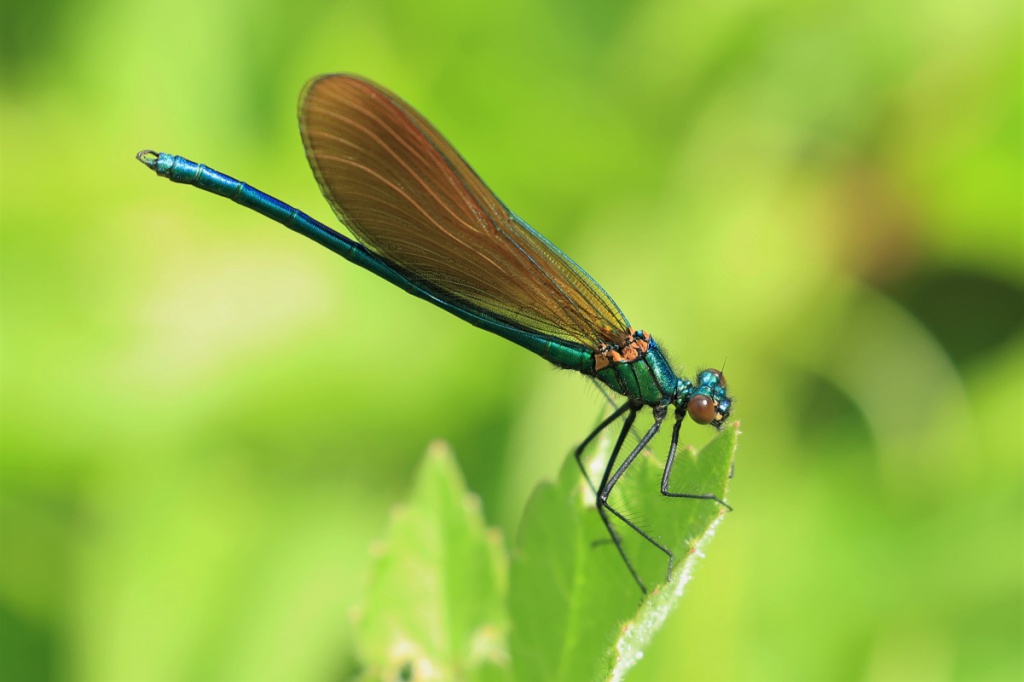
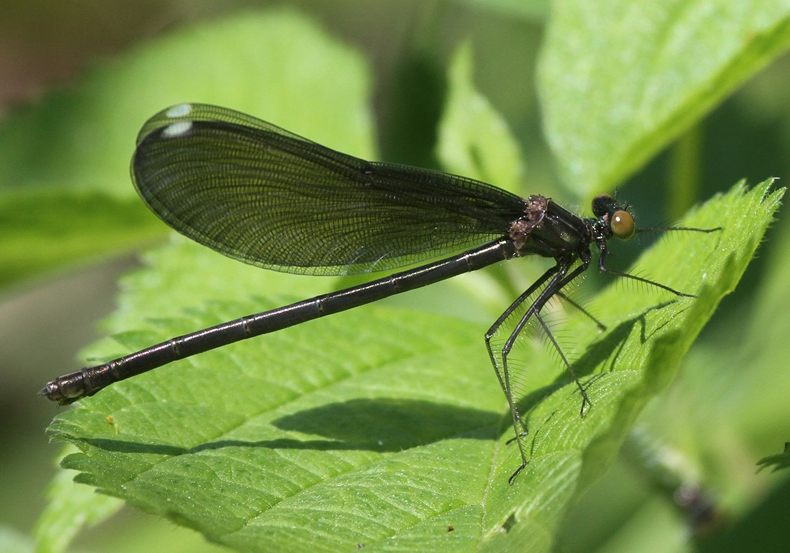
When you see a slim, delicate insect near a pond, it may not always be a dragonfly. It could be a damselfly.
Dragonflies and damselflies are close relatives, and both belong to the order Odonata. The easiest way to tell them apart is often their resting posture:
- Dragonflies usually rest with their wings held open, like airplane wings.
- Damselflies usually rest with their wings folded together over the body.
Dragonflies also tend to look stronger and more robust, while damselflies are often slimmer and more delicate. Both are common around freshwater habitats and both have aquatic young.
Final Thoughts: Why Ponds Matter to Dragonflies
Dragonflies live near ponds because ponds give them what they need at almost every stage of life. Adults use ponds for hunting, mating, territory, and egg-laying. Their nymphs live underwater, feeding and growing among plants, mud, rocks, and sheltered pond edges. When the time comes, those nymphs climb out of the water and emerge as adults.
So the next time you see a dragonfly skimming across a pond, it is not just passing through. It may be patrolling a territory, searching for prey, looking for a mate, or returning to the same kind of watery habitat where its own life began.
A pond with clean water, native plants, natural edges, and fewer disturbances can become much more than a backyard feature. It can become a small but valuable home for dragonflies and many other forms of pond life.
FAQ
Do dragonflies live near ponds?
Yes. Many dragonflies live near ponds, especially as adults during hunting, mating, and egg-laying. Their young, called nymphs or naiads, live underwater before emerging as flying adults.
Why do dragonflies stay close to water?
Dragonflies stay close to water because they need freshwater habitats for reproduction. Females lay eggs in or near water, and the larvae develop underwater.
Do dragonflies lay eggs in ponds?
Yes. Many dragonflies lay eggs directly in pond water, on aquatic plants, in mud, or near the water’s edge. The exact method depends on the species.
Do dragonfly larvae live in ponds?
Yes. Dragonfly larvae, also called nymphs or naiads, live underwater in ponds, lakes, streams, and other freshwater habitats. They are predators and feed on small aquatic animals.
Are dragonflies good for a pond?
Yes. Dragonflies are beneficial pond predators. Adults eat flying insects such as mosquitoes and midges, while nymphs feed on aquatic prey. Their presence can also suggest that a pond has useful habitat structure and reasonably good ecological conditions.
How can I attract dragonflies to my pond?
To attract dragonflies, provide clean water, native aquatic and marginal plants, sunny perches, shallow edges, and places for nymphs to hide and emerge. Avoid pesticides and be cautious with large fish, which may eat dragonfly nymphs.
Do dragonflies mean there are mosquitoes?
Not necessarily. Dragonflies often appear where flying insects are available, and mosquitoes may be part of their diet. However, dragonflies alone will not guarantee a mosquito-free yard.
What is the difference between dragonflies and damselflies?
Dragonflies usually rest with their wings spread open, while damselflies often rest with their wings folded together over the body. Dragonflies are also usually larger and more powerful fliers.