Dragonfly Habitat: Where Dragonflies Live
Dragonflies occur on every continent except Antarctica, but breeding species depend on suitable aquatic or semi-aquatic habitats. Their eggs and nymphs develop in water or saturated wetland environments, while adults may hunt, mature, migrate and roost well away from the water where they emerged.
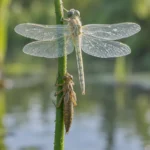
The most important distinction: seeing an adult dragonfly shows that the insect has reached that location. It does not, by itself, prove that the nearest pond or stream supports successful breeding. Larvae and especially shed larval skins, called exuviae, provide stronger evidence that dragonflies developed locally.
Where Do Dragonflies Live?
Dragonflies are found across tropical, temperate and some subarctic regions. They occur around natural wetlands and around many human-made water bodies, but their distribution is not determined by water alone. Climate, elevation, seasonal temperature, water chemistry, habitat history and the ability of adults to reach a site all affect which species occur there.
A landscape may contain numerous ponds yet support few dragonflies if the climate is too cold, the water dries at the wrong time, the shoreline offers no safe emergence sites or the water conditions do not suit local species. Conversely, a drainage channel, reservoir or newly created pond may be colonized by adaptable species when it provides suitable conditions.
Why Dragonflies Need Water
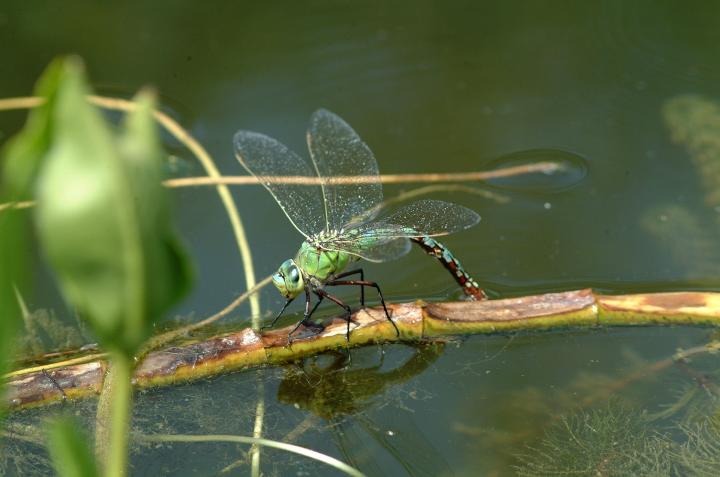
Dragonflies do not pass through a caterpillar-like or pupal stage. Their basic life cycle consists of egg, aquatic nymph and adult. Depending on the species, eggs may be released into water, inserted into aquatic plants, placed in wet mud or deposited where later flooding will immerse them.
After hatching, the nymph feeds and grows underwater. Most dragonfly nymphs are fully aquatic. A small number of specialized lineages occupy saturated seepages or other semi-terrestrial wetland conditions, but these are exceptions rather than the normal dragonfly life cycle.
When development is complete, the nymph leaves the water and attaches itself to a stem, root, rock, bank, tree trunk or another stable surface. The adult emerges from the larval skin, expands its wings and eventually flies away. Read the complete sequence in the dragonfly life cycle guide.
Life-Cycle Stage and Habitat
| Stage or activity | Typical habitat | Why it is needed | Important qualification |
|---|---|---|---|
| Egg | Water, aquatic vegetation, saturated mud or seasonally flooded material | Provides the moisture and conditions needed for embryonic development | Egg-laying method and resistance to drying vary greatly among species |
| Nymph | Pond, lake, marsh, river, stream, seep, temporary pool or another suitable wet habitat | Provides prey, shelter, oxygen and space for growth | No single water depth, flow speed or chemistry suits every species |
| Emergence | Stems, reeds, roots, rocks, banks, woody debris or other surfaces above water | Allows the final-stage nymph to leave the water and the adult to expand its wings | The surface must remain accessible and reasonably stable during emergence |
| Immature adult | Meadows, woodland edges, scrub, hedges, clearings and other prey-rich areas | Provides food and shelter while the adult matures | Immature adults may be difficult to associate with their original water body |
| Breeding adult | Suitable water and its margins | Provides meeting, mating and egg-laying habitat | Territorial behavior differs by species, sex and population density |
| Roosting and shelter | Grass, reeds, shrubs, trees, woodland or sheltered banks | Reduces exposure to wind, rain, heat and predators | Roosting sites may be beside water or some distance away |
| Dispersal or migration | Open countryside, coasts, ridges, roadsides, fields and broad landscape corridors | Allows movement between habitats or over long seasonal routes | A passing adult does not demonstrate local reproduction |
Where Eggs and Nymphs Develop
A dragonfly breeding habitat must support more than the brief visit of an egg-laying female. The water or saturated substrate must remain suitable long enough for eggs to hatch and nymphs to grow. Depending on the species, development may require permanent water, predictable seasonal flooding or a temporary pool that dries only after development has reached a drought-resistant stage.
Nymphs occupy different positions within a water body. Some hide among submerged plants or roots. Others bury partly in sand, silt or leaf litter. Some cling to stones, woody material or vegetation in flowing water. These differences help explain why two nearby water bodies can support very different dragonfly communities.
For a closer look at underwater behavior, feeding and identification, visit the dragonfly larvae guide.
A flying or perched adult is evidence of adult presence only. Courtship or egg-laying suggests that a site is being investigated or used, but it still does not prove successful development. A dragonfly nymph confirms larval use. An exuvia—the empty skin left after emergence—is stronger evidence that a nymph completed its aquatic development and emerged at that site.
Standing-Water Habitats
Ponds and small lakes
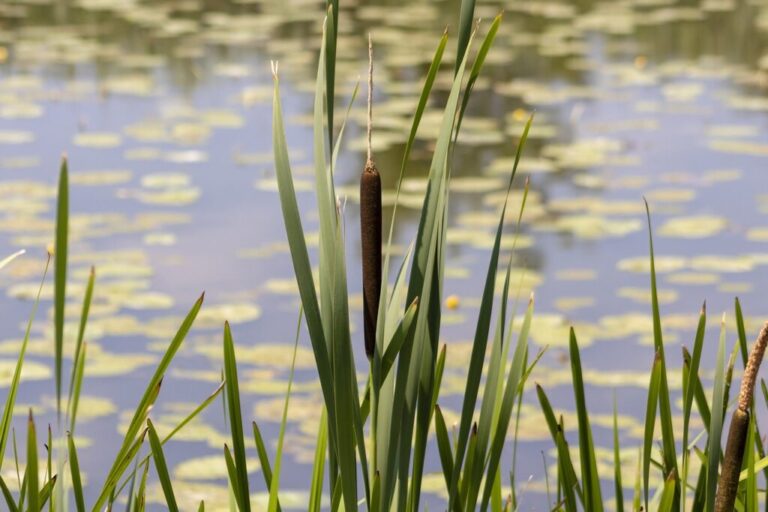
Ponds are among the most familiar dragonfly habitats. Shallow margins can warm quickly and may support submerged, floating and emergent plants. Open water provides flight space, while reeds, rushes, sedges, roots, stones and woody material can provide shelter or emergence surfaces.
This does not mean every pond supports dragonflies or that all pond species need dense vegetation. Some prefer extensive plant growth; others use more open shorelines or sparsely vegetated water. Pond depth, drying pattern, fish abundance, shading and water chemistry all influence the result. The separate guide to why dragonflies are often seen near ponds covers pond-specific behavior in greater detail.
Large lakes and reservoirs
Dragonfly activity on a large lake is often concentrated around sheltered bays, warm shallow edges, wetlands connected to the lake and areas where aquatic plants can grow. Deep open water may provide relatively little larval habitat for many species. Wave exposure and steep, unvegetated shores can also reduce safe emergence opportunities, although the requirements of lake-associated species differ.
Marshes and swamps
Marshes, swamps and seasonally flooded wetlands may offer complex mosaics of shallow water, open pools, sedges, reeds, shrubs and wet soil. Some species depend on these mosaics rather than on a clearly defined pond. Water depth and plant cover can change through the year, creating habitat for species adapted to seasonal variation.
Fens, bogs and peatland pools
Fens and bogs can support specialized communities associated with cool water, acidic or mineral-rich conditions, peat, mosses, sedges, seepages and small pools. “Wetland” is therefore not a single habitat category. A species adapted to an acidic bog pool may not occur in a nutrient-rich lowland pond, even when both appear suitable to a casual observer.
Flowing-Water Habitats
Slow rivers, canals and drainage channels
Slow-flowing rivers and canals may resemble long ponds in sheltered sections, especially where they contain backwaters, shallow margins and aquatic vegetation. Some species use these low-current habitats, while others require a gentle but continuous flow. Dredging, abrupt water-level changes, heavy boat wash and removal of all bankside vegetation can alter the habitat.
Fast-flowing streams and rivers
Species associated with faster water may depend on current, oxygenated conditions and particular combinations of stones, gravel, sand, silt, roots or submerged debris. Larvae must be able to avoid being swept away while still obtaining oxygen and prey. The best habitat is not always the fastest or clearest section; pools, riffles, shaded reaches and open margins can support different species.
Springs and seeps
Springs, hillside seepages and small headwater channels can provide cool, continuously wet habitat. Some specialized dragonflies occupy narrow spring-fed streams or saturated banks that would be overlooked during a survey focused only on ponds and lakes. Because these habitats are small, changes to water extraction, trampling, shading or flow can have disproportionate effects.
Temporary and Specialized Habitats
Temporary pools and seasonally flooded wetlands
Temporary water is not automatically unsuitable. Some dragonflies have eggs or rapid larval development adapted to predictable drying cycles. Fish may be absent from these pools, reducing one source of predation. However, a temporary pool that dries too early, fills at the wrong season or loses its natural flooding pattern may fail to support the same species.
Brackish and mildly saline water
Most dragonflies are freshwater insects, and they are not marine animals. Nevertheless, limited salinity tolerance has been recorded in some species, and some coastal wetlands or lagoons support specialized or tolerant dragonfly communities. This should not be generalized into a claim that dragonflies can breed in seawater. Salinity tolerance depends on the species, life stage, concentration and duration of exposure.
Tree holes and other plant-held water
Water-filled tree holes and other phytotelmata are exceptional dragonfly habitats, not a normal alternative to ponds. Research from the Western Ghats has documented the true dragonfly Lyriothemis tricolor using tree holes in evergreen and semi-evergreen forest as larval habitat. Such specialized examples should not be used to describe the needs of common pond or stream dragonflies.
How Major Water Habitats Differ
| Habitat type | Potential features | Possible limitations | Species-level caution |
|---|---|---|---|
| Pond | Shallow margins, warm water, plants, open flight space | Early drying, excessive shading, steep banks or heavy fish stocking | Some pond species prefer open water; others need dense structural cover |
| Lake or reservoir | Sheltered bays, broad shorelines, connected marshes | Deep water, waves and limited shallow edge habitat | Larval habitat may be concentrated in a small part of the shoreline |
| Marsh or swamp | Shallow water, wet soils, varied vegetation and seasonal pools | Drainage, infilling, altered flooding or vegetation loss | Species may depend on a particular stage of wetland succession |
| Bog or fen | Peat, moss, sedges, pools, seepage and distinctive chemistry | Drying, nutrient enrichment, peat damage or hydrological change | Acidic-bog and mineral-rich-fen specialists are not interchangeable |
| Slow river or canal | Gentle current, marginal plants, backwaters and silt | Dredging, pollution, hard banks or unstable water levels | Some species need flow even when the water appears almost still |
| Fast stream | Current, oxygen, stones, gravel, roots and woody material | Sedimentation, channel engineering or removal of bank structure | Different stream species occupy different current and substrate zones |
| Temporary pool | Warm shallow water and often few or no fish | Unpredictable filling or drying before development is complete | Only species with suitable life-cycle adaptations can use it reliably |
| Spring or seep | Persistent moisture, cool water and small headwater channels | Water extraction, trampling, flow alteration or complete shading | Some occupants have extremely restricted habitat requirements |
| Brackish wetland | Coastal pools, lagoons or mildly saline seasonal water | High or rapidly changing salinity | Salt tolerance is documented for only some species and conditions |
Where Adult Dragonflies Go Away From Water
Adults use a much larger landscape than their aquatic nymphs. Newly emerged dragonflies often leave the immediate shoreline while their bodies harden and they become sexually mature. Prey-rich meadows, forest edges, hedges, clearings, gardens, roadsides and sheltered slopes may provide feeding areas.
Mature adults may return to water to find mates and lay eggs, but their behavior is not uniform. Males of some species defend small territories; others patrol long stretches of shoreline or search without holding a fixed territory. Females may visit water briefly, remain nearby or feed elsewhere between reproductive visits. Nonterritorial males can also occur away from the breeding site.
Trees, shrubs, tall grasses and reeds can provide shelter from wind, rain and extreme heat. Adults may roost in dense vegetation at night or during unsuitable weather. Migratory and dispersing dragonflies can cross farmland, cities, ridges, islands and coastlines far from any visible breeding water.
What Makes a Good Breeding Habitat?
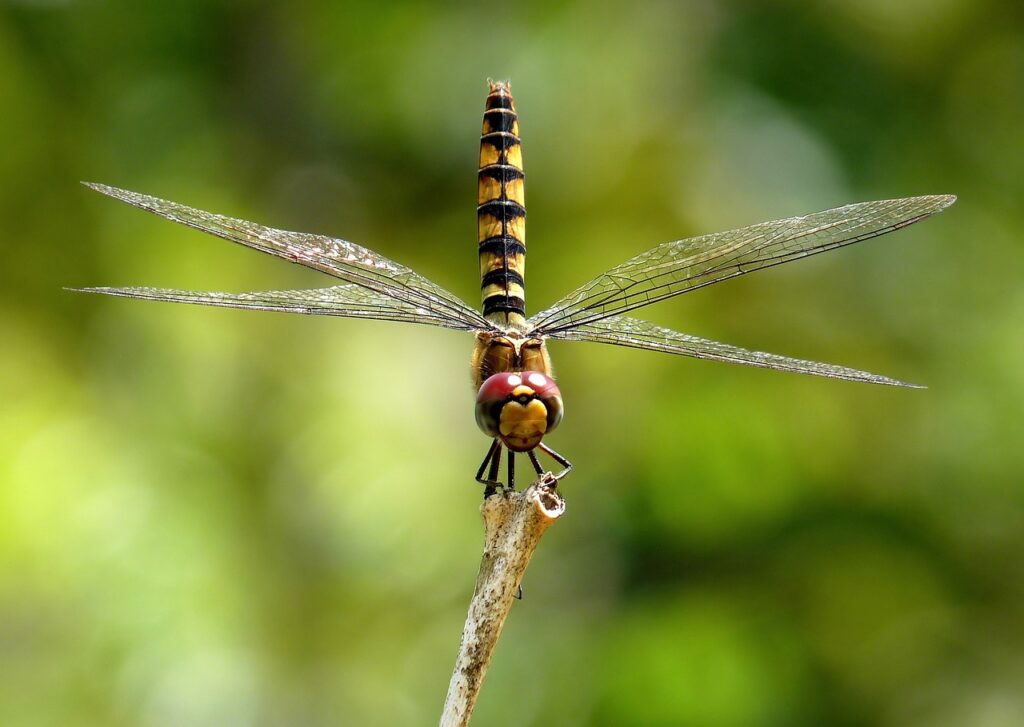
There is no universal checklist that defines good habitat for every dragonfly. Habitat quality must be judged for the species and life stage being studied. Important variables can include:
- Flow: still, gently moving or fast-flowing water.
- Water duration: permanent, seasonal or predictably temporary.
- Temperature: warm lowland water, cool upland water or stable spring water.
- Depth: shallow margins, deeper pools or a mixture of depth zones.
- Substrate: rock, gravel, sand, silt, peat, leaf litter, roots or woody debris.
- Dissolved oxygen: influenced by flow, temperature, decomposition and plant growth.
- Aquatic plants: submerged, floating and emergent structures used differently by different species.
- Bank vegetation: shade, shelter, perches, prey habitat and emergence surfaces.
- Water chemistry: acidity, alkalinity, nutrients, salinity and contaminants.
- Predators: fish, amphibians, aquatic insects and other predators.
- Landscape context: nearby woodland, meadow, scrub, connected wetlands and dispersal routes.
Conditions that may favor some species
- Sunny, warm and well-vegetated pond margins
- Fishless temporary pools
- Open, gently flowing channels
- Acidic peatland pools
- Cool, shaded forest streams
Why none is a universal rule
- Heavy shade excludes some species but benefits others
- Fish reduce some larvae but coexist with fish-adapted species
- Dense vegetation can provide shelter or close open-water habitat
- Temporary drying can be harmful or part of a species’ normal cycle
- Warm water favors some species while cool-water specialists decline
Do Dragonflies Require Clean Water?
“Dragonflies need clean water” is useful only as a simplified introduction. Some species are sensitive to pollution, excess nutrients, sediment, low oxygen or altered flow. Their decline can reveal ecological change. Other widespread species tolerate moderate disturbance and may reproduce in reservoirs, drainage channels, farm ponds, urban ponds or former extraction sites.
A single dragonfly therefore cannot certify that water is unpolluted. Ecological assessment requires identification of the species present, knowledge of their tolerance, records of larvae or exuviae, repeated surveys and measurements appropriate to the water body. A diverse specialist community may provide more information than one mobile generalist adult.
Dragonflies can be valuable bioindicators when they are part of a standardized survey. They should not be treated as a one-insect water-quality test.
How Habitat Needs Differ by Species
Dragonfly habitat selection reflects adaptations accumulated over many generations. A stream larva may have a flattened or clinging body suited to current. A burrowing larva may depend on sand or fine sediment. A temporary-pool species may survive a dry period as an egg, while a species with slower aquatic development may require water that remains present for several seasons.
Sunlight also has different effects. Open sunny water can warm rapidly and support active adults, but shaded forest streams may remain cooler and retain moisture. Vegetated margins can provide emergence surfaces and shelter, yet excessive plant growth or tree encroachment can remove open water required by another species.
Fish-containing and fishless waters can support different communities. Fish may consume dragonfly larvae, but some larvae use vegetation, sediment, defensive spines or behavior that reduces predation. It is therefore inaccurate to state that every pond must be fishless, although adding large numbers of ornamental fish can reduce habitat value for many pond invertebrates.
Dragonflies in Garden Ponds
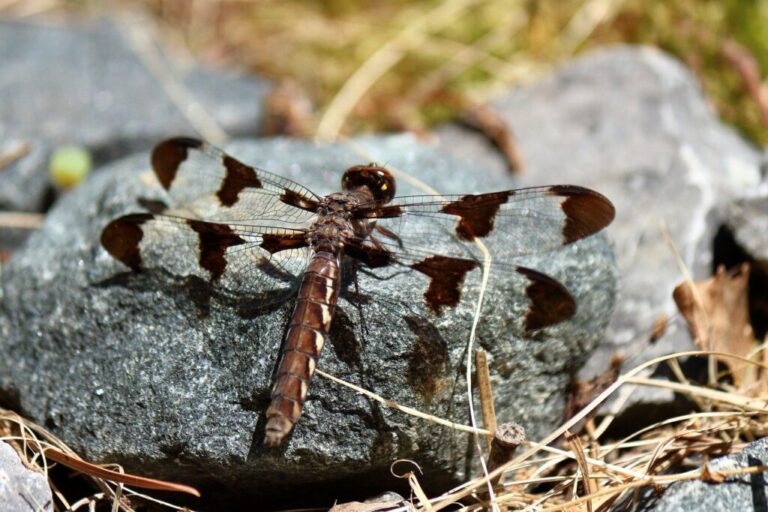
A backyard pond may be discovered by local dragonflies, but no design can guarantee a particular species. The most appropriate pond also depends on regional climate, native plants and nearby populations.
- Provide at least one gently sloping or shallow margin rather than steep sides everywhere.
- Include a mixture of open water and locally appropriate aquatic or marginal plants.
- Leave stems, rocks or other stable surfaces that nymphs can climb during emergence.
- Avoid introducing non-native invasive plants or releasing animals collected from natural wetlands.
- Do not overstock the pond with ornamental fish when wildlife habitat is the priority.
- Reduce unnecessary pesticide and fertilizer runoff entering the water.
- Retain nearby grasses, shrubs or other sheltered terrestrial vegetation where practical.
- Allow time for natural colonization instead of transferring dragonfly eggs or larvae.
Pond construction and maintenance should also protect children and pets and comply with local rules. A small pond can contribute habitat, but it does not replace natural marshes, streams, peatlands or larger wetland networks.
Major Habitat Threats
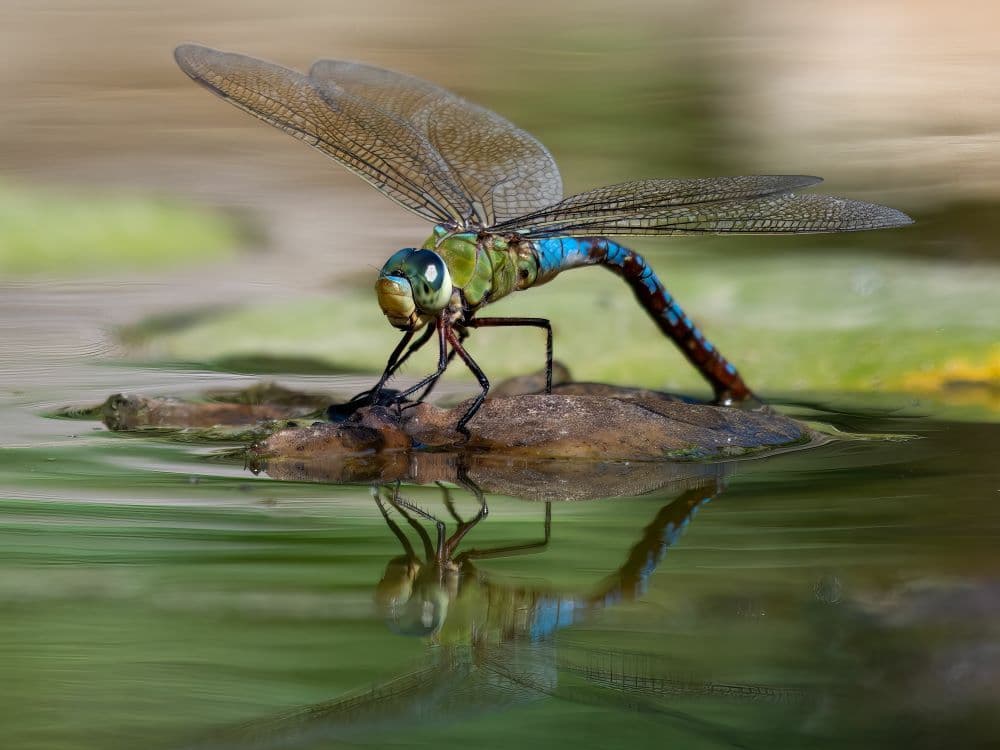
The 2021 global IUCN assessment identified the loss and degradation of marshes, swamps and free-flowing rivers as major drivers of dragonfly and damselfly decline. Important pressures differ among regions and species but include:
- Drainage, infilling and conversion of wetlands
- Dams, channelization and other changes to natural flow
- Groundwater extraction and loss of springs or seepages
- Pollution, nutrient enrichment and oxygen depletion
- Sedimentation that buries suitable stream or lake substrates
- Removal of all marginal, riparian or emergence vegetation
- Invasive plants, invasive predators or unnaturally high fish densities
- Climate-driven changes in temperature, drought, flooding and salinity
- Fragmentation between aquatic breeding sites and terrestrial adult habitat
Management should be based on the species and habitat already present. Clearing all vegetation, deepening every pool, removing all shade or permanently stabilizing naturally temporary water can damage the specialists that a project is intended to protect.
How to Observe Habitat Without Disturbance
- Watch from established paths or firm ground rather than trampling soft banks and marsh vegetation.
- Photograph adults from a distance and avoid repeatedly flushing resting or newly emerged individuals.
- Look carefully for empty exuviae on stems, bridge supports, rocks and banks without removing living larvae.
- Do not pull apart moss, submerged vegetation or woody debris simply to search for nymphs.
- Record the date, weather, water type, vegetation and observed behavior instead of recording only “dragonfly present.”
- Follow local rules before collecting specimens or entering protected wetlands.
Dragonfly activity changes with season, temperature and weather. The guide to when dragonflies are most active explains how to choose suitable observation times.
Frequently Asked Questions
Do dragonflies live only near water?
No. Their eggs and nymphs depend on aquatic or saturated wetland habitat, so breeding populations are linked to water. Adults may travel far from water to feed, mature, rest, disperse or migrate.
Can dragonflies live in saltwater?
Dragonflies are primarily freshwater insects and do not normally breed in the open sea. Some species can tolerate brackish or mildly saline wetlands, but salt tolerance is species- and life-stage-specific.
Do dragonflies live in forests?
Yes. Adults may feed and roost in woodland, forest edges and clearings. Some species breed in shaded forest streams, seepages or swamps, and a few specialized tropical species use water-filled tree holes.
Where do dragonflies sleep?
“Sleep” is an informal description, but inactive dragonflies commonly roost on grasses, reeds, shrubs or trees. They often choose sheltered vegetation where they are less exposed to wind, rain and predators.
Where do dragonflies go in winter?
The answer depends on the species and climate. Many temperate species overwinter as eggs or aquatic nymphs. Some migrate to warmer regions, while a smaller number can survive winter as adults. There is no single winter habitat used by all dragonflies.
Can dragonflies live in a backyard pond?
A backyard pond can support dragonflies when its water duration, margins, plants, predators and surrounding landscape suit species found in the region. A pond may attract visiting adults without supporting successful larval development.
Does seeing dragonflies mean the water is clean?
Not by itself. Some species are sensitive to ecological degradation, while others tolerate disturbed or artificial habitats. Reliable assessment requires species identification, repeated observations, larval or exuvial evidence and standardized environmental measurements.
Why are dragonflies far away from water?
They may be hunting where flying insects are abundant, maturing after emergence, seeking shelter, moving between breeding sites or undertaking seasonal migration. The nearest visible water body may not be where the adult developed.
Sources and Further Reading
- Smithsonian Gardens — Dragonflies
- British Dragonfly Society — Managing Habitats for Dragonflies
- British Dragonfly Society — Garden and Habitat Management Resources
- IUCN — Dragonflies Threatened as Wetlands Around the World Disappear, 2021
- Nagy et al. — Landscape-Scale Terrestrial Factors Are Also Vital in Shaping Odonata Assemblages of Watercourses
- Vilenica et al. — How Suitable Are Man-Made Water Bodies as Habitats for Odonata?
- Raebel et al. — The Dragonfly Delusion: Why It Is Essential to Sample Exuviae to Avoid Biased Surveys
- Remsburg and Turner — Aquatic and Terrestrial Drivers of Dragonfly Assemblages at Prairie Wetlands
- Hogreve and Suhling — Development of Two Sympetrum Species in Brackish Water
- Das et al. — Larval Use of Tree Holes by Lyriothemis tricolor