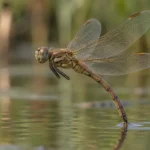
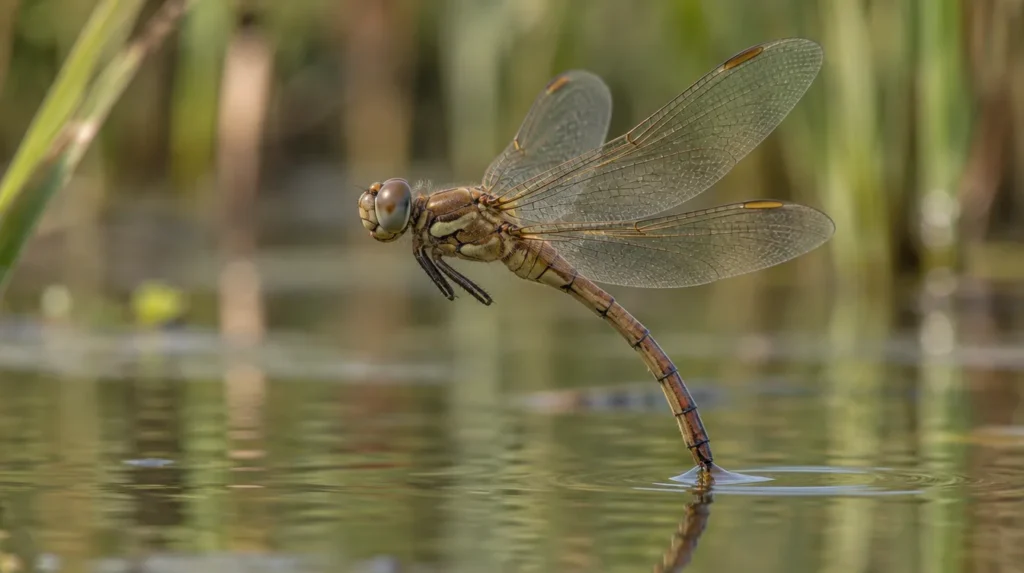
Dragonflies usually dip their tails in water to lay eggs. A female touches the tip of her abdomen—the body section often called the tail—to the surface and releases eggs into the water. This behavior is called oviposition, and it is common among many skimmers, chasers and darters.
Watch a pond for a few minutes and you may see a dragonfly repeat the same movement: hover, tap the water, rise, then tap again somewhere else. Those small touches can be the beginning of another generation of dragonflies.
What Happens When a Dragonfly Taps the Water?
In dragonflies that lay eggs this way, the female releases eggs from an opening near the end of her abdomen. Contact with the water helps transfer them into the aquatic habitat.
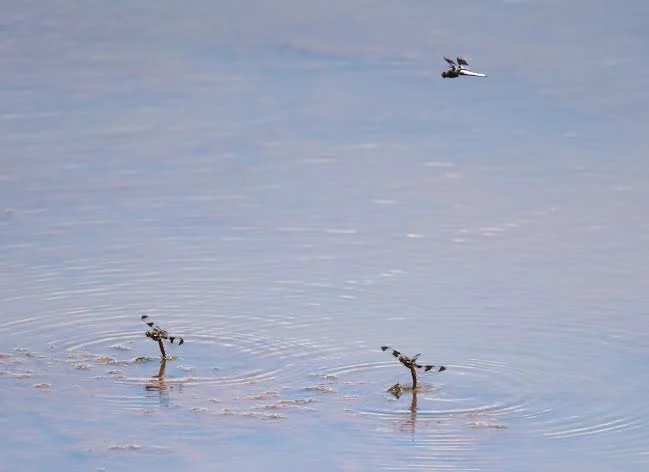
This is called exophytic egg-laying: eggs are deposited outside plant tissue. Some have a gelatinous covering that helps them attach to submerged vegetation or other surfaces.
The movement can be surprisingly forceful. The U.S. National Park Service describes female Common Whitetails striking the surface hard enough to scatter droplets. A splash, by itself, does not mean the insect has lost control.
Repeated dips allow a female to deposit eggs in successive releases. She may also move between laying sites. In a study of Black Saddlebags (Tramea lacerata) at an Illinois pond, researchers observed pairs distributing egg-laying locations around the pond. That finding describes one species and study site; other dragonflies use different patterns.
How Can You Recognize Egg-Laying?
Watch which part of the insect touches the water and what happens next.
| What you see | What it can tell you |
|---|---|
| The abdomen tip repeatedly taps the surface while the dragonfly remains airborne | A characteristic pattern of egg-laying in many dragonflies |
| Small splashes followed by controlled flight | Compatible with egg-laying, including the vigorous strikes of Common Whitetails |
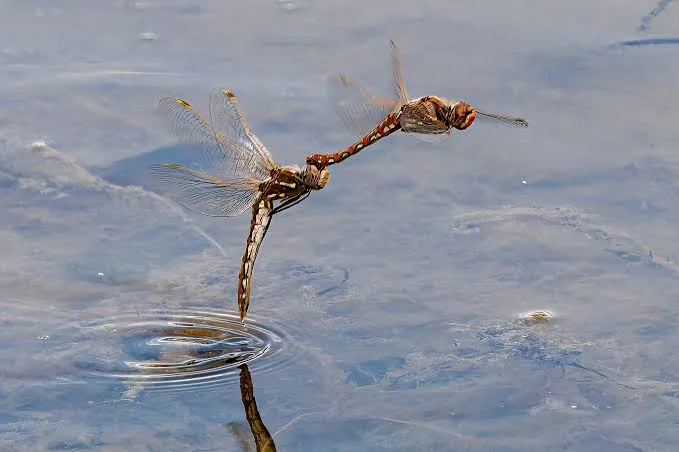
| Two dragonflies fly attached while the rear insect reaches toward the water | The female may be laying eggs while the male remains attached |
| A dragonfly rests on vegetation and works its abdomen against a stem | It may be inserting eggs into plant tissue |
| The mouthparts touch the water | Drinking is a possibility; this is a different contact point from releasing eggs |
A single photograph may not show enough to identify the behavior. A short video can reveal whether the insect repeatedly taps with its abdomen, contacts the water with its mouthparts, or remains on a plant.
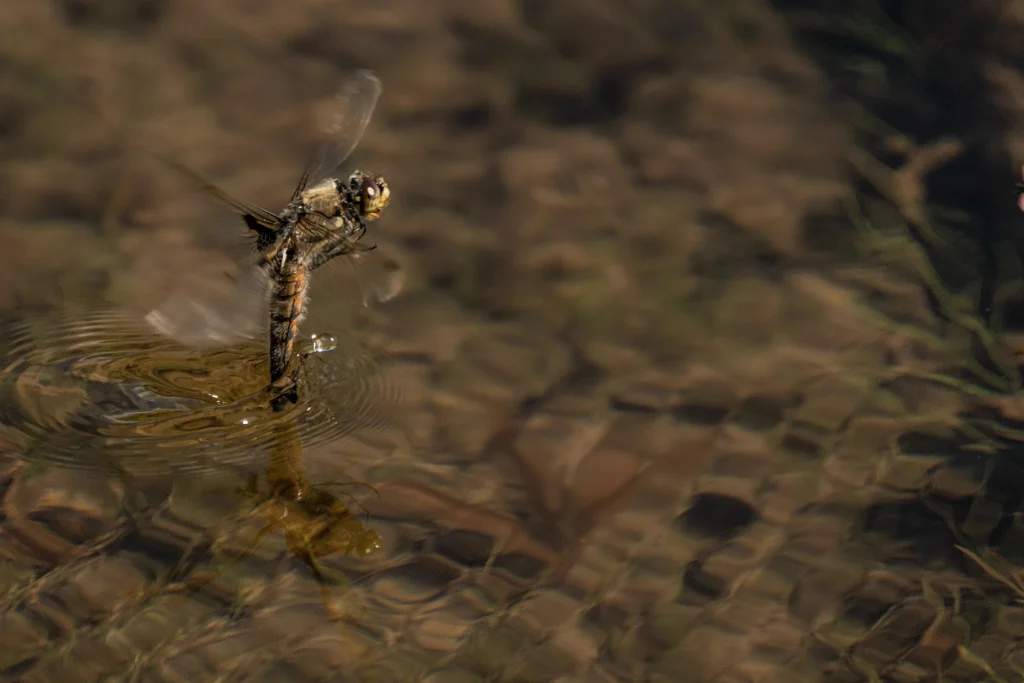
Use the whole sequence as evidence. One low pass over a pond does not establish that eggs were released.
Why Are Two Dragonflies Sometimes Attached?
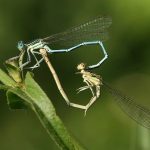
The attached pair is usually a male and female in tandem. The male uses appendages at the end of his abdomen to hold the female behind her head.
Depending on the species, he may remain attached during egg-laying or release her and fly nearby. This is a form of mate guarding that can reduce interference from competing males and improve his chances of fathering the offspring.
The female is the one producing and depositing the eggs. A male accompanying her is not laying eggs through his own abdomen.
Black Saddlebags provide an interesting variation. Researchers observed males releasing females for a dip, then reconnecting before the pair moved on. In Common Green Darners (Anax junius), the pair can settle together on vegetation while the female inserts eggs into plant material.
These are examples of different reproductive behaviors, rather than one routine followed by every dragonfly.
Do All Dragonflies Lay Eggs by Dipping?
No. Egg-laying methods vary among groups and species.
Many skimmers, chasers and darters release eggs directly into water. Darners, also called hawkers, commonly use an ovipositor, an egg-laying structure, to place eggs inside vegetation or other suitable material.
The National Park Service describes a female Common Green Darner dipping her abdomen while piercing a plant stem. From a distance, that could look like ordinary water tapping, even though the eggs are being inserted into the plant.
Other species use wet wood, mud or streambed material. Golden-ringed Dragonflies, for example, can hover upright and drive the abdomen into a streambed to deposit eggs.
Dragonflies and damselflies both belong to Odonata, but they are distinct groups. Many damselflies also insert eggs into plants; their behavior should not be treated as proof that all true dragonflies do the same.
Are They Drinking or Cooling Down Instead?
Not every contact with water is egg-laying. Where the water touches the insect matters.
Drinking has been documented after egg-laying in several odonate species. A 2015 study examined this behavior in 11 species, including five true dragonflies and six damselflies. Females contacted the water with their mouthparts before leaving the laying site.
The paper also discusses downward bending of the abdomen during drinking. An abdomen angled toward the surface, therefore, is not enough on its own to identify oviposition.
For the familiar sequence of repeated abdomen-tip taps over a pond, egg-laying is the well-supported explanation. A hot afternoon does not, by itself, establish that a dragonfly is dipping to cool down. If the contact point is unclear, describe what you saw rather than assigning a definite purpose.
Why Would a Dragonfly Tap a Swimming Pool or Car?
Dragonflies use visual information to find potential breeding sites, including the polarization of light reflected from water.
Some smooth artificial surfaces produce misleading reflections. Researchers have reported reproductive behavior and egg-laying attempts over shiny plastic, glass and car surfaces.
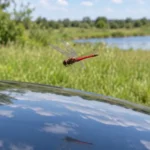
A female tapping a car may therefore be responding to a surface that resembles water to her visual system. She is not necessarily attacking the vehicle.
A swimming pool contains real water, but that does not make it suitable for larvae. An egg-laying attempt shows that an insect selected a surface; it does not prove that offspring can develop there.
For a broader explanation of suitable freshwater environments, see our guide to dragonfly habitat.
What Happens to the Eggs?
In a suitable habitat, the eggs develop and hatch into young aquatic dragonflies. Hatching time varies with the species and conditions; some eggs hatch within weeks, while others remain through an unfavorable season.
The young insects are called nymphs or larvae. They hunt underwater and grow through successive molts before eventually emerging as winged adults. They do not pass through a pupal stage.
Our dragonfly life cycle guide explains those transitions. For a closer look at the underwater stage, read about dragonfly larvae.
Seeing a female deposit eggs is evidence of a breeding attempt. It does not tell you how many eggs will survive or whether the site will produce adults.
Should You Do Anything When You See It?
If the dragonfly is tapping the water and flying normally, give it space to continue.
Stay back from the edge, use your camera’s zoom, and watch without trying to catch or reposition it. For a useful observation, note the location, whether the insect is alone or paired, and whether its abdomen or mouthparts contact the surface.
Repeated, controlled visits to the water are part of normal reproductive behavior in many species. They do not, on their own, call for a rescue.
Frequently Asked Questions
Does a dipping dragonfly release live babies?
No. A female laying eggs releases eggs, which must develop before they hatch. The wingless young then live as aquatic nymphs.
Do male dragonflies lay eggs?
No. Males may accompany or remain attached to females during egg-laying, but females deposit the eggs.
Does every tap release an egg?
A laying dip can release one or more eggs, but an observer cannot assume every apparent touch was successful. A distant view usually cannot confirm the number released.
How This Article Was Created
This article was researched using specialist dragonfly resources, National Park Service species accounts, museum information and published studies. The review checked egg-laying methods, male and female roles, and the distinction between drinking and oviposition. No personal field observations or author qualifications are claimed.
References
- British Dragonfly Society. Frequently Asked Questions. Direct explanation of repeated abdomen dipping and egg-laying.
- British Dragonfly Society. Life Cycle and Biology. Egg deposition, differences among groups and early development.
- U.S. National Park Service. Common Whitetail Skimmer. Surface-striking behavior during egg-laying.
- U.S. National Park Service. Common Green Darner. Tandem egg-laying into vegetation.
- Thornton, J. L., and Switzer, P. V. (2015). Factors Affecting the Spatial Distribution of Oviposition Sites for Tandem Black Saddlebags Dragonflies (Odonata: Libellulidae). Journal of Insect Science, 15(1), 54.
- Khelifa, R. (2015). Does water intake after oviposition indicate the end of oviposition and egg depletion in Odonata females?. International Journal of Odonatology, 18(3), 225–231.
- Polarized vision in the eyes of the most effective predators: dragonflies and damselflies (Odonata) (2025). The Science of Nature. Polarization vision and responses to artificial surfaces.
- Natural History Museum, London. Dragonflies: The ultimate hunters. Anatomy, reproduction, aquatic development and habitat.
Sources checked October 16, 2026.