Yes, a dragonfly can sometimes fly with a broken or partly missing wing. Small tears may leave it able to take off, while more extensive damage can reduce flight performance or prevent flight. The outcome depends on the damage and the individual insect. An adult dragonfly cannot regrow its wing, even if it continues flying.
If you have found one with a ragged wing, avoid trying to repair it. First give it space and check whether it is injured, newly emerged, or simply resting in cool weather.
How Much Wing Damage Can a Dragonfly Tolerate?
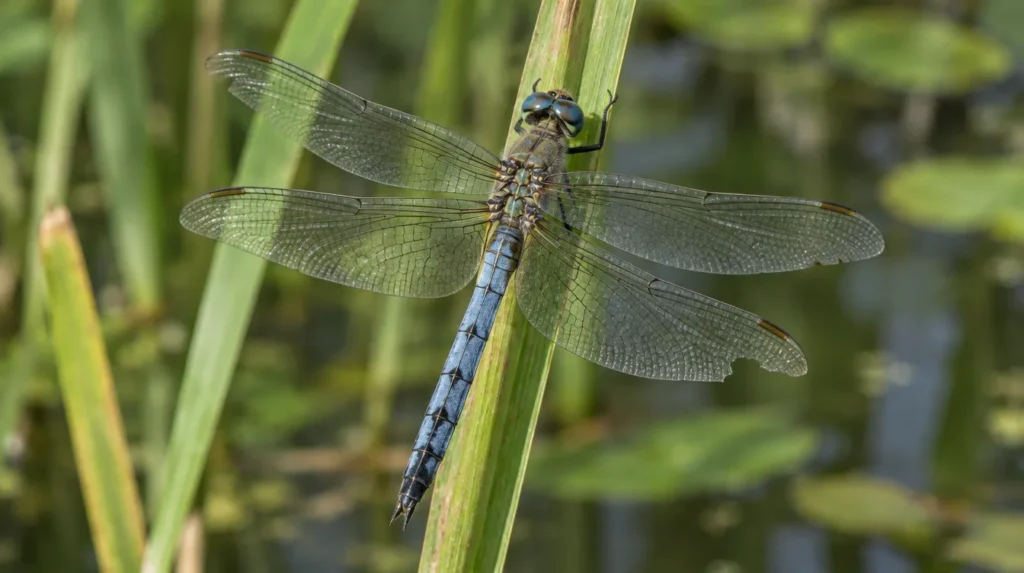
“Broken wing” can describe several different problems: a small notch at the edge, a missing section, a deep crack, or a wing that never expanded properly. These are not equivalent injuries.
The following comparisons are useful for observation, but they cannot predict the fate of an individual dragonfly.
| What you see | What it may mean for flight |
|---|---|
| A small notch or ragged wing margin | Flight may remain possible; visible wear does not automatically mean the insect is grounded. |
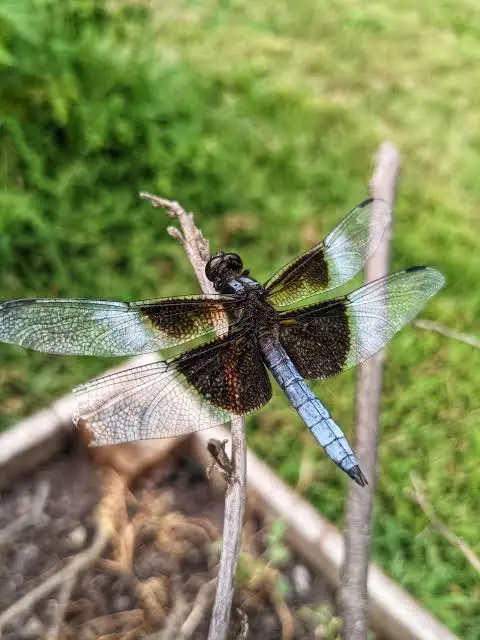
| A large section missing from one or more wings | Reduced wing area can impair flight performance and make prey capture harder. |
| A deep tear or a wing that cannot move normally | The extent of functional damage may be greater than the missing area suggests. |
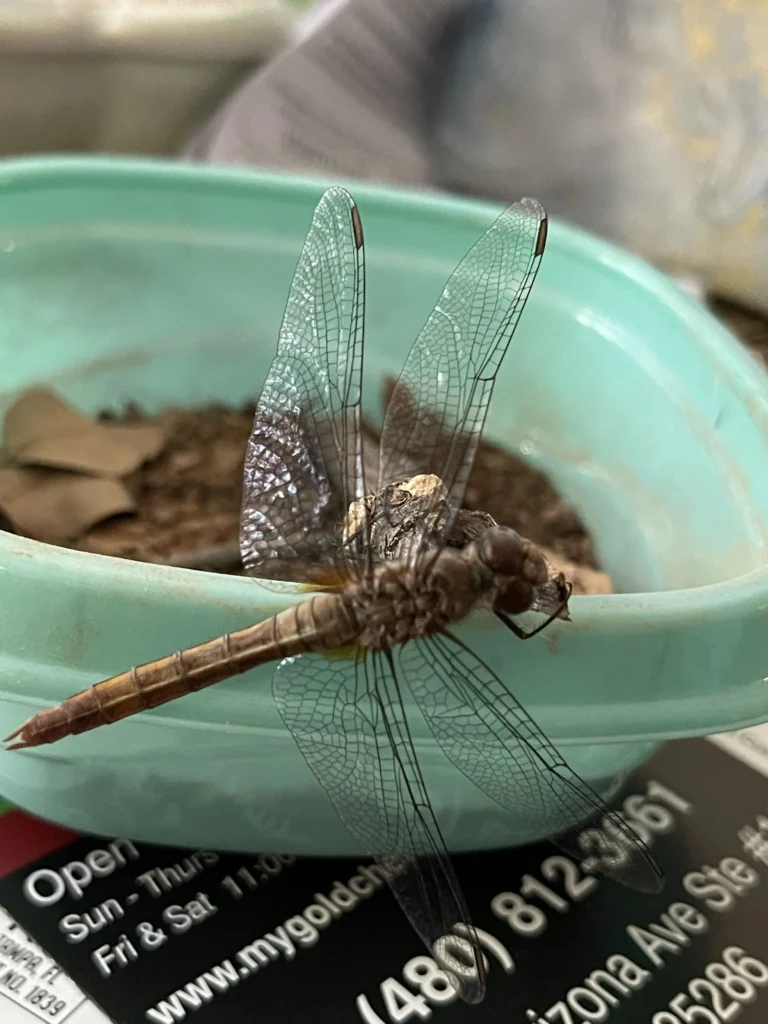
| Short, soft wings on a newly emerged adult | The wings may still be expanding and hardening. Avoid disturbing it. |
| Wings that remain severely crumpled after hardening | This is an emergence problem rather than ordinary wear; normal flight may be impossible. |
There is no reliable rule such as “a dragonfly can lose one-quarter of a wing and still fly.” Research on a particular species, injury pattern, and flight task does not establish a universal cutoff.
Why Can Some Dragonflies Still Fly With a Damaged Wing?
Dragonflies normally have four wings: two forewings and two hindwings. They can control the movement of the forewings and hindwings separately, changing wing angles and timing during flight. Their flight system therefore has more flexibility than four rigid surfaces moving in a single fixed pattern.
That flexibility helps explain how flight can remain possible after damage, but it does not make every injury manageable. The insect must still generate enough aerodynamic force and control its movement. Losing wing material changes the surfaces that interact with the air.
A dragonfly may sometimes fly with one wing missing. That observation should not become a promise that every three-winged dragonfly will survive. Taking off, turning toward prey, and escaping a predator place different demands on flight.
Our guide to how dragonfly wings work explains more about their structure and movement.
What Does Research Say About Wing Damage?
In a 2010 study, Stacey Combes and colleagues examined dragonfly flight after experimentally reducing hindwing area. They combined laboratory escape-flight tests with prey-capture observations in a greenhouse.
Hindwing area loss reduced vertical acceleration and average flight velocity in the laboratory tests. In the predation experiment, damage also reduced capture success. The important distinction is that an insect can remain capable of flight while becoming less effective at an essential task.
The study used particular dragonflies and controlled damage patterns. It did not provide a survival calculator for every naturally injured insect, or show that every missing wing section has the same effect.
A separate 2017 field study examined 119 wings from more than 30 Sympetrum vulgatum dragonflies collected during the second half of their flight period. Researchers documented both wear and fracture. Most damage involved less than 10% of wing area, although some cases were much more severe.
Finding damaged wings in wild adults shows that visible wear and continued adult life can coexist. It does not establish how long those individuals subsequently lived.
Can a Dragonfly’s Broken Wing Heal or Grow Back?
An adult dragonfly will not grow a replacement wing. Structural damage to its mature wing is irreversible. Its final molt has already taken place, so it will not shed its outer covering and emerge with a fresh set of adult wings.
Wing veins can help limit the spread of cracks, and flexible structures can reduce damage during collisions. These are forms of damage resistance, rather than regeneration after a section has been lost.
An insect that flies again after resting has not necessarily healed its wing. It may have become warm enough to fly or resumed activity despite the damage.
Is the Wing Broken, or Is the Dragonfly Newly Emerged?
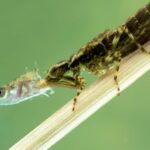
A newly emerged dragonfly can look surprisingly unfinished. Its wings begin short and soft, then expand and harden. This vulnerable young adult is called a teneral.
Look for clues without touching it:
- An empty larval skin attached nearby, sometimes on the same stem.
- A pale body and soft-looking, recently expanded wings.
- A position on vegetation close to the water where it emerged.
These clues suggest emergence, but a photograph alone may not settle the question. Naturally pale coloration is not proof that an adult is teneral.
Give an emerging dragonfly room to complete the process. Do not pull at its wings or try to spread them by hand. Wings that fail to expand and then harden in a distorted position will not simply unfold later like a wrinkled leaf.
See the dragonfly life cycle for the transition from aquatic nymph to flying adult.
How Can You Help a Dragonfly With a Broken Wing?
The most useful approach is usually minimal intervention.
- Observe from a distance. A resting dragonfly is not necessarily unable to fly. Cool conditions can suppress activity.
- Leave it where it is if the spot is safe. Keep pets away and avoid repeated attempts to make it take off.
- Move it only out of immediate danger. If it is on a busy path, offer a twig or nearby plant stem to climb onto, then place it on sheltered vegetation close by. Avoid touching its wings.
- Let it depart by itself. Do not toss it into the air or drop it to test its flight.
Avoid glue, tape, trimming the opposite wing, or attempts to straighten hardened wings. Wing surfaces and supporting structures matter to flight, and a household repair can add damage rather than restore function.
If it remains unable to fly because of permanent wing damage, there is no established home treatment that will rebuild the wing. Leaving it on suitable vegetation avoids further handling.
Should You Put It in Water?
No. The winged adult is the land-and-air stage of the life cycle, even when it lives close to a pond. Returning an adult to the water will not repair its wings. Keep an emerging or resting adult on its support above water.
Can a Dragonfly Survive With a Broken Wing?
Survival is possible when enough flight function remains, but it cannot be guaranteed. A useful distinction is whether the dragonfly can merely leave its perch or can also obtain food over time.
Research showing reduced prey-capture success helps explain why wing damage matters beyond appearance. A short successful flight does not tell you how well the insect will feed later, and the size of a visible tear alone cannot reveal its remaining lifespan.
For a dragonfly that can fly away independently, continued observation from a distance is more useful than capture. For one that cannot fly, avoid repeated handling and attempted wing repairs.
How This Article Was Created
This article was prepared by comparing published dragonfly flight research, a field study of natural wing damage, and British Dragonfly Society guidance on injured and emerging adults. The research summaries distinguish flight performance from long-term survival. Practical suggestions focus on avoiding additional disturbance and injury; individual outcomes cannot be diagnosed from a brief sighting.
References
- British Dragonfly Society. Frequently Asked Questions. Guidance on damaged wings, resting adults, and emergence.
- Combes, S. A., Crall, J. D., & Mukherjee, S. (2010). Dynamics of animal movement in an ecological context: dragonfly wing damage reduces flight performance and predation success. Biology Letters, 6, 426–429. DOI: 10.1098/rsbl.2009.0915.
- Rajabi, H., Schroeter, V., Eshghi, S., & Gorb, S. N. (2017). The probability of wing damage in the dragonfly Sympetrum vulgatum (Anisoptera: Libellulidae): a field study. Biology Open, 6, 1290–1293. DOI: 10.1242/bio.027078.
- Bomphrey, R. J., Nakata, T., Henningsson, P., & Lin, H.-T. (2016). Flight of the dragonflies and damselflies. Philosophical Transactions of the Royal Society B, 371, 20150389. DOI: 10.1098/rstb.2015.0389.
- British Dragonfly Society. Life Cycle and Biology. Wing expansion, emergence, and the teneral adult stage.
- Rajabi, H., Shafiei, A., Darvizeh, A., & Gorb, S. N. (2016). Resilin microjoints: a smart design strategy to avoid failure in dragonfly wings. Scientific Reports, 6, 39039. DOI: 10.1038/srep39039.
- Insect wing damage: causes, consequences and compensatory mechanisms (2020). Journal of Experimental Biology, 223, jeb215194. DOI: 10.1242/jeb.215194.