How Fast Can a Dragonfly Fly?
Large dragonflies can fly at approximately 23–24 mph in maintainable forward flight, while exceptional short bursts may approach 35–36 mph. The widely repeated claim that dragonflies fly at 60 mph confuses an old ground-speed observation with true airspeed.
Fact-checked against institutional sources and peer-reviewed research. Last reviewed: July 14, 2026.
How fast can a dragonfly fly? The direct answer
A scientifically cautious answer is that a large dragonfly may sustain speeds of around 23–24 mph (37–39 km/h) and may reach approximately 35–36 mph (56–58 km/h) during a brief burst.
Speed varies by species, body size, flight behavior, wind and measurement method. Dragonflies do not normally travel continuously at their maximum recorded speed.
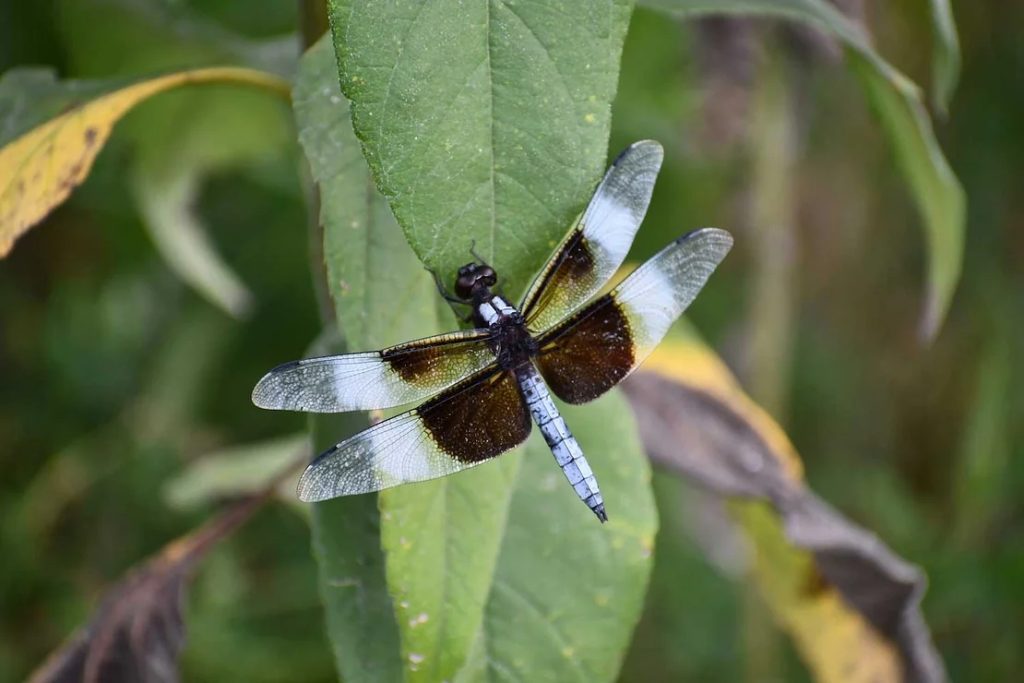
The Wildfowl & Wetlands Trust gives 36 km/h, or about 23 mph, for large hawker dragonflies.
Guinness describes 39 km/h, or 24 mph, as the highest maintainable airspeed established by acceptable modern experiments.
Guinness lists 58 km/h, or 36 mph, as the short-burst maximum for the Australian dragonfly Austrophlebia costalis.
Dragonfly Speed Compared
| Speed figure | Equivalent | What the figure represents | How it should be used |
|---|---|---|---|
| 36 km/h | About 23 mph | WWT estimate for large hawker dragonflies | A useful estimate for the upper speed of large hawkers |
| 39 km/h | About 24 mph | Highest maintainable insect airspeed described by Guinness | Useful for distinguishing sustained flight from a short burst |
| 56 km/h | About 35 mph | Popular dragonfly speed figure published by Smithsonian | Best treated as an approximate upper figure rather than a universal speed |
| 58 km/h | About 36 mph | Guinness short-burst maximum for Austrophlebia costalis | A credible exceptional maximum, not a normal cruising speed |
| 98.6 km/h | 61.3 mph | Historical ground velocity recorded in 1917 | Must not be presented as confirmed dragonfly airspeed |
These values do not describe every dragonfly. The order Odonata includes species with very different body sizes, wing shapes, habitats and flight behaviors. A small dragonfly moving through dense vegetation should not be expected to match the speed of a large hawker flying through open air.
Can Dragonflies Really Fly at 60 MPH?
The evidence does not support presenting 60 mph as a dragonfly’s verified airspeed through still air.
The famous figure comes from a 1917 observation of the Australian dragonfly Austrophlebia costalis. It was reported moving at 98.6 km/h, or 61.3 mph, over a distance of approximately 73–82 meters.
However, Guinness World Records identifies that measurement as ground velocity. Ground velocity measures movement relative to the land and can be increased by a tailwind. It is not the same as the speed generated by the insect relative to the surrounding air.
Why the 60 mph statement is misleading
A dragonfly moving at 30 mph through the air while receiving a strong tailwind could cross the ground much faster than 30 mph. Without measuring the wind, an observer cannot use ground speed alone to determine the insect’s true airspeed.
Airspeed: the insect’s speed relative to the air through which it is flying.
Ground speed: the insect’s speed relative to the ground, including the effect of wind.
Guinness gives 58 km/h, or 36 mph, as the maximum short-burst airspeed for Austrophlebia costalis. That is the more defensible figure to use when discussing the species’ exceptional flight performance.
Why Do Sources Give Different Dragonfly Speeds?
Conflicting speed figures usually result from differences in the species, flight behavior and measurement method being discussed.
1. Different species have different flight capabilities
“Dragonfly” does not refer to one animal with one fixed speed. Large hawkers, skimmers and other dragonfly groups differ in body mass, muscle capacity, wing loading and preferred habitat.
The 36 mph Guinness figure applies specifically to the southern giant darner, Austrophlebia costalis. It should not be presented as the everyday speed of all dragonflies.
2. Maximum speed is different from normal flight speed
A dragonfly may accelerate sharply while chasing prey, avoiding danger, competing with another dragonfly or launching from a perch. Such a burst is not equivalent to a maintainable cruising speed.
Guinness explicitly separates a highest maintainable airspeed of about 24 mph from the 36 mph short-burst maximum recorded for the Australian species.
3. Wind can change the observed ground speed
A tailwind increases ground speed, while a headwind reduces it. Historical observations made without simultaneous wind measurements can therefore overestimate or underestimate the insect’s self-generated speed.
4. Small flying insects are difficult to measure
Dragonflies do not normally follow a long, level and perfectly straight flight path. They accelerate, brake, turn, climb and descend rapidly. Modern studies use calibrated high-speed cameras, reconstructed three-dimensional trajectories and aerodynamic models to analyze these movements.
5. Popular fact pages may simplify the evidence
One Smithsonian “Incredible Insects” page states that dragonflies travel at 35 mph. A separate Smithsonian insect-flight information sheet identifies sphinx moths at 33 mph as the fastest insect flight in its summary.
This difference illustrates why the title “fastest flying insect” depends on the source, species, definition and quality of the underlying measurement. The safest wording is that dragonflies are among the fastest and most capable insect fliers.
Are Dragonflies the Fastest Flying Insects?
Under the current Guinness World Records classification, Austrophlebia costalis holds the fastest-flying-insect record, with a maximum airspeed of 58 km/h or 36 mph during short bursts.
Broader scientific comparisons are more complicated. Only a limited selection of insect species has been measured under comparable conditions. Some older claims about extremely fast horseflies and bot flies were based on estimates that modern researchers consider unreliable.
Dragonflies can reasonably be described as among the world’s fastest flying insects, but every speed claim should identify whether it refers to sustained airspeed, a short burst or wind-assisted ground speed.
How Do Dragonflies Fly So Fast?
A dragonfly’s flight performance comes from a combination of four-wing control, strong flight muscles, rapid sensory processing and the ability to alter its body and wing movements from one maneuver to the next.
Four separately controlled wings
Dragonflies have a pair of forewings and a pair of hindwings. The two pairs can be moved with different timing rather than functioning as one permanently linked surface.
By changing the phase relationship between the forewings and hindwings, a dragonfly can adjust the balance between lift, forward thrust, stability and maneuverability.
Wing phasing can affect aerodynamic efficiency
A study published in the Journal of the Royal Society Interface found that appropriate forewing–hindwing phasing could reduce aerodynamic power requirements by as much as 22 percent in the modeled conditions, compared with relying on a single pair of wings.
This does not mean that one wing pattern is always best. Dragonflies adjust wing timing according to whether they are hovering, accelerating, cruising or turning.
Flexible control of stroke angle and wing rotation
Dragonfly wings do more than flap vertically. During each wingbeat, the insect changes stroke direction, angle of attack and wing rotation. These movements interact with vortices and other unsteady airflow structures around the wings.
The resulting airflow is more complex than the steady airflow over a fixed airplane wing. This is why simple airplane or propeller comparisons do not adequately explain dragonfly flight.
Can Dragonflies Fly Backward?
Yes. Backward flight in dragonflies has been recorded and studied using high-speed video and aerodynamic analysis.
In a 2018 study published in the Journal of the Royal Society Interface, researchers examined a dragonfly accelerating backward along a flight path inclined relative to the horizontal. The insect changed its body angle and wing kinematics to generate the forces required for reverse movement.
Dragonflies can also perform several other movements that many insects cannot execute with the same degree of control:
- Hovering in a nearly fixed position
- Flying forward and backward
- Moving sideways
- Climbing or descending rapidly
- Gliding between periods of powered flight
- Turning sharply while tracking another insect

Speed Is Only Part of a Dragonfly’s Hunting Ability
Dragonflies catch other insects in the air, but successful hunting depends on more than simply flying faster than the prey.
A 2015 study in Nature tracked the head and body orientation of dragonflies during prey interception. The researchers found evidence that the insects used predictive internal models of their own body dynamics and the prey’s movement.
The dragonfly’s head continuously tracked the prey’s angular position, while body movements aligned the insect with an interception path. Vision was also used to respond when the prey moved unexpectedly.
This means a dragonfly does not always fly directly toward the prey’s current position. It can steer toward a point where the prey is likely to be, reducing the need for an inefficient tail chase.
What did laboratory hunting studies find?
A study published in the Journal of Experimental Biology followed nine dragonflies feeding on fruit flies over thousands of predation trials. Median capture-success rates among the individuals ranged from 0.83 to 0.95, or approximately 83–95 percent.
The result demonstrates highly effective aerial predation under the study conditions. It should not be interpreted as proof that every dragonfly catches every type of prey at the same rate in the wild.
What Determines a Dragonfly’s Flight Speed?
Species and body size
Larger, strongly built dragonflies may be capable of higher forward speeds than smaller species, although size alone does not determine performance. Wing geometry, muscle capacity and behavior also matter.
Wing shape and condition
Wing area, shape, stiffness, flexibility and damage can influence lift, drag and maneuverability. Research on dragonfly wing damage has found that damage can reduce flight performance and predation success.
Flight purpose
A territorial chase, prey interception, migration flight and slow patrol require different combinations of speed, endurance and maneuverability.
Temperature and weather
Environmental conditions affect insect flight. Wind changes ground speed, while temperature can influence muscle performance and the amount of time a dragonfly remains active.
Measurement method
Results from a short timed observation, a wind tunnel, a high-speed camera system and a three-dimensional free-flight study are not automatically interchangeable.
Claims Removed or Corrected From the Previous Article
| Previous claim | Problem | Corrected approach |
|---|---|---|
| Dragonflies can fly at 60 mph | The figure came from historical ground velocity and may include wind assistance | Use about 36 mph as an exceptional short-burst maximum airspeed |
| Every dragonfly flies at 35 mph | Species, behavior and measurement conditions differ | Present 35–36 mph as an approximate exceptional upper figure |
| Dragonflies always fly at 100 body lengths per second | The claim was presented as a universal value without a clear source or context | Use directly sourced measurements in mph, km/h or m/s |
| Dragonflies are hundreds of times more fuel-efficient than aircraft | No suitable evidence was supplied, and the comparison uses incompatible systems | Explain four-wing aerodynamics using published flight research |
| Aircraft and baseball analogies explain dragonfly lift | The comparisons do not accurately describe unsteady flapping-wing aerodynamics | Discuss wing phasing, angle of attack, rotation and vortices |
| One dragonfly eats hundreds of mosquitoes every day | The statement lacked a species-specific study and measurable conditions | State only that dragonflies prey on flying insects unless stronger evidence is available |
Frequently Asked Questions
How fast can a dragonfly fly in mph?
Large dragonflies may reach around 23–24 mph in maintainable flight. An exceptional short-burst maximum of approximately 36 mph has been reported for the Australian dragonfly Austrophlebia costalis.
How fast can a dragonfly fly in kilometers per hour?
About 37–39 km/h is a reasonable maintainable upper figure, while the Guinness short-burst maximum is 58 km/h for Austrophlebia costalis.
Can a dragonfly fly at 60 mph?
A 61.3 mph ground velocity was recorded in 1917, but ground speed can include wind assistance. It should not be described as verified dragonfly airspeed. A more defensible short-burst maximum is 36 mph.
Do dragonflies normally fly at 35 mph?
No. The 35–36 mph figure represents an approximate maximum or brief burst, not a normal speed maintained throughout routine flight.
Are dragonflies the fastest flying insects?
Guinness currently recognizes the Australian dragonfly Austrophlebia costalis in its fastest-flying-insect record. However, comparisons among insects remain difficult because relatively few species have been measured under equivalent conditions.
Can dragonflies fly backward?
Yes. Scientific studies have recorded backward free flight and analyzed the body posture and wing movements used to generate it.
Can dragonflies hover?
Yes. Dragonflies can coordinate their forewings and hindwings to remain nearly stationary in the air, although wind may cause small adjustments in position.
Why are dragonflies so good at catching prey?
Their success combines broad visual coverage, predictive prey tracking, rapid acceleration, precise steering and the ability to capture insects with their legs during flight.
Final Answer
A large dragonfly may sustain approximately 23–24 mph and reach about 35–36 mph during an exceptional short burst.
The commonly repeated 60 mph claim is based on a historical ground-speed observation that could have included wind assistance. It should not be used as the dragonfly’s confirmed airspeed.
Dragonflies are remarkable not because they continuously fly at one extreme speed, but because they combine speed with hovering, backward flight, rapid acceleration, tight turns and predictive interception of moving prey.
Research and Fact-Checking Sources
The central speed figures and flight explanations in this article were checked against the following institutional and peer-reviewed sources.
- Guinness World Records — Fastest Flying Insect . Distinguishes the 39 km/h maintainable airspeed, the 58 km/h short-burst maximum and the historical 98.6 km/h ground velocity.
- Wildfowl & Wetlands Trust — Getting Around Factsheet . Reports that large hawker dragonflies fly at up to 36 km/h, or approximately 23 mph.
- Smithsonian Institution — Incredible Insects . Gives the widely repeated popular estimate of 35 mph for dragonflies.
- Smithsonian Institution — Insect Flight . Discusses insect-flight records and cautions against implausible historical speed estimates.
- Bomphrey, Nakata, Phillips and Walker — Flight of the Dragonflies and Damselflies . A scientific review of wing mechanics, aerodynamics, performance and visually guided flight.
- Usherwood and Lehmann — Phasing of Dragonfly Wings Can Improve Aerodynamic Efficiency . Examines how forewing–hindwing timing affects aerodynamic power.
- Mischiati et al. — Internal Models Direct Dragonfly Interception Steering . Nature, 2015.
- Combes, Rundle, Iwasaki and Crall — Linking Biomechanics and Ecology Through Predator–Prey Interactions . Journal of Experimental Biology, 2012.
- Bode-Oke, Zeyghami and Dong — Flying in Reverse . A study of dragonfly kinematics and aerodynamics during backward free flight.