Dragonfly Species: Families, Diversity and Examples Around the World
Scientists currently recognize more than 3,100 described species of true dragonflies in the suborder Anisoptera. They belong to 20 currently accepted families, ranging from familiar darners, clubtails and skimmers to small, geographically restricted lineages known mainly to specialists.
Classification checked 19 July 2026. Species totals use the World Odonata List snapshot downloaded 1 May 2025 and synthesized in a peer-reviewed classification published in 2026.
How Many Dragonfly Species Are There?
The most defensible current answer is approximately 3,112 described living species of true dragonflies. That number applies to Anisoptera, not to the entire order Odonata.
The remaining three species in that dataset belong to Anisozygoptera. These figures are dated snapshots rather than permanent totals. Researchers continue to describe species, combine names that prove to be synonyms, transfer genera between families and revise relationships using new morphological and molecular evidence.
Dragonflies Within the Order Odonata
Odonata is the insect order that includes dragonflies, damselflies and the small living lineage traditionally called Anisozygoptera. In ordinary English, “dragonfly” normally refers to an adult member of Anisoptera, while “damselfly” refers to Zygoptera.
3,332 species
3 species
3,112 species
Some scientific frameworks have grouped Anisoptera and Anisozygoptera together under the name Epiprocta. The 2026 classification used for this page retains three living suborders. The three living Epiophlebia species should not be described as primitive “half-dragonflies” or as a simple evolutionary bridge between modern damselflies and dragonflies.
Anisoptera is currently divided into four superfamilies: Aeshnoidea, Gomphoidea, Cordulegastroidea and Libelluloidea. Within those superfamilies, the 2026 framework recognizes 20 families. Older books and websites may show fewer families because several lineages previously placed in broad families such as Corduliidae or Synthemistidae have since been separated.
What Do Family, Genus and Species Mean?
“Type of dragonfly” is useful everyday language, but it is not a formal taxonomic rank. A person asking about types may mean broad groups such as darners and clubtails, scientific families such as Aeshnidae and Gomphidae, or individual species such as the Common Green Darner.
A family groups related genera and normally ends in “-idae.” A genus contains one or more closely related species. A species is the basic named unit used in biological classification. Scientific species names contain the genus followed by the specific epithet, as in Anax junius.
Common names are less consistent. One species may have different English names in Britain, North America, Australia or other regions. The same informal group name may also be applied differently by separate field-guide traditions. Scientific names are therefore essential when comparing records from different countries.
Major Dragonfly Families
The following families include several of the groups most often encountered in general field guides. Their typical features are useful starting points, but no single feature identifies every member of a family.
Darners and Hawkers
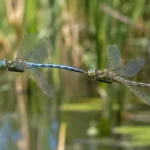
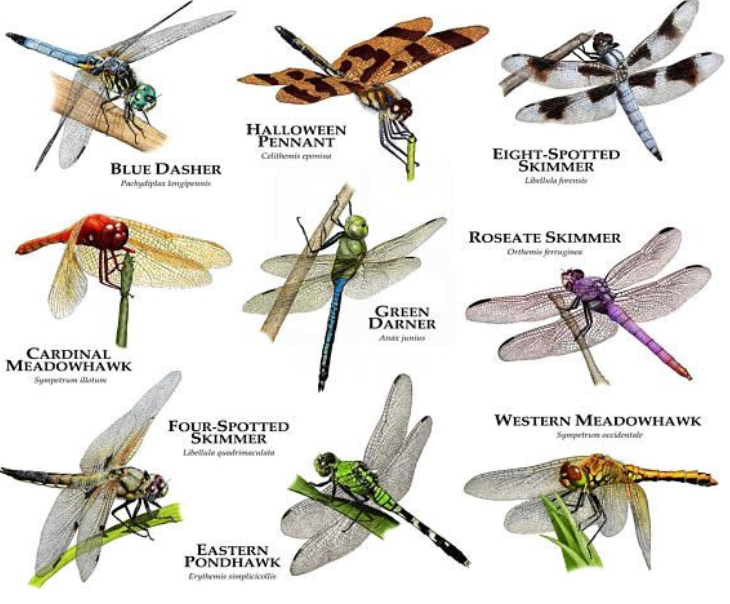
Aeshnids are generally long-bodied, strong-flying dragonflies. Many patrol ponds, lakes, marshes or forest openings and spend long periods in flight. The family occurs worldwide and includes the Common Green Darner, Anax junius, and Emperor Dragonfly, Anax imperator.
Caution: many aeshnids are large, but body size alone does not establish the family, and the family should not be described as containing every exceptionally large dragonfly.
Clubtails
Gomphids are especially diverse and are often associated with streams and rivers, although some use lakes or other habitats. Adults commonly have eyes that remain visibly separated on top of the head. Many, but not all, have an expanded tip to the abdomen.
Caution: a pronounced abdominal club is not present in every gomphid, and a club-shaped abdomen is not sufficient for species-level identification.
Skimmers, Perchers, Darters and Chasers
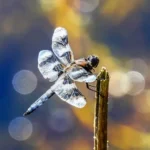
Libellulidae is one of the two most species-rich dragonfly families. It includes many conspicuous pond and wetland species, including skimmers in North America, darters and chasers in Europe, and numerous perchers in tropical regions. Examples include the Wandering Glider, Pantala flavescens, and Four-spotted Chaser, Libellula quadrimaculata.
Caution: the family is extremely varied. Color, perching behavior or a broad abdomen cannot identify all libellulids.
Emeralds and Related Groups
Many corduliids have dark metallic bodies and bright green eyes, giving rise to the name “emeralds” in several regional guides. Species may use bogs, lakes, ponds, marshes or forested wetlands. Cordulia aenea and species of Somatochlora are familiar examples.
Caution: green eyes occur outside Corduliidae, and recent classification changes have moved several former “corduliid” lineages into separate families.
Cruisers
Macromiids are often powerful, continuously flying dragonflies associated with rivers, streams or large water bodies. Many have dark bodies with pale markings and bright eyes. The family is broadly distributed, especially in tropical and warm-temperate regions.
Caution: “cruiser” is a regional common name and should not be treated as a universally standardized scientific category.
Spiketails and Goldenrings
These long-bodied dragonflies are frequently associated with streams, springs and seepages. Many have bold yellow markings on a dark body. The Golden-ringed Dragonfly, Cordulegaster boltonii, is a familiar European example.
Caution: black-and-yellow patterning also occurs in unrelated families and is not diagnostic by itself.
Petaltails
Petaluridae is a small, geographically scattered family associated with specialized wet habitats such as seepages, swamps and saturated soils. It includes the Giant Petaltail, Petalura ingentissima, of northeastern Australia.
Caution: petaltails are not globally common, and their family name refers to structural features rather than a reliable field mark visible in every photograph.
Regionally Restricted Lineages
Several accepted families contain comparatively few species or have concentrated distributions. Examples include Chlorogomphidae in parts of Asia, Austropetaliidae in southern South America and Australasia, and Neopetaliidae, represented by a single living species in southern South America.
Caution: many small families do not have a stable, widely used English collective name.
Family Comparison Table
| Superfamily | Family | Dated species count | Familiar English usage or representative lineage | Broad distribution or ecology |
|---|---|---|---|---|
| Aeshnoidea | Austropetaliidae | 11 | Archipetalia and related southern lineages | Southern South America and Australasia; streams and wet forest habitats |
| Aeshnoidea | Aeshnidae | 499 | Darners or hawkers | Worldwide; ponds, lakes, wetlands, streams and forest openings |
| Gomphoidea | Petaluridae | 10 | Petaltails | Scattered temperate regions; seepages, swamps and saturated soils |
| Gomphoidea | Gomphidae | 1,009 | Clubtails | Nearly worldwide; especially diverse around rivers and streams |
| Cordulegastroidea | Chlorogomphidae | 56 | Chlorogomphids; mainly Chlorogomphus and relatives | Asia; many species associated with forest streams |
| Cordulegastroidea | Cordulegastridae | 49 | Spiketails or goldenrings | Holarctic and parts of Asia and the Neotropics; streams and seepages |
| Cordulegastroidea | Neopetaliidae | 1 | Neopetalia punctata | Southern Chile and southwestern Argentina |
| Libelluloidea | Pseudocorduliidae | 2 | Pseudocordulia | Australasia; no standardized global group name |
| Libelluloidea | Gomphomacromiidae | 7 | Gomphomacromia and close relatives | Southern Hemisphere lineages with restricted distributions |
| Libelluloidea | Synthemistidae | 51 | Synthemis and relatives | Primarily Australasia; often associated with streams and forest wetlands |
| Libelluloidea | Austrocorduliidae | 16 | Austrocordulia and relatives | Australasia; recently separated in the revised family framework |
| Libelluloidea | Idionychidae | 29 | Idionyx and relatives | Africa and Asia; many are difficult to identify without structural details |
| Libelluloidea | Macromiidae | 125 | Cruisers | Broad tropical and temperate distribution; many patrol flowing water |
| Libelluloidea | Idomacromiidae | 31 | Idomacromia and related genera | Africa, Madagascar and parts of Asia |
| Libelluloidea | Lauromacromiidae | 6 | Lauromacromia | Neotropical region; generally localized |
| Libelluloidea | Macromidiidae | 10 | Macromidia | East and Southeast Asia |
| Libelluloidea | Neophyidae | 1 | Neophya | Tropical Africa; a single-species family in the current framework |
| Libelluloidea | Corduliidae | 149 | Emeralds and related groups | Broadly distributed; bogs, ponds, lakes, marshes and forest wetlands |
| Libelluloidea | Aeschnosomatidae | 12 | Aeschnosoma and related lineages | Localized southern and tropical distributions |
| Libelluloidea | Libellulidae | 1,038 | Skimmers, perchers, darters and chasers | Worldwide; highly varied still-water and running-water habitats |
The counts above sum to 3,112 Anisoptera species in the cited dataset. They are included to show relative diversity, not as permanent limits for each family.
Representative Dragonfly Species Around the World
A useful global guide should not imply that a short list represents every important species. The examples below were selected to show different families, regions, habitats and identification problems.
| Common name | Scientific name | Family | General region | Useful distinguishing feature | Habitat summary |
|---|---|---|---|---|---|
| Common Green Darner | Anax junius | Aeshnidae | North America, with movements beyond breeding areas | Large darner with a largely unmarked green thorax; mature males commonly show blue abdominal coloration | Ponds, lakes, marshes, wetlands and open areas near or away from water |
| Common Clubtail | Gomphus vulgatissimus | Gomphidae | Europe | Separated eyes and a moderately expanded end of the abdomen | Primarily rivers and other flowing-water habitats |
| Golden-ringed Dragonfly | Cordulegaster boltonii | Cordulegastridae | Western Europe | Long black body with conspicuous yellow rings and green eyes | Streams, small rivers, flushes and seepage-fed habitats |
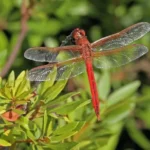
| Red-veined Dropwing | Trithemis arteriosa | Libellulidae | Africa and adjacent warm regions | Mature males are red with conspicuously reddish wing venation; females and immature males differ | Pools, dams, marshes, lakes and still or sluggish reaches of rivers |
| Common Flangetail | Ictinogomphus rapax | Gomphidae | South and Southeast Asia | Bold black-and-yellow pattern with lateral flanges near the end of the abdomen | Ponds, reservoirs and other still or slow-moving waters |
| Giant Petaltail | Petalura ingentissima | Petaluridae | Northeastern Australia | Exceptionally large member of a small, specialized family | Wetlands, seepage systems and saturated soils associated with its restricted range |
| Spotwing | Neopetalia punctata | Neopetaliidae | Southern Chile and southwestern Argentina | The only living species currently placed in Neopetaliidae | Cool southern freshwater habitats, including stream-associated environments |
| Wandering Glider | Pantala flavescens | Libellulidae | Widespread across tropical and subtropical regions | Long, broad wings and a yellowish to brown body suited to sustained gliding flight | Permanent waters as well as shallow temporary rain pools in open country |
For closer comparisons of familiar species, visit the common dragonfly species guide. For an explanation of sexual differences, maturity and structural color, see how dragonfly colors vary.
Why Dragonfly Species Differ by Region
Dragonfly diversity is not evenly distributed. The 2026 global synthesis found especially high Odonata richness in the Neotropical, Australasian and Indo-Malayan biogeographic realms. Tropical regions contain many specialized freshwater habitats and often provide long seasons in which adults can feed and reproduce.
Climate alone does not determine local diversity. Flowing forest streams support different families from temporary rain pools, peatlands, alpine wetlands, large lakes or desert springs. Elevation, water chemistry, vegetation, seasonal rainfall, permanence of water, surrounding land cover and biogeographic history all influence which species can occur.
Recorded diversity also depends on survey effort. A country with active field recording, museum collections and modern identification resources may have a more complete checklist than a poorly surveyed tropical region. Continued species descriptions suggest that additional diversity remains undocumented, especially in tropical areas.
This is why a dragonfly described as “common” in Britain, the eastern United States or southern Africa should not automatically be called common worldwide. Even widely distributed species may be abundant in one habitat and absent from another nearby habitat.
Dragonflies vs. Damselflies
Dragonflies and damselflies belong to Odonata, but true dragonflies are classified in Anisoptera and damselflies in Zygoptera. Adult dragonflies are often more robust, and most hold their wings spread when resting. Most damselflies are more slender and commonly bring their wings together or partly together.
Eye position is another useful general clue. The compound eyes of many dragonflies meet broadly or approach each other on top of the head, while damselfly eyes are normally well separated. Gomphidae is an important dragonfly exception because clubtails also have distinctly separated eyes.
These are field rules of thumb, not definitions of taxonomic rank. Classification depends on a much larger body of anatomical and genetic evidence.
How Scientists Classify New Dragonfly Species
A new species is not established simply because an individual has an unusual color. Taxonomists compare specimens with previously described species, published descriptions, museum type material and records from related populations.
Later studies may show that two named species are synonyms, that one apparent species contains several hidden species, or that a genus belongs in another family. Taxonomy is therefore a continuously tested scientific framework rather than a static list.
How to Find Dragonfly Species in Your Area
A regional checklist or field guide is more useful for practical identification than a worldwide color chart. Begin with the species documented in your country, state, province or recording region, then filter them by habitat, date and structural features.
| Coverage | Resource | Best use |
|---|---|---|
| Worldwide | World Odonata List | Checking currently listed scientific names and global taxonomic placement |
| Worldwide | Catalogue of Life | Checking accepted names, synonyms and classification across biological groups |
| Worldwide | GBIF | Exploring occurrence records while considering identification quality and sampling bias |
| Western Hemisphere | Odonata Central | Regional species lists, records and mapping resources |
| North and South America | Dragonfly Society of the Americas | Society publications, meetings and specialist resources |
| Britain and Ireland | British Dragonfly Society | Species accounts, flight periods, distribution and regional recording |
| Australia | Atlas of Living Australia | Accepted names, occurrence data and links to Australian biodiversity records |
| Taiwan | Taiwan Biodiversity Network | Locally accepted names, records and regional biodiversity data |
| Malaysia | Malaysia Biodiversity Information System | Government biodiversity records and selected regional species information |
| Southern Africa | Dragonflies of Southern Africa | Regional photographs, habitat notes and comparisons among similar species |
Record the exact location, date, water-body type, behavior and approximate size. Photograph the dragonfly from above and from the side, including the whole wings, thorax, abdomen tip and head when possible. Difficult groups may require close examination of wing venation or reproductive structures.
Follow the complete dragonfly identification process before assigning a species name. Additional background is available in the dragonfly habitat guide, the main dragonfly facts guide, and the guide to the largest living dragonflies.
Frequently Asked Questions
How many dragonfly species are there in the world?
A peer-reviewed 2026 classification counted 3,112 described extant species in Anisoptera, using a World Odonata List snapshot downloaded on 1 May 2025. Treat this as a dated count because new species and taxonomic revisions continue to change the total.
Is the number of Odonata species the same as the number of dragonfly species?
No. Odonata includes dragonflies, damselflies and Anisozygoptera. The same dated dataset contained 6,447 Odonata species, of which 3,112 belonged to the true dragonfly suborder Anisoptera.
How many dragonfly families are currently recognized?
The 2026 classification followed here recognizes 20 living families in Anisoptera, arranged in four superfamilies. Older field guides may show fewer families because several lineages have recently been separated or reassigned.
Is “type of dragonfly” a scientific classification?
No. “Type” may refer informally to a family, a regional group name, a genus or an individual species. Family, genus and species are formal ranks; “darner,” “skimmer” and “emerald” are useful but regionally variable common group names.
Are darners always the largest dragonflies?
Many darners are large and powerful, but size ranges overlap among families. Petaluridae and other lineages also include very large species. Family identification should not be based on body length alone.
Can a dragonfly be identified by color?
Color is only one clue. Sex, maturity, pruinescence, wear, lighting and geographic variation can change appearance. Reliable identification combines color with wing markings, eye arrangement, body shape, abdominal appendages, location, season and habitat.
What is the most common dragonfly species worldwide?
There is no single well-supported “most common” species for every region and habitat. The Wandering Glider, Pantala flavescens, is exceptionally widespread, but abundance still varies by climate, season, rainfall and local habitat.
Why do different databases show different species totals?
Databases may use different update dates, species concepts and taxonomic sources. A newly described species may appear in one list before another, while a revision may merge names, split a species or move a genus between families. Always record the source and access or dataset date.
Sources and Further Reading
Classification and species totals on this page were checked against current taxonomic databases and peer-reviewed research. Regional field resources are used for examples, not as substitutes for the global classification.
- Carter, J. M. et al. 2026. The classification and diversity of extant dragonflies and damselflies (Odonata) . International Journal of Odonatology 29: 95–124.
- Naturalis Institutional Repository record and open-access paper .
- University of Puget Sound. World Odonata List . Dataset snapshot cited by Carter et al. downloaded 1 May 2025; live resource accessed 19 July 2026.
- Catalogue of Life. Current taxonomic search resource accessed 19 July 2026.
- GBIF Backbone Taxonomy: Odonata . Accessed 19 July 2026.
- Dijkstra, K.-D. B. et al. 2013. The classification and diversity of dragonflies and damselflies (Odonata) . An important earlier framework that should be read alongside later revisions.
- Odonata Central. Western Hemisphere records and identification resources.
- Dragonfly Society of the Americas .
- British Dragonfly Society . Regional species accounts and checklist resources.
- Atlas of Living Australia .
- Malaysia Biodiversity Information System: Pantala flavescens .
- International Code of Zoological Nomenclature .