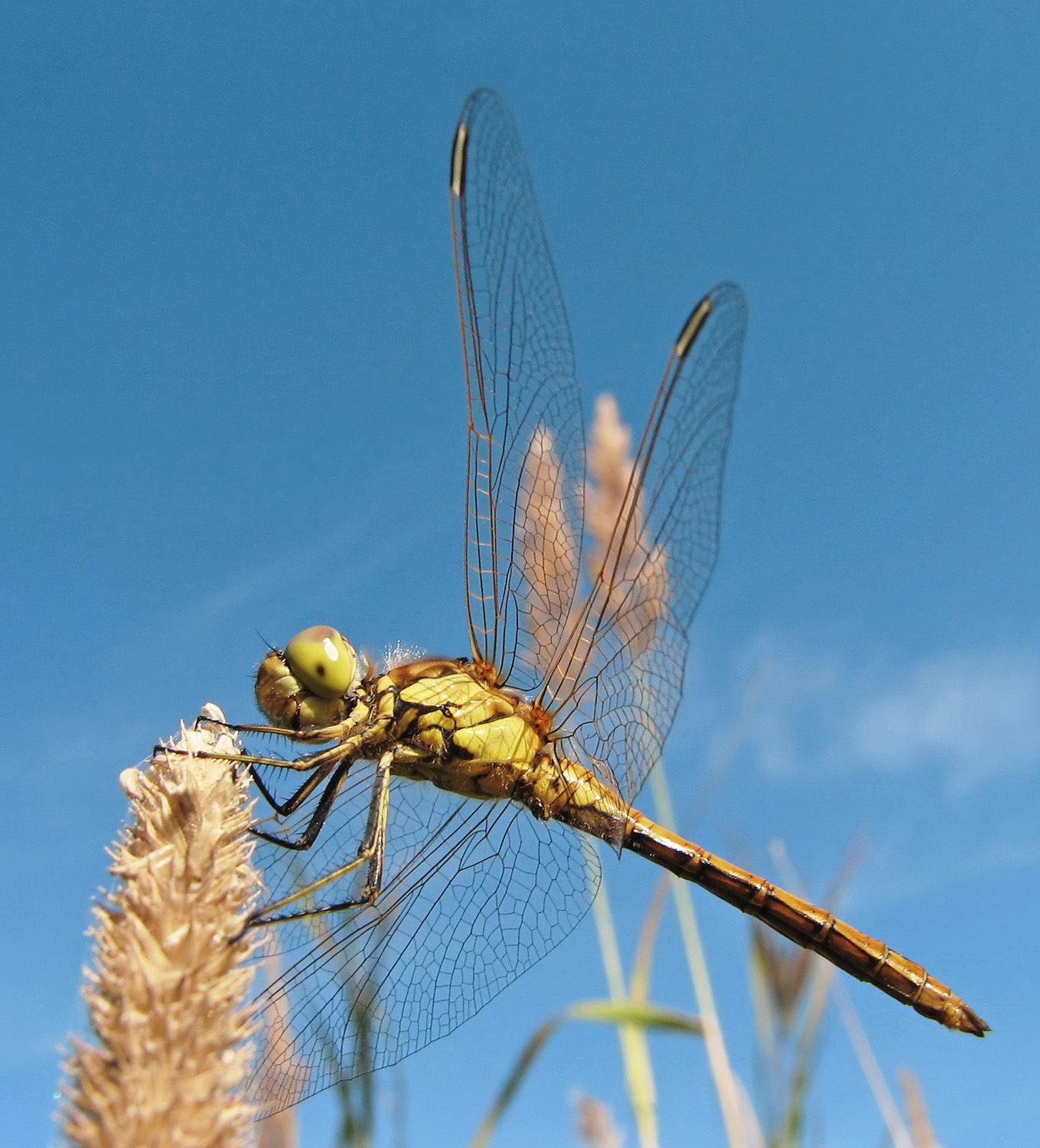
Dragonfly Colors: Why Species, Sexes and Ages Look Different
Blue, red, green, black, yellow, brown, metallic and powdery-white dragonflies do not belong to one color-coded classification system. Their appearance can be produced by pigments, microscopic light-reflecting structures or surface wax, and it may change with sex, maturity, temperature, wear, lighting and camera processing.
Direct answer: Color can help narrow down a dragonfly identification, but it cannot confirm a species by itself. The same species may include a blue mature male, a green or brown female and a pale immature adult. A reliable identification also requires location, season, habitat, body shape, thoracic and abdominal patterns, wing markings, pterostigma, eye color and evidence of the insect’s sex and maturity.
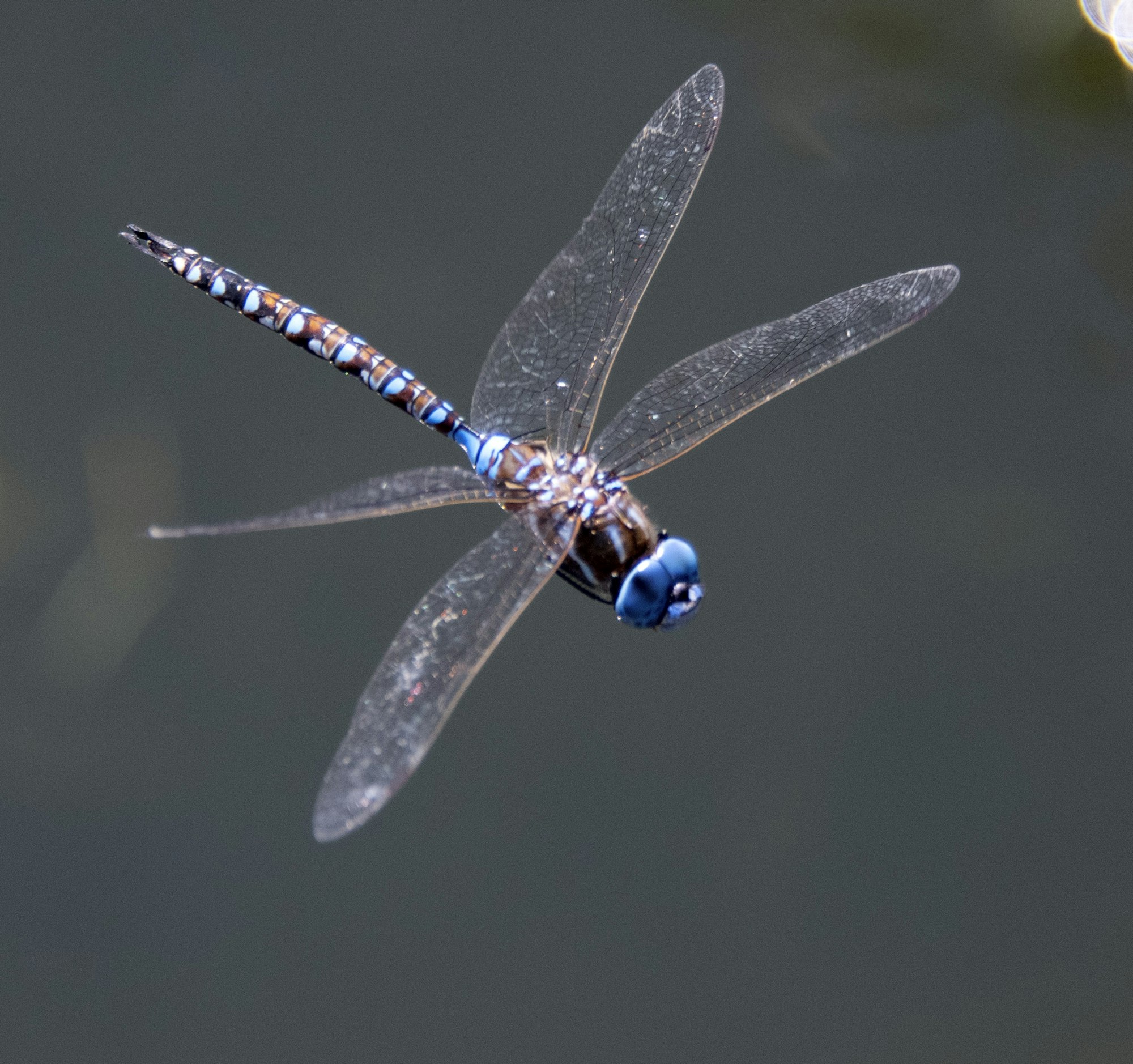
Why Do Dragonflies Have Different Colors?
Dragonfly coloration varies among species, between individuals of the same species and across an adult’s lifetime. Researchers studying Odonata—the order that includes true dragonflies and damselflies—have documented sexual color differences, maturity-related transitions and multiple color forms within the same sex.
Color patterns may be involved in visual recognition, courtship, competition, camouflage or thermal biology, but no single function applies to every species. A red abdomen in one species and a metallic green thorax in another may be produced by different physical mechanisms and used in different ecological contexts.
This page concentrates on true dragonflies, primarily the suborder Anisoptera. For global diversity, families and taxonomic organization, visit the guide to dragonfly species and families.
Pigment, Structural Color and Pruinescence
Pigment colors
Pigments absorb some wavelengths and reflect others. Ommochromes and pteridines contribute to several yellow, orange, red, green and pale-blue patterns. In some red dragonflies, chemical changes in ommochrome pigments accompany the transition from yellowish immature males to red mature males.
Structural colors
Microscopic structures can scatter or reflect selected wavelengths without relying only on a blue or metallic pigment. Nanostructures in the epidermis and multilayer structures in wings can produce blue, green, metallic or iridescent effects. These colors may change with the viewing and lighting angle.
Pruinescence
Pruinescence, also called pruinosity, is a waxy bloom secreted through fine ducts in the cuticle. It may make the abdomen or thorax look powdery white, pale blue or gray. It is not necessarily dust, mold or the insect’s underlying pigment.
These mechanisms can overlap. A dragonfly may have dark pigment beneath a light-scattering wax layer, while another apparently blue species may obtain much of its color from structures within living epidermal cells. The word “blue” therefore describes what an observer sees, not one universal biological process.
Do Dragonflies Change Color as They Mature?
Many do. After emergence, an adult may gradually develop stronger pigment, darker markings or a waxy surface coating. The direction of the change depends on the species. Some immature males resemble females before developing the typical mature-male pattern; some females also darken or become redder with age.
Red dragonflies provide a well-studied example. In several libellulid species, young males begin yellowish and become red during sexual maturation. Research has linked this transition to changes in the redox state of ommochrome pigments. That mechanism should not be presented as the explanation for every red dragonfly worldwide.
Powdery blue or white changes may instead result from increasing pruinescent wax. Mature male Eastern Pondhawks, for example, develop blue pruinescence over a body that was green when immature. A green Eastern Pondhawk is therefore not automatically a female.
Male vs. Female Dragonfly Colors
Sexual dimorphism means that mature males and females differ in appearance. It is common in dragonflies, but the oversimplified rule that every male is bright and every female is dull is incorrect.
In some species, females and immature males share a similar pattern. In others, females may occur in more than one color form, including forms that resemble males. Female Common Green Darners, for example, can vary from brownish orange to colors approaching the male’s blue. In metallic emerald dragonflies, both sexes may have strongly reflective bodies while differing more clearly in abdominal shape.
Sex should therefore be assessed using structural features where visible, including abdominal shape, terminal appendages and the ovipositor, rather than inferred from color alone.
Why Teneral Dragonflies Look Pale
A teneral dragonfly is a newly emerged adult whose body and wings have not yet fully hardened. At this stage, the final adult coloration may be incomplete. Teneral individuals are often pale, soft-looking or weakly marked and may not resemble photographs of fully mature adults.
Photograph the insect without handling it, note whether an empty larval skin is nearby and avoid forcing a species identification from color. The body can darken or acquire wax after the first flight, so a pale individual may look substantially different later.
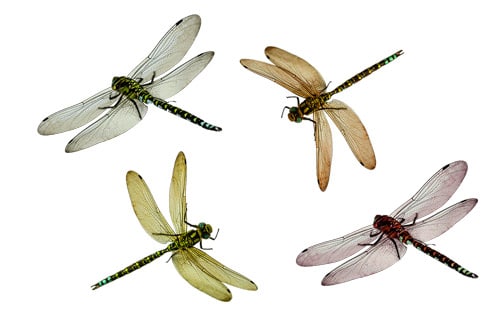
Dragonflies by Color
Blue Dragonflies
Blue may come from pigments, internal nanostructures or a powdery wax coating. Blue species cannot be separated reliably until the observer checks where the blue occurs, whether it is glossy or powdery, and what patterns remain visible beneath it.
Blue Dasher — Pachydiplax longipennis
- Region
- Southern Canada and much of the United States.
- Mature male
- Powder-blue abdomen with a darker tip, green eyes and a pale face.
- Female or immature
- Females are brown-black with yellow-green marks; juveniles have interrupted yellow abdominal stripes.
- Non-color clue
- A relatively small skimmer with a short abdomen, especially in females.
- Reliable source
- Wisconsin Odonata Survey
Red Dragonflies
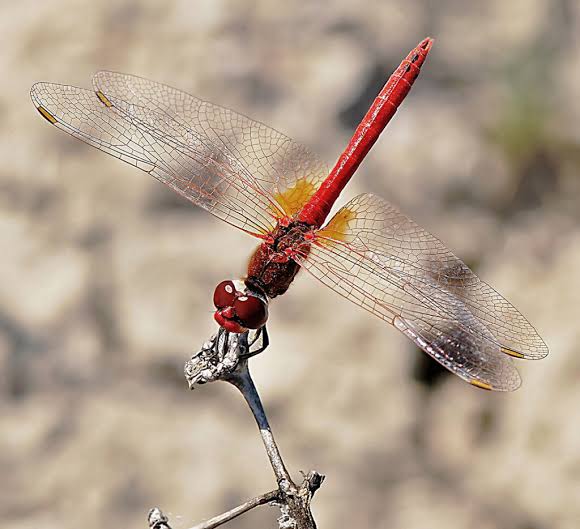
Red dragonflies belong to multiple genera and occur in different regions. The amount of red may differ between mature males, young males and females, so “a red dragonfly” is not a species-level identification.
Scarlet Skimmer — Crocothemis servilia
- Region
- Native to eastern and southeastern Asia; introduced populations occur in several other regions.
- Mature male
- Usually vivid red, with red eyes and a narrow dark line along the upper abdomen.
- Female or immature
- Females and young males are typically straw-yellow, ochre or olive-brown rather than bright red.
- Non-color clue
- Look for the narrow dorsal abdominal line and the pattern at the bases of the hindwings.
- Reliable source
- LUMS Biodiversity
Green Dragonflies
Green does not mean “darner.” Green occurs in darners, pondhawks, emeralds and other groups, and it may cover the thorax, abdomen, eyes or only a series of spots.
Common Green Darner — Anax junius
- Region
- Widespread across much of North America.
- Mature male
- Solid green thorax with a dark abdomen carrying bright blue markings.
- Female or immature
- Female abdominal color is variable, often brownish orange but sometimes approaching the male’s blue.
- Non-color clue
- A large darner with a very long abdomen; when resting, it commonly hangs from vegetation.
- Reliable source
- U.S. National Park Service
Black and Dark Dragonflies
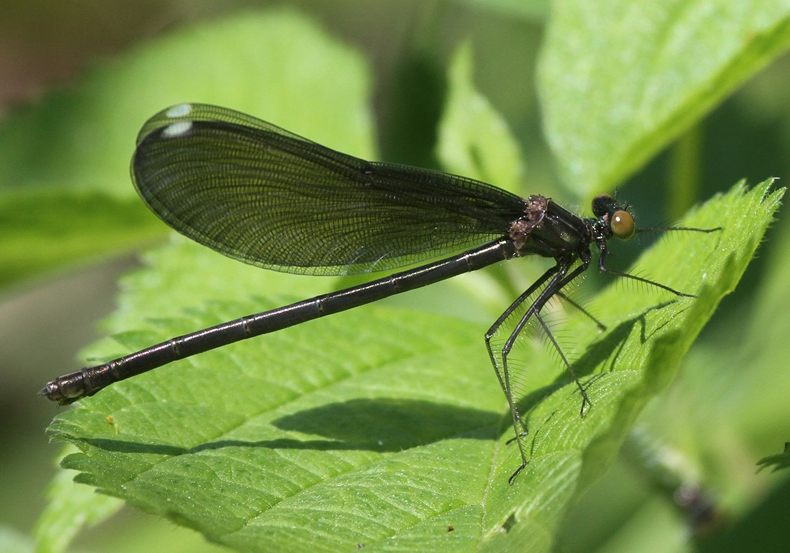
A dragonfly may look black because of body pigment, heavy wing patches, backlighting or underexposure. Record whether the darkness is on the body, the wings or both.
Black Saddlebags — Tramea lacerata
- Region
- North America, with a broad range extending southward into Mexico and the Caribbean region.
- Mature male
- Dark-bodied appearance with prominent dark patches near the bases of the hindwings.
- Female or immature
- Newly emerged individuals can be much paler and become darker after emergence.
- Non-color clue
- Two large basal blotches on the hindwings form the characteristic “saddlebag” pattern; adults spend long periods in flight.
- Reliable source
- Missouri Department of Conservation
Yellow, Orange and Brown Dragonflies
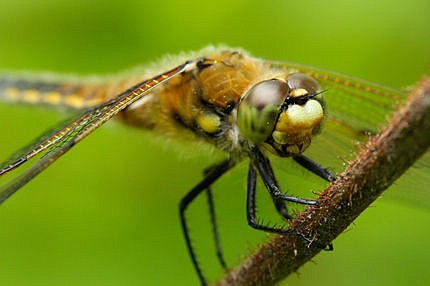
Yellow, ochre and brown frequently occur in females, teneral adults and immature males, but they are also the normal mature colors of some species. They should not automatically be interpreted as immature or female.
Common Darter — Sympetrum striolatum
- Region
- A familiar example across the British Isles.
- Mature male
- Dull to bright orange-red, especially along the upper abdomen.
- Female or immature
- Females are ochre and may become duller or redder with age; immature adults are similar but paler.
- Non-color clue
- Pale stripes on the legs and a dark line across the top of the face that does not continue down the sides of the eyes.
- Reliable source
- British Dragonfly Society
White or Powdery-Looking Dragonflies
Most white-looking dragonflies are not uniformly white and should not automatically be called albino. A pale gray, blue-white or chalky surface often comes from pruinescence over a darker body.
Common Whitetail — Plathemis lydia
- Region
- Widespread across much of North America.
- Mature male
- A white or pale-blue dusty abdomen with a broad dark band near the tip.
- Female or immature
- Females have brown abdomens with pale diagonal markings and a different wing-spot pattern.
- Non-color clue
- Females have three dark spots on each wing; mature males show a different arrangement of dark wing bands and basal marks.
- Reliable source
- Illinois Department of Natural Resources
Questions about modern cultural or spiritual interpretations belong on the separate white dragonfly meaning page. They are not evidence for a biological identification.
Metallic and Iridescent Dragonflies
Metallic color is produced when light interacts with reflective structures. The apparent hue and brightness can change as the insect, observer or light source moves. A metallic green dragonfly may therefore look bronze, blue-green or nearly black in different photographs.
Brilliant Emerald — Somatochlora metallica
- Region
- A localized species in Scotland and southeast England, with a wider European distribution.
- Mature male
- Dark metallic emerald body with bright green eyes.
- Female or immature
- Females retain the metallic body but have a broader abdomen; their wings may appear more strongly saffron-suffused.
- Non-color clue
- The male abdomen is waisted and widens toward the end; the female has a broader abdomen and a distinctive projecting vulvar scale.
- Reliable source
- British Dragonfly Society
Can You Identify a Dragonfly by Color Alone?
No. Color is best treated as a filtering clue. A blue dragonfly might be a mature male skimmer with pruinescence, a structurally blue darner or a photograph of a green individual shifted toward blue by shade and white balance.
Begin with geographic range and date, then compare shape and pattern. Look at where each color occurs: thorax stripes, abdominal spots, a continuous coating, wing bands or only reflected highlights. Pattern placement is usually more informative than a broad description such as “red dragonfly.”
For a complete field process, including wing venation, abdominal shape and comparison with similar species, use the dragonfly identification guide. For a shorter set of familiar examples, see common dragonfly species.
Photo Color vs. Real-Life Color
A photograph records light filtered through a lens, sensor and processing system. It does not automatically preserve the exact color seen in the field. Direct sun may produce glare, deep shade may shift a body toward blue, and reflected vegetation may add a green cast.
Automatic white balance attempts to compensate for illumination, but different cameras and phones can produce different results. Exposure, saturation, contrast, sharpening, compression and later editing may also hide wax texture or make red and blue areas appear stronger.
Iridescent and structural colors create an additional problem because their appearance may change with viewing angle. For useful identification photographs, record the location and date, retain the original file, avoid extreme color editing and photograph the insect from several angles. A calibrated gray card or color target is preferable when accurate color measurement is important.
Preserved specimens also require caution. Drying and chemical preparation can alter body color or destroy surface wax. A museum specimen may therefore differ from a living adult even when its structural markings remain useful.
Dragonfly Color Identification Checklist
Context
- Location and country
- Date and season
- Pond, lake, marsh, stream or upland habitat
- Perching, patrolling or migratory behavior
Body and wings
- Overall body size
- Thoracic stripe pattern
- Abdominal shape and markings
- Wing patches and wing shape
- Pterostigma shape and position
Color reliability
- Sex and maturity
- Powdery wax versus glossy pigment
- Eye color
- Light and viewing angle
- White balance and editing
Frequently Asked Questions
Why do some dragonflies look blue?
Blue can be produced by microscopic light-scattering structures, combinations of epidermal pigments or a pale-blue wax coating. The mechanism depends on the species and body region.
Why do some dragonflies turn red?
In several red libellulid dragonflies, young males are yellowish and become red during sexual maturation. Research has linked this change to the chemical state of ommochrome pigments, but not every red species has been tested.
Are green dragonflies all the same species?
No. Green occurs in numerous unrelated species, including darners, pondhawks and emeralds. Body shape, pattern, region, habitat and maturity must also be checked.
What is the white powder on a dragonfly?
It is often pruinescence: a light-scattering wax secreted onto the cuticle. It may increase during maturity and can be worn or rubbed away.
Do female dragonflies have different colors?
Frequently, but not always. Some females differ strongly from mature males, some look similar, and certain species include multiple female color forms.
Can dragonflies change color?
Yes. Maturation, increasing surface wax, aging and wear can change appearance. Reversible temperature-related changes have also been documented in particular species, but they are not a universal dragonfly trait.
What color is the rarest dragonfly?
There is no scientifically established rarest dragonfly color worldwide. Conservation rarity is assessed by species, population and geographic range, not by broad color categories.
Can a photograph accurately show dragonfly color?
It can provide useful evidence, but illumination, viewing angle, exposure, white balance and editing may change apparent color. Several angles and the original unedited file are more reliable than one processed image.
Sources and Further Reading
- Bybee, S. M. et al. “Dragon colors: the nature and function of Odonata coloration.” Journal of Zoology. DOI record.
- Prum, R. O. et al. “Blue integumentary structural colours in dragonflies are not produced by incoherent Tyndall scattering.” Journal of Experimental Biology. PubMed record.
- Okude, G. and Futahashi, R. “Pigmentation and color pattern diversity in Odonata.” Current Opinion in Genetics & Development. DOI record.
- Futahashi, R. et al. “Redox alters yellow dragonflies into red.” Proceedings of the National Academy of Sciences. DOI record.
- Futahashi, R. et al. “Molecular basis of wax-based color change and UV reflection in dragonflies.” eLife. Full article.
- Futahashi, R. “Diversity of UV Reflection Patterns in Odonata.” Frontiers in Ecology and Evolution. Full review.
- Sternberg, K. “On reversible, temperature-dependent colour change in males of the dragonfly Aeshna caerulea.” Odonatologica. Publication record.
- Paulson, D., Schorr, M. and Deliry, C. World Odonata List. Puget Sound Museum of Natural History.
- British Dragonfly Society. Dragonfly identification help.
- Wisconsin Odonata Survey. Blue Dasher species account.
- U.S. National Park Service. Common Green Darner species account.
- U.S. National Park Service. Eastern Pondhawk species account.
- Missouri Department of Conservation. Black Saddlebags field guide.
- Illinois Department of Natural Resources. Common Whitetail species account.
- British Dragonfly Society. Common Darter species account.
- British Dragonfly Society. Brilliant Emerald species account.
- National Museums Scotland. Lighting and colour-balance guidance.