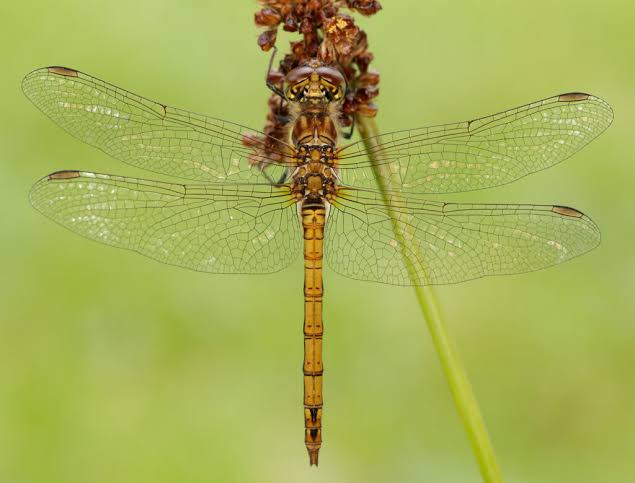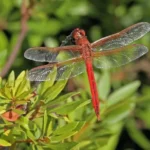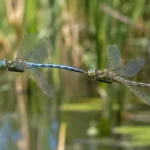
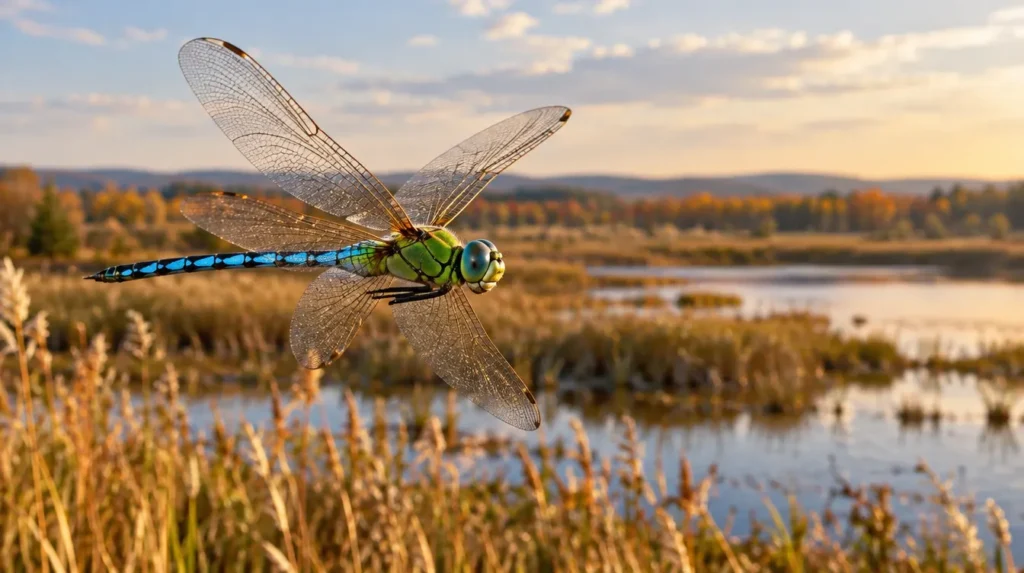
Yes, some dragonflies migrate. Migratory species may travel hundreds of miles between seasonal habitats, and a few participate in journeys spanning continents or oceans. They move to places where temperatures, rainfall, and breeding conditions are more favorable. But most dragonfly species are not known to migrate, and many dragonflies remain near their home waters.
If you have watched a steady stream of dragonflies heading in one direction on an autumn afternoon, you may have witnessed a migration. The insects are not simply wandering away from a pond: some are following seasonal routes that their offspring—or even their offspring’s offspring—will help complete.
Do Dragonflies Really Migrate?
Dragonfly migration is sustained movement from one area to another, typically associated with seasonal changes in suitable habitat. It differs from a dragonfly’s ordinary daily flights to hunt, find a mate, or patrol a pond.
Not every dragonfly flying away from water is migrating. Some species spread out after emerging as adults, and a large group hovering in one place may be feeding on a concentration of smaller insects rather than traveling.
A major scientific review published in Biological Reviews in 2026 documented 85 dragonfly species and 15 damselfly species with confirmed migratory behavior. The researchers identified another 85 possible migrants across both groups. Together, those confirmed migrants represent about 1.5% of the roughly 6,390 dragonfly and damselfly species considered in the review. The distinction matters: dragonflies and damselflies are closely related, but they are not the same insects.
Migration has evolved in several branches of the dragonfly family tree. It does not follow one universal pattern, and even within a migratory species, some populations or generations may stay in place.
Why Do Dragonflies Migrate?
The simplest explanation is that conditions suitable for living and breeding change with the seasons. Different species respond to different environmental pressures.
Escaping colder weather
In temperate regions, falling temperatures make active adult life increasingly difficult. Some migratory dragonflies move toward warmer regions as summer ends. Their descendants can later move back north as temperatures rise.
This does not mean every dragonfly must migrate to survive winter. Many dragonflies survive the cold as aquatic nymphs in ponds and wetlands, emerging as adults when conditions improve. Migration and overwintering are alternative strategies that can even occur within the same species.
Following rain and temporary pools
Other migrants take advantage of seasonal rainfall. Their young need water in which to develop, so newly filled pools and wetlands can offer breeding opportunities. The globe skimmer, for example, is particularly well adapted to exploiting temporary freshwater habitats.
In tropical and subtropical regions, migrating toward rain can be more important than escaping cold. Some journeys are connected to large-scale seasonal wind and rain systems.
Finding suitable places to reproduce
Migration can help dragonflies use productive habitats across a wider geographic area. An adult may travel a long way, lay eggs, and die; the next generation emerges somewhere else and continues the annual cycle.
The benefit is not a guaranteed safe destination. Migratory dragonflies encounter storms, predators, dehydration, and risky crossings, especially over open water.
When Do Dragonflies Migrate?
In much of North America, dragonfly migration is most noticeable in late summer and fall, often from August through October, although timing varies by region, species, and weather. Northbound movement also occurs in spring, but it is often less conspicuous.
Common green darners (Anax junius) are particularly well known for seasonal movement. Observers have recorded their southbound flights along coastlines, the Great Lakes, and other migration corridors. Some movements become noticeable after changes in temperature and wind associated with passing weather fronts.
There is no single global dragonfly migration season. In other parts of the world, migration can track monsoon rains, local dry seasons, or changes in elevation. A dragonfly migration calendar for the United States cannot simply be applied to India, Africa, or Japan.
If you want to understand seasonal sightings more generally, see when dragonflies are most active.
Which Dragonflies Migrate?
Several species are familiar to researchers and wildlife watchers in North America. These five have been focal species in the Migratory Dragonfly Partnership’s monitoring materials:
| Species | Scientific name | What makes it notable |
|---|---|---|
| Common green darner | Anax junius | A well-studied, multi-generational migrant in North America |
| Wandering glider / globe skimmer | Pantala flavescens | A widespread migrant associated with exceptional long-distance flights |
| Black saddlebags | Tramea lacerata | Often observed in migratory movements, sometimes with green darners |
| Variegated meadowhawk | Sympetrum corruptum | A North American migratory dragonfly |
| Spot-winged glider | Pantala hymenaea | Another glider species associated with seasonal movements |
This list is not a complete worldwide inventory. Migratory species also occur in Europe, Asia, Africa, and elsewhere. Researchers are still determining how regular the movements of many species actually are.
To learn the visual characteristics of familiar dragonfly groups, visit our common dragonfly species guide.
How Far Do Dragonflies Migrate?
There is no single distance that describes all dragonfly migration. Some movements cover relatively short distances; others exceed hundreds of kilometers. The most dramatic estimates concern routes completed across multiple generations, which should never be mistaken for the mileage of one individual insect.
Common green darner: hundreds of kilometers
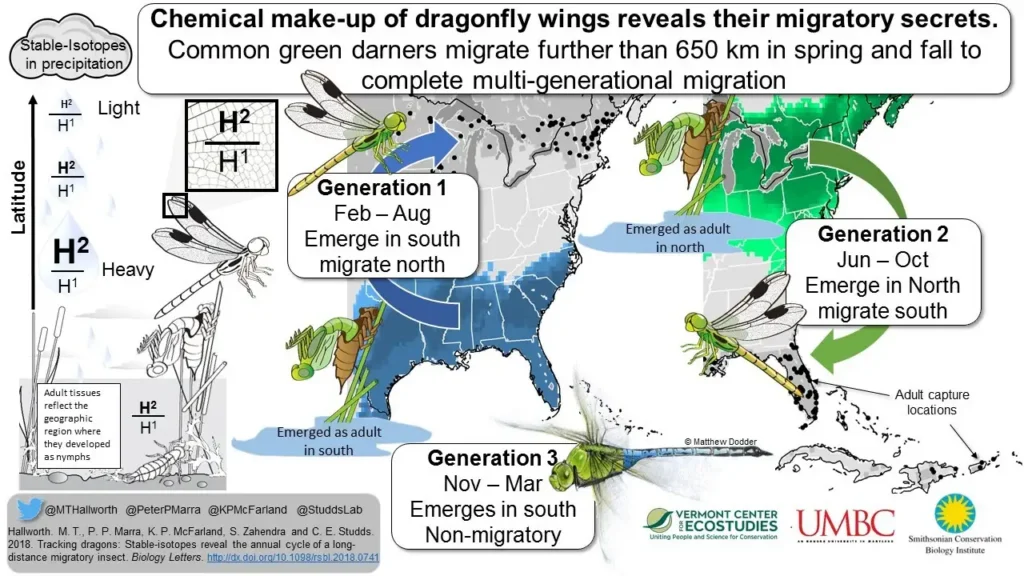
A major study published in Biology Letters used stable hydrogen isotopes in dragonfly wings, historical specimens, and citizen-science records to reconstruct the green darner’s annual cycle. It found spring northbound movements of more than 650 kilometers (about 400 miles) and southbound movements of more than 680 kilometers (about 420 miles) within the multi-generational migration system.
These are research-based measures of geographic movement in the seasonal cycle, not a promise that every green darner flies exactly those distances. Local conditions and the mix of resident and migrating individuals vary.
Globe skimmer: a possible ocean-spanning circuit
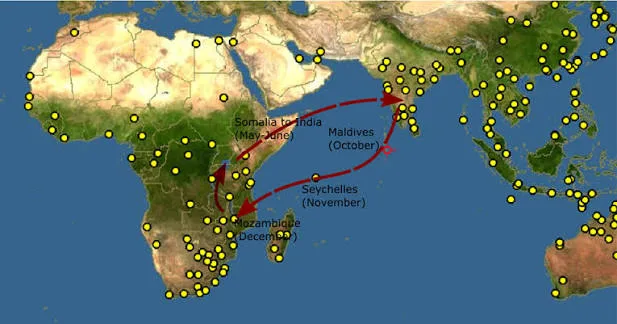
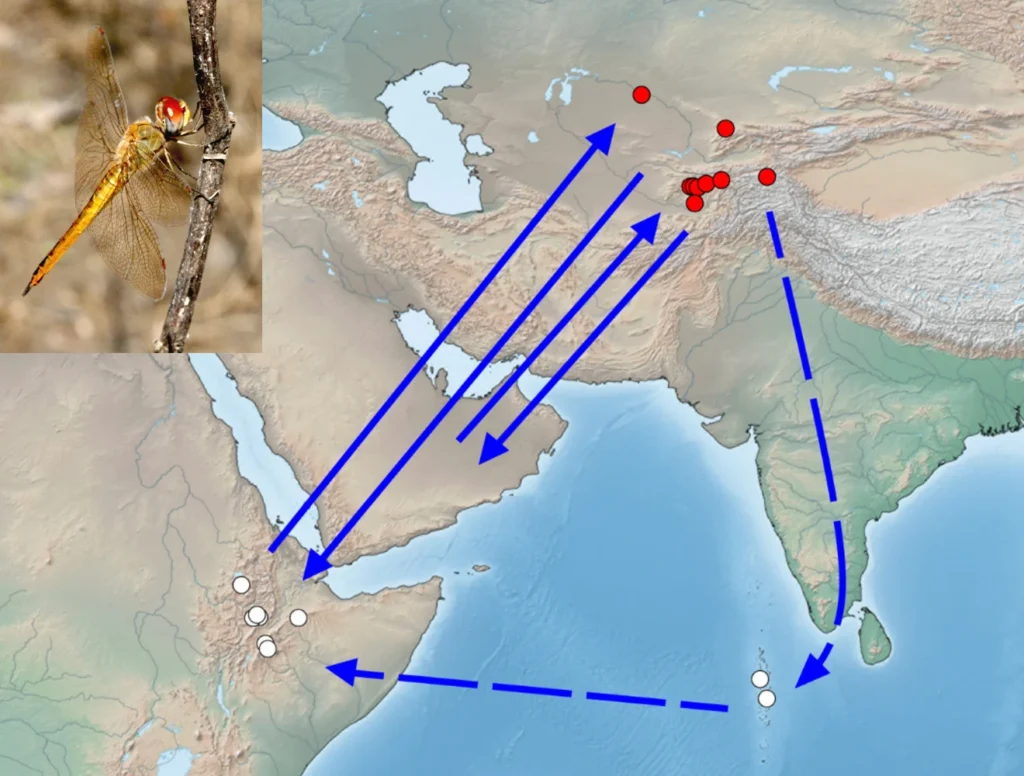
The wandering glider or globe skimmer (Pantala flavescens) has attracted interest because of movements linked to the Indian Ocean. Scientists have used wing-isotope chemistry, observations, and atmospheric trajectory models to investigate connections among the Indian subcontinent, the Maldives, Africa, and other areas.
Some research proposes an Afro-Asian migratory circuit exceeding 14,000 kilometers (about 8,700 miles) across multiple generations. However, the complete proposed route has not been directly tracked by following individual dragonflies from start to finish. Some portions are better supported than others.
That difference between evidence of long-distance migration and certainty about an exact route is essential. Saying that one dragonfly flies 14,000 kilometers in a single trip would misrepresent the research.
How Does Dragonfly Migration Work Across Generations?
Unlike many migrating birds, individual dragonflies usually do not travel to a distant breeding region and return to the starting point year after year. Their lives are generally too short for that kind of annual round trip.
The common green darner offers an especially clear example:
- Spring: A generation of green darners moves north from warmer areas and breeds.
- Summer into fall: Their offspring emerge. Some travel south and reproduce in warmer regions.
- The following cycle: A further generation may remain and develop in the south, helping produce the individuals that move north again.
Research indicates that this seasonal cycle can involve at least three generations. The details are more complicated than a rigid relay race: some green darners are residents, some immature stages overwinter, and local weather changes when adults emerge.
The key idea is simple: the migration belongs to a population across generations, not necessarily to one dragonfly making a complete round trip.
For background on eggs, aquatic nymphs, and adult emergence, read our dragonfly life cycle guide.
Can Dragonflies Really Cross an Ocean?
Yes, dragonflies have been observed over open water, and the globe skimmer is strongly associated with long-distance movements that involve oceanic regions. Its precise routes, however, are still an active area of research.
Dragonflies are capable fliers, but wind is an important part of the story. Researchers study favorable high-altitude airflows and seasonal atmospheric patterns to explain how small insects may cross vast stretches of water. Wing-isotope evidence from globe skimmers collected in the Maldives points toward origins on the northern Indian subcontinent, consistent with major movement across the region.
Scientific models can show whether a proposed crossing is physically plausible under particular wind conditions. They cannot, by themselves, prove that every insect traveled a modeled route. That is why researchers combine modeling with sightings, seasonal timing, specimens, and chemical evidence.
Do Dragonflies Migrate in Swarms?
Sometimes. Large numbers of dragonflies traveling in a similar direction can create the impression of a moving cloud of insects. Common green darners and other migrants have been recorded in conspicuous flights, particularly in autumn.
But a dragonfly swarm is not automatically a migration. Dragonflies may also gather where flying prey is unusually abundant. If insects circle and hunt repeatedly over one small area, feeding may be the better explanation. If many dragonflies maintain a consistent direction over a sustained period, migration becomes more plausible.
Observers can look for three useful clues:
- Direction: Are most dragonflies heading the same way?
- Continuity: Does the movement continue for several minutes or longer?
- Weather and setting: Is the flight occurring during a seasonal transition, near a coastline or lake, or after a change in wind conditions?
These clues help, but they do not conclusively identify a migration without further evidence.
Do Dragonflies Migrate at Night?
Many familiar migrating dragonflies are chiefly active by day, when they can fly, orient, and hunt under favorable conditions. Their flights can also depend heavily on temperature and weather.
It would be too broad to claim that no dragonflies move at night or that every species follows the same daily schedule. Global migratory behavior remains incompletely studied, and researchers continue to investigate flight timing and movement at different heights. For beginners watching green darners, daylight observations are generally the most practical way to spot conspicuous migratory movement.
What About Dragonflies That Move Up Mountains?
Not every migration follows a north–south line on a map. A 2026 global review also described altitudinal migration, in which adults temporarily move to higher, cooler areas and later return to their reproductive habitat.
One example involves the Japanese red dragonfly Sympetrum frequens, which can move from lowland breeding areas to cooler highlands during the warmer part of the year, then return as conditions change. The review identified 18 dragonfly and damselfly species with evidence of this kind of high-elevation refuge migration.
This distinction is important because, unlike the familiar multi-generational seasonal journeys, an altitudinal refuge trip can be completed by the same adult.
How Do Scientists Track Migrating Dragonflies?
Following a small, fast-moving insect across a continent is difficult. Instead of relying on a single tracking technique, scientists combine several kinds of evidence.
Stable isotopes in wings: The chemical signature in an adult dragonfly’s wings can reflect the environmental conditions where it developed. Scientists compare that signature with geographic patterns to estimate the area in which the insect emerged. The method indicates probable origins rather than a precise flight-by-flight route.
Field observations: Wildlife watchers record species, dates, abundance, and travel direction. Repeated observations at migration sites help reveal seasonal patterns.
Historical specimens: Museum collections can preserve biological evidence from past decades, allowing researchers to examine changes across long periods.
Tracking and atmospheric models: Small tracking devices can sometimes reveal individual movements, while wind models help test whether proposed long-distance flights are possible.
The best-supported migration reconstructions use several of these methods together.
How to Watch Dragonfly Migration
You do not need specialized equipment to notice a movement event. During the local migration season, try watching an open stretch near a wetland, lake, coastline, or other place where dragonflies pass through.
Record the date, approximate time, weather, location, number of dragonflies, and direction of flight. If you can identify the species confidently, note that too. Photographs can help confirm identification later.
Avoid assuming that every large gathering is migratory. A note such as “about 30 dragonflies passed southward in ten minutes” is more useful than a dramatic but uncertain claim about a giant migration. Observations like these can contribute to broader community-science datasets.
If you are watching around a pond, also note whether dragonflies are patrolling, mating, laying eggs, or emerging. These activities often indicate local breeding rather than migration.
Frequently Asked Questions About Dragonfly Migration
Do all dragonflies migrate?
No. Most dragonfly species are not confirmed migrants. A 2026 global review documented confirmed migratory behavior in 85 dragonfly species, alongside 15 migratory damselfly species. Many others remain local or use different seasonal survival strategies.
What month do dragonflies migrate?
In much of North America, noticeable southbound migration often occurs from August through October. Spring movement also occurs. The timing differs in other regions and can depend on seasonal rainfall rather than a fixed calendar month.
Where do dragonflies go in winter?
It depends on the species and population. Some adults migrate toward warmer regions, while many nonmigratory dragonflies survive colder periods as aquatic nymphs. There is no single winter destination for all dragonflies.
What is the longest dragonfly migration?
The globe skimmer is associated with some of the most extraordinary proposed insect migration circuits. Researchers have proposed Afro-Asian routes exceeding 14,000 kilometers across multiple generations. That figure does not describe a verified nonstop flight by one dragonfly.
Why are there so many dragonflies in the fall?
You may be seeing seasonal migrants, newly emerged local adults, or feeding aggregations attracted to abundant prey. Consistent directional flight is a stronger clue to migration than numbers alone.
Do dragonflies return to the same place every year?
Populations may use broadly recurring seasonal regions, but the same adult usually does not complete the annual round trip. In multi-generational migration, descendants help complete the cycle. Exact routes and individual destinations remain uncertain for many species.
The Takeaway
Dragonfly migration is real, but it is not one universal journey shared by every species. Some common green darners move between northern and southern North America as part of a migration spanning generations. Globe skimmers exploit seasonal weather systems and may participate in remarkable ocean-crossing circuits. Other dragonflies move up and down mountains to find seasonal refuge.
The most important discovery is that migration can be a family journey through time. One generation travels, another emerges and moves on, and together they connect ponds and wetlands across enormous distances.
How This Article Was Created
This guide was prepared as a research-based educational overview using peer-reviewed studies, conservation-organization resources, and government natural-history information available through October 12, 2026. It distinguishes observed movements from proposed routes and separates findings about dragonflies from broader findings about dragonflies and damselflies together. It does not claim personal field observations or interviews. Migration estimates may change as new studies become available.
References
- Hedlund, J. S. U., Menz, M., Chapman, J. W., & Hayward, A. (2026). Flight of the dragons: a global review of migration in Odonata. Biological Reviews. https://doi.org/10.1002/brv.70170
- Hallworth, M. T., et al. (2018). Tracking dragons: stable isotopes reveal the annual cycle of a long-distance migratory insect. Biology Letters. https://pmc.ncbi.nlm.nih.gov/articles/PMC6303508/
- Xerces Society. Migratory Dragonfly Partnership (species and monitoring overview). https://xerces.org/sites/default/files/publications/13-013.pdf
- Hobson, K. A., et al. (2012). Isotopic evidence that dragonflies (Pantala flavescens) migrating through the Maldives come from the northern Indian subcontinent. https://pmc.ncbi.nlm.nih.gov/articles/PMC3527571/
- Borisov, S. N., et al. (2020). Seasonal Migrations of Pantala flavescens in Middle Asia and Understanding of the Migration Model in the Afro-Asian Region Using Stable Isotopes of Hydrogen. https://pmc.ncbi.nlm.nih.gov/articles/PMC7765977/
- National Park Service. Common Green Darner. https://www.nps.gov/articles/000/common-green-darner.htm
- Vermont Center for Ecostudies. Green Darner Dragonfly Migration. https://vtecostudies.org/what-we-do/projects/green-darner-migration