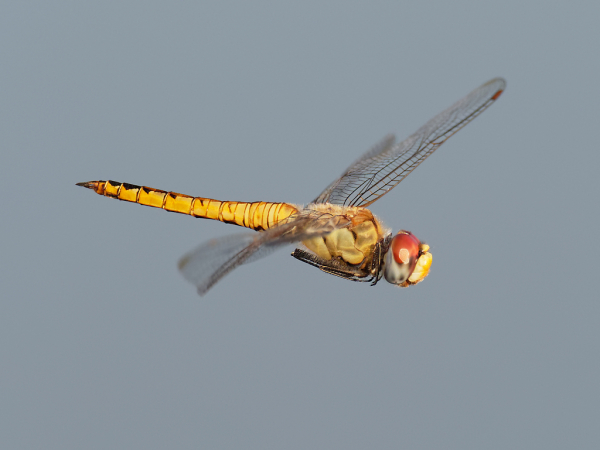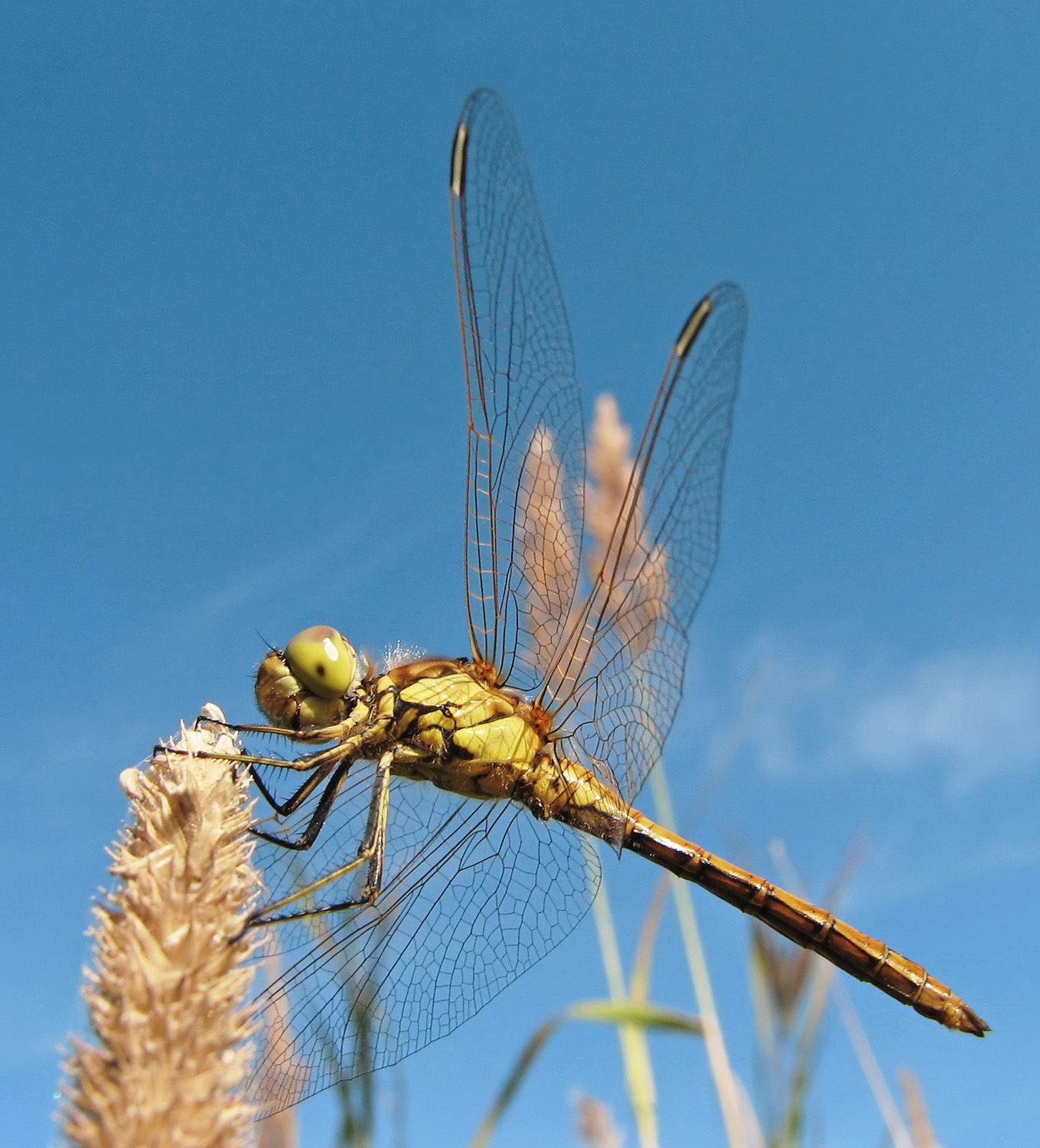
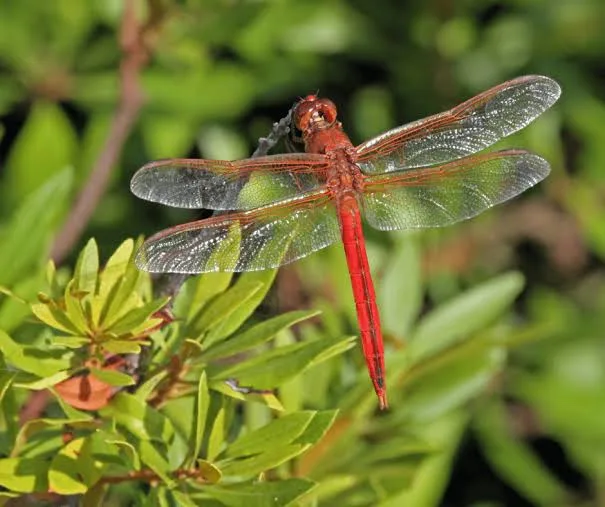
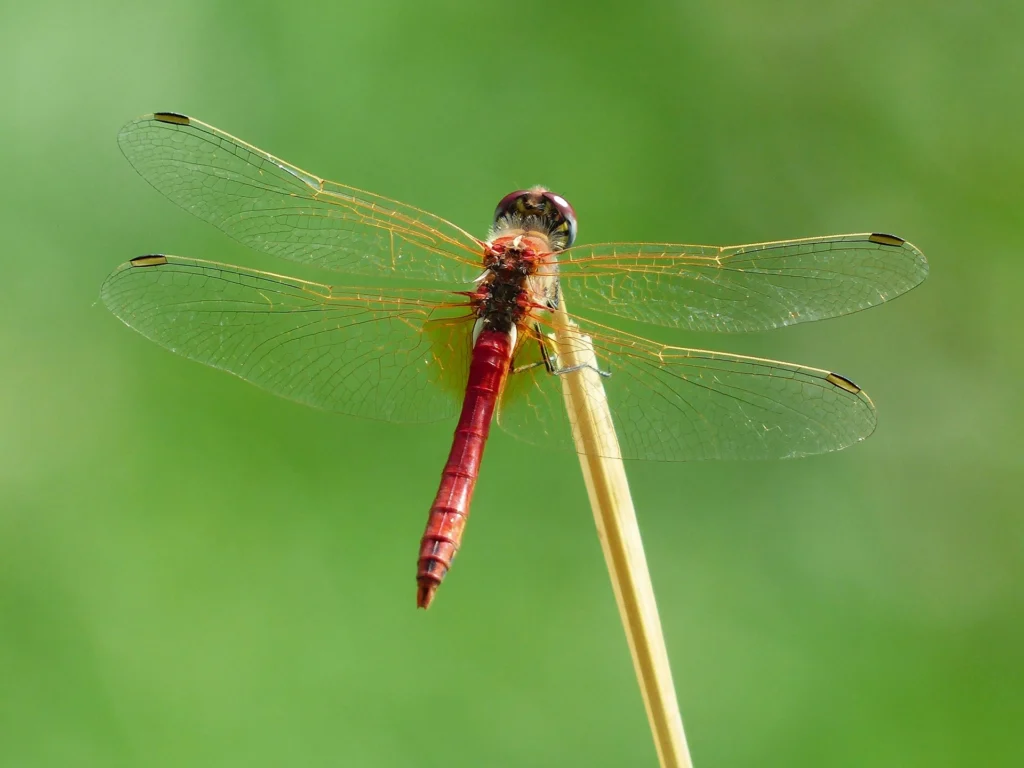
A red dragonfly has no single, universal meaning. In modern Western symbolism it is often linked with energy, passion, courage and change. In Japan, the red dragonfly (akatombo) is a long-standing sign of autumn and childhood nostalgia. Biologically, a red dragonfly is usually a mature male whose pigments turned red as he reached breeding age.
Those three layers — modern symbolism, documented cultural tradition and biology — are often blended together online. This guide keeps them separate, so you can see which red dragonfly meanings come from a named tradition, which are recent personal or spiritual interpretations, and what the insect in front of you was most likely doing.
Red Dragonfly Meaning at a Glance
| Layer | What it says about red dragonflies | What kind of claim it is |
|---|---|---|
| Modern symbolism | Energy, passion, courage, love, vitality, transformation | Recent interpretation that combines general dragonfly symbolism with Western color associations for red |
| Japanese tradition | Autumn, the rural rice-field landscape, childhood memory and nostalgia | Documented in dictionaries, haiku seasonal-word collections and a well-known 1920s song |
| Grief and remembrance | A reminder of, or comfort after, a loved one’s death | Personal and modern belief, often shaped by a 20th-century children’s story; not a tested fact |
| Biology | Red is usually the adult breeding color of males in certain species | Measurable and studied |
What Does a Red Dragonfly Symbolize?
Most modern red dragonfly meanings are built from two older ideas. The first is general dragonfly symbolism: because a dragonfly spends its early life underwater as a nymph and then emerges as a flying adult, it is widely used as a symbol of change, transformation and a new stage of life. You can read more about where that idea comes from in our guide to dragonfly meaning and symbolism.
The second is color symbolism. In many Western contexts, red is associated with energy, strength, love, passion and courage. Put the two together and you get the meanings most often attached to a red dragonfly today:
- Energy and vitality — a prompt to act, move forward or recover strength
- Passion and love — a symbol some people connect with romance or a close bond
- Courage — facing a change rather than avoiding it
- Transformation with intensity — change that feels urgent or emotionally charged
These are interpretations, not properties of the insect. They are recent, they vary from writer to writer, and none of them comes from a single historical source. If one of them resonates with you, it can be a meaningful personal symbol — but it is a meaning you bring to the sighting, not a message the dragonfly carries.
Red Dragonfly Meaning in Japan: The Akatombo
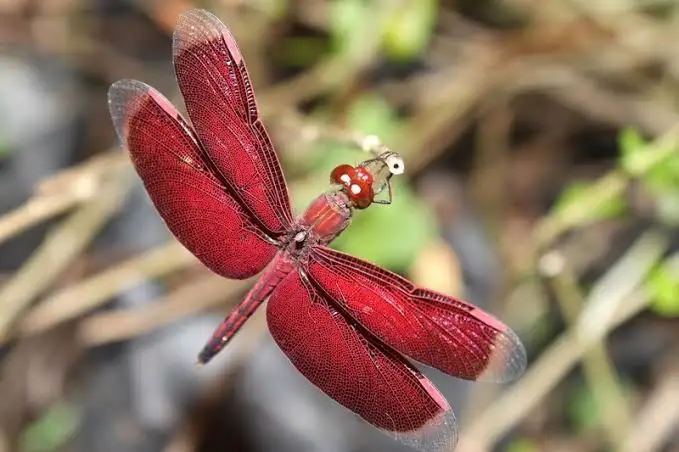
Japan is the one place where “red dragonfly” has a clearly documented cultural meaning of its own, and that meaning is mostly about autumn, landscape and memory rather than luck or prophecy.
A seasonal word for autumn
In Japanese, akatombo (赤とんぼ, 赤蜻蛉) is a general name for red or reddish dragonflies, mainly in the genus Sympetrum (Japanese akane). Standard Japanese dictionaries describe it as a collective term for these species, naming the Autumn Darter (akiakane, Sympetrum frequens) among the typical examples. The same dictionaries mark akatombo as an autumn seasonal word (kigo) — a word that tells the reader of a haiku which season the poem belongs to. Haiku seasonal-word collections list red dragonfly poems by writers such as Yosa Buson, Masaoka Shiki and Natsume Sōseki.
So when a red dragonfly appears in Japanese poetry, its first job is to say “autumn,” in the same way cherry blossoms say “spring.”
“Akatombo,” the song
The best-known red dragonfly in Japanese culture is probably a song. “Akatombo” (“Red Dragonfly”) has lyrics by the poet Rofū Miki, written in 1921, and music by the composer Kōsaku Yamada, from 1927. The song looks back on childhood: seeing red dragonflies at sunset while being carried on someone’s back, and remembering a young nursemaid who married and left the village. Its mood is gentle longing rather than anything supernatural. A monument to the song stands in Tatsuno, Hyōgo Prefecture, Miki’s hometown.
For many Japanese readers, then, a red dragonfly can call up nostalgia, home, early autumn evenings and the passing of time.
A symbol of the countryside — with a real conservation story
The Autumn Darter is closely tied to Japan’s rice-growing landscape. Researchers describe it as a species symbolic of the Japanese countryside. Its life history explains why: it breeds in lowland rice fields, the immature adults move to cooler mountain areas in midsummer, often tens of kilometers away, and the mature adults return to the lowland fields in autumn — just when red dragonflies become a familiar autumn sight.
That familiar sight became much less common in parts of Japan. A 2020 study in Scientific Reports reported that Autumn Darter numbers fell sharply in the 1990s, dropping to around one-hundredth of early-1990s levels in many regions, with the timing varying by prefecture. A 2018 analysis in Environmental Science and Pollution Research concluded that the insecticide fipronil, used in rice seedling nursery boxes, was a major cause of those declines, while noting that farming practices such as midsummer drainage may also have contributed. For some people in Japan, the red dragonfly has therefore also become a symbol of what healthy rural wetlands look like.
“Victory insect” and “Island of Dragonflies” — not specifically red
You may also read that dragonflies were a samurai emblem called kachimushi, or “victory insect,” and that an early name for Japan, Akitsushima, means “Island of Dragonflies.” Museum sources such as the Smithsonian’s Cooper Hewitt collection and the Manggha Museum of Japanese Art and Technology in Kraków describe both associations. However, these traditions are about dragonflies in general, not red dragonflies in particular. Online articles that present kachimushi as a “red dragonfly meaning” are stretching the source.
Does a Red Dragonfly Mean a Loved One Is Visiting?
This is one of the most common reasons people search for red dragonfly meaning, and it deserves a careful answer.
Many people who are grieving feel comforted when a dragonfly appears near them, and some come to see a particular color — often red — as a sign of a specific person. That experience is real and personal, and there is nothing wrong with finding meaning in it.
What the evidence does not support is the idea that a red dragonfly is objectively a visit, a message or a sign from someone who has died. There is no scientific evidence that a dragonfly sighting predicts or communicates anything, and we could not trace the specific “red dragonfly = loved one” belief to an identifiable historical culture.
Part of the modern link between dragonflies and death likely comes from a well-known children’s story. Water Bugs and Dragonflies by Doris Stickney first appeared as a magazine piece in 1970 and was expanded into a book in 1982. It uses the change from an underwater creature to a flying dragonfly as a gentle way to talk with children about death. (As a small biological note, dragonfly nymphs are not “water bugs” in the scientific sense, but the metaphor is the point of the story.) The story is about dragonflies generally; it does not assign a special meaning to red ones.
A kind way to hold both ideas at once: the dragonfly was most likely hunting, resting or looking for a mate — and you are still free to let that moment remind you of someone you love.
Is a Red Dragonfly Good Luck or a Bad Omen?
Neither, in any factual sense. A red dragonfly does not bring good or bad luck, and it does not predict illness, death, money or romance.
Cultural attitudes do differ. In Japan, dragonflies have historically had largely positive associations, as the kachimushi and Akitsushima traditions show. In parts of Europe, older folk names such as “devil’s darning needle” reflected fear that dragonflies could sting or harm people — which they cannot, since dragonflies have no stinger. Neither tradition is specifically about red dragonflies.
If you want to treat a red dragonfly as a lucky sign for yourself, that is a personal choice. It becomes a problem only when the belief is presented as a fact, or when it leads someone to make an important decision based on a sighting.
Red Dragonfly Claims You May See Online That We Could Not Trace
Several red dragonfly meanings are repeated across spiritual and gift websites without a source. We looked for a documented origin and could not find one strong enough to present as a tradition:
- “In Japan, red dragonflies carry the spirits of ancestors during Obon.” This appears on many Japanese and English websites, sometimes with advice not to catch dragonflies during the summer festival for the dead. We found it in popular articles but did not locate a folklore study or regional record we could cite. It may reflect local customs, but its origin and extent are unclear.
- “Native Americans saw the red dragonfly as the soul of the dead” or “as a symbol of courage and happiness.” These statements usually do not name a specific nation, region or source. Indigenous nations have distinct traditions, and we found no documented red-specific belief behind these claims. Our dragonfly meaning guide explains how to evaluate claims about Indigenous traditions.
- “The red dragonfly is a symbol of eternal love and death.” This phrase circulates widely on blogs and memorial pages but does not trace back to a named culture or text.
- Root chakra and other energy-system meanings. These come from modern spiritual frameworks that assign colors to body centers. They are interpretations within those systems, not traditional dragonfly lore.
If you see any of these claims presented as ancient or universal, treat them as modern interpretation until a named source is given.
Why Is the Dragonfly Red? The Biology Behind the Color
In many red dragonfly species, the red color is a sign of maturity, and it is usually strongest in males.
In the familiar red darters and meadowhawks (Sympetrum), newly emerged adults of both sexes are typically yellowish or brownish. As males mature over the following days and weeks, they turn red. Females often stay yellowish, olive or brown, though in some species older females become duller or partly reddish. The British Dragonfly Society, for example, describes the male Common Darter (Sympetrum striolatum) as bright orange-red, and the female as ochre that becomes duller or reddish with age.
Researchers at Japan’s National Institute of Advanced Industrial Science and Technology (AIST) studied how this happens in three red species: the Autumn Darter (Sympetrum frequens), the Summer Darter (Sympetrum darwinianum) and the Scarlet Skimmer (Crocothemis servilia). Their 2012 study in PNAS found that the color comes from ommochrome pigments, which look yellow in their oxidized form and red in their reduced form. As males mature, a larger share of the pigment is held in the reduced, red form. In experiments, injecting a reducing agent (vitamin C) turned yellow dragonflies red, while an oxidizing agent reversed the change. Red coloring in these species appears to work as a breeding signal, and the researchers suggested it may also help with protection from oxidative stress, such as from sunlight.
So, in plain terms, a bright red dragonfly is most often a mature male ready to breed. For more on the ecology of one well-studied red species, see our red dragonfly facts, habitat and life cycle guide, and for the wider picture of how dragonfly colors vary by species, sex and age, see our coloration article.
Why You Might Notice Red Dragonflies in Late Summer and Fall
Red dragonflies often seem to “appear” at meaningful moments, but their timing and behavior have natural explanations:
- Season: Many red Sympetrum species fly late in the year. The British Dragonfly Society notes that the Common Darter can be found well into November in Britain, and the Wisconsin Odonata Survey reports the Autumn Meadowhawk (Sympetrum vicinum) flying from late July to mid-November in Wisconsin. Late-season red dragonflies are one reason autumn and red dragonflies are linked in several cultures.
- Perching: Darters and meadowhawks often perch on exposed tips — stems, fence posts, garden stakes — and return to the same spot after short flights to catch prey. That makes them easy to notice and can make it feel as if one is “following” you.
- Warmth: On cool mornings, dragonflies bask on sunlit surfaces to warm up, including walls, decks and sometimes people.
- Habitat: Seeing red dragonflies usually means still or slow water — a pond, wetland, rice field or ditch — is somewhere nearby.
If a red dragonfly lands on you, it is most likely using you as a warm or elevated perch. Our article on why dragonflies land on people explains the common reasons.
Which Red Dragonfly Did You See?
“Red dragonfly” is not one species. Many unrelated dragonflies — and some damselflies — are red, and several look very similar. Color alone is not enough for a reliable identification. Location, date, habitat, size, leg color, wing markings, face markings and whether the insect is male or female all matter, and some meadowhawks are difficult even for experienced observers.
| Region | Red dragonflies often seen | Identification notes |
|---|---|---|
| Japan and East Asia | Autumn Darter (Sympetrum frequens), other Sympetrum darters, Scarlet Skimmer (Crocothemis servilia) | Akatombo covers several Sympetrum species; females and young adults are often yellowish |
| Britain and Europe | Common Darter (Sympetrum striolatum), Ruddy Darter (Sympetrum sanguineum), Red-veined Darter | The British Dragonfly Society separates the Common Darter partly by pale leg stripes and yellow thorax panels on males |
| North America | Autumn Meadowhawk (Sympetrum vicinum) and other meadowhawks | Mature males are red; females and immatures start yellow. Several similar meadowhawks are hard to separate from photos |
| Many regions | Red damselflies, such as the Large Red Damselfly (Pyrrhosoma nymphula) in Europe | These are damselflies (Zygoptera), not true dragonflies: slimmer bodies, widely separated eyes, and most hold their wings closed at rest |
A photo taken from above can show wing pattern and abdomen color but often misses leg color, face markings and the side of the thorax. If you want to put a name to your red dragonfly, try to photograph it from the side as well as from above, and note the place and date. Our dragonfly identification guide explains which features to check.
How to Hold a Personal Meaning Without Treating It as Fact
If a red dragonfly sighting felt meaningful to you, these steps keep the meaning personal and the facts accurate:
- Name the layer. Is the meaning you are drawn to modern symbolism, a documented tradition such as the Japanese akatombo, or your own feeling in the moment?
- Check the source. If a website says a meaning is “ancient” or belongs to a particular culture, look for a named community, place, period or text.
- Keep the biology in view. The dragonfly was most likely a mature male hunting, basking, guarding a perch or looking for a mate near water.
- Let the meaning be yours. A red dragonfly can be a reminder to act with courage, a nudge to notice the season, or a moment of remembrance — without needing to be a supernatural message.
- Observe without handling. Enjoy it at a distance and avoid catching it for a photo; a perched dragonfly will often return to the same spot if you wait.
Frequently Asked Questions
Is a red dragonfly rare?
Usually not. Red darters and meadowhawks are common in many parts of Europe, East Asia and North America, especially in late summer and autumn near still water. Some individual species are rare or declining in particular regions, such as the Autumn Darter in parts of Japan during the 1990s.
What does a red dragonfly mean in love?
In modern symbolism, some people link red dragonflies with passion or a strong bond because red is associated with love in Western color symbolism. This is a recent interpretation, not a documented traditional meaning, and a sighting does not predict anything about a relationship.
What does it mean to see two red dragonflies together?
Biologically, two red dragonflies flying joined together are usually a mating pair. In many darters the male holds the female behind the head, and the pair may fly in tandem while she lays eggs in water. Any symbolic reading of “two dragonflies” is personal interpretation.
Are red dragonflies dangerous?
No. Red dragonflies have no stinger and are not venomous. Like other dragonflies, a large one may try to nip if it is grabbed, but they do not attack people.
How this article was checked
We checked the biology of red coloration against research on dragonfly pigments reported by Japan’s National Institute of Advanced Industrial Science and Technology; species names, flight seasons and identification features against the British Dragonfly Society and a Wisconsin Department of Natural Resources–sponsored Odonata survey; the Autumn Darter’s life history and decline against peer-reviewed studies; and Japanese cultural claims against Japanese dictionaries, a haiku seasonal-word collection and museum sources. Symbolic and spiritual meanings are presented as interpretation, not as fact.