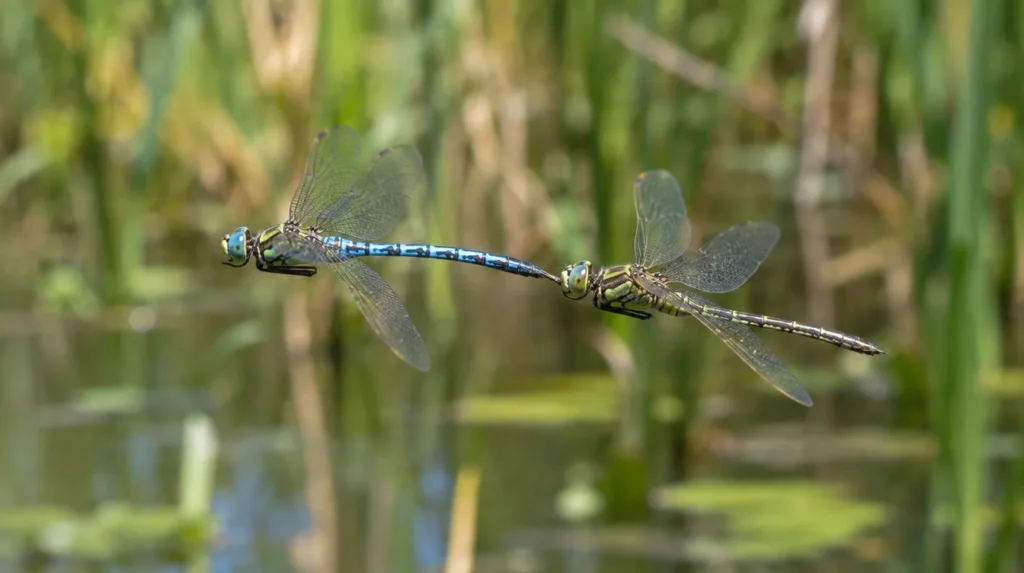
If you see two dragonflies flying together, especially when they are physically connected, the most likely explanation is reproduction. A male may clasp a female behind the head and fly with her in a tandem position before mating, after mating, or while she is moving toward an egg-laying site. In other species, the pair separates after mating but the male stays close and follows the female while she lays eggs.
However, two dragonflies flying near each other are not always a mating pair. They may also be involved in a territorial chase, a mating pursuit, or a brief encounter between competing adults. The way the two insects are positioned is the best clue.
Why Do Dragonflies Fly in Pairs?
Dragonflies most commonly fly in pairs because a male and female are involved in reproductive behavior.
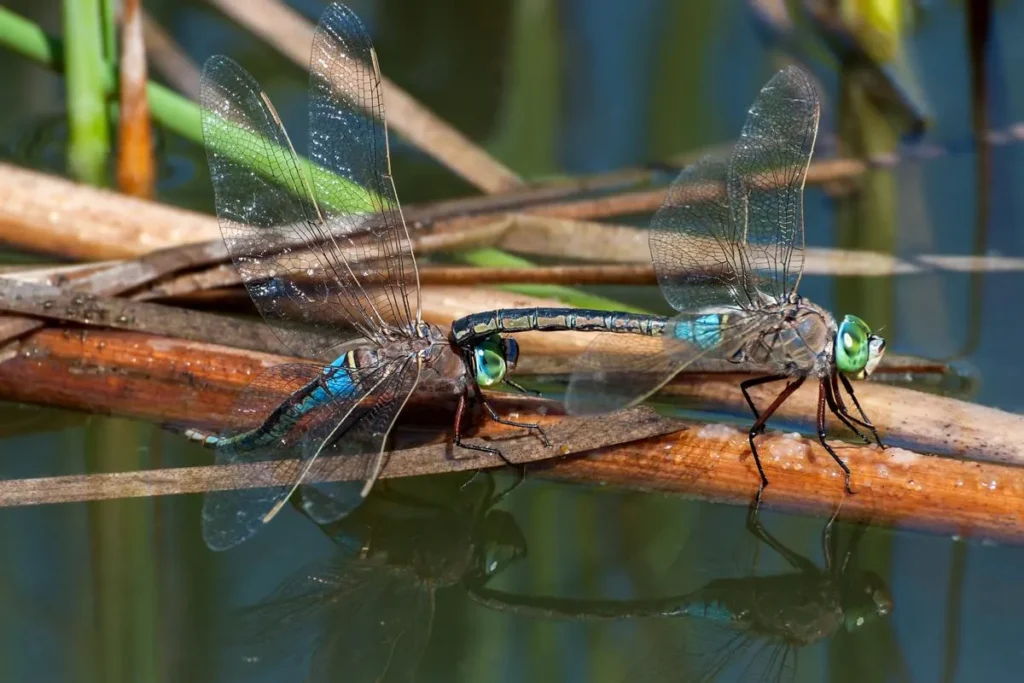
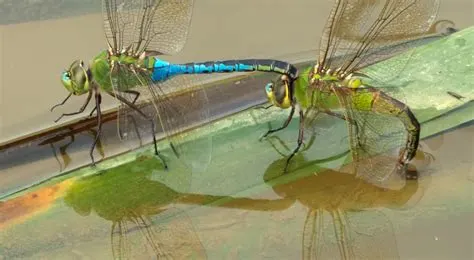
During tandem flight, the male uses specialized appendages at the end of his abdomen to hold the female behind the head. The pair can then fly as a connected unit. This position may occur before copulation, after copulation, or during the trip to a suitable place for egg laying.
A pair may also appear to be flying together without touching. In some species, the male releases the female after mating but stays nearby while she lays eggs. This behavior is called non-contact mate guarding.
So, when people describe dragonflies “flying in pairs,” they may actually be seeing several different behaviors:
| What you see | Most likely explanation |
|---|---|
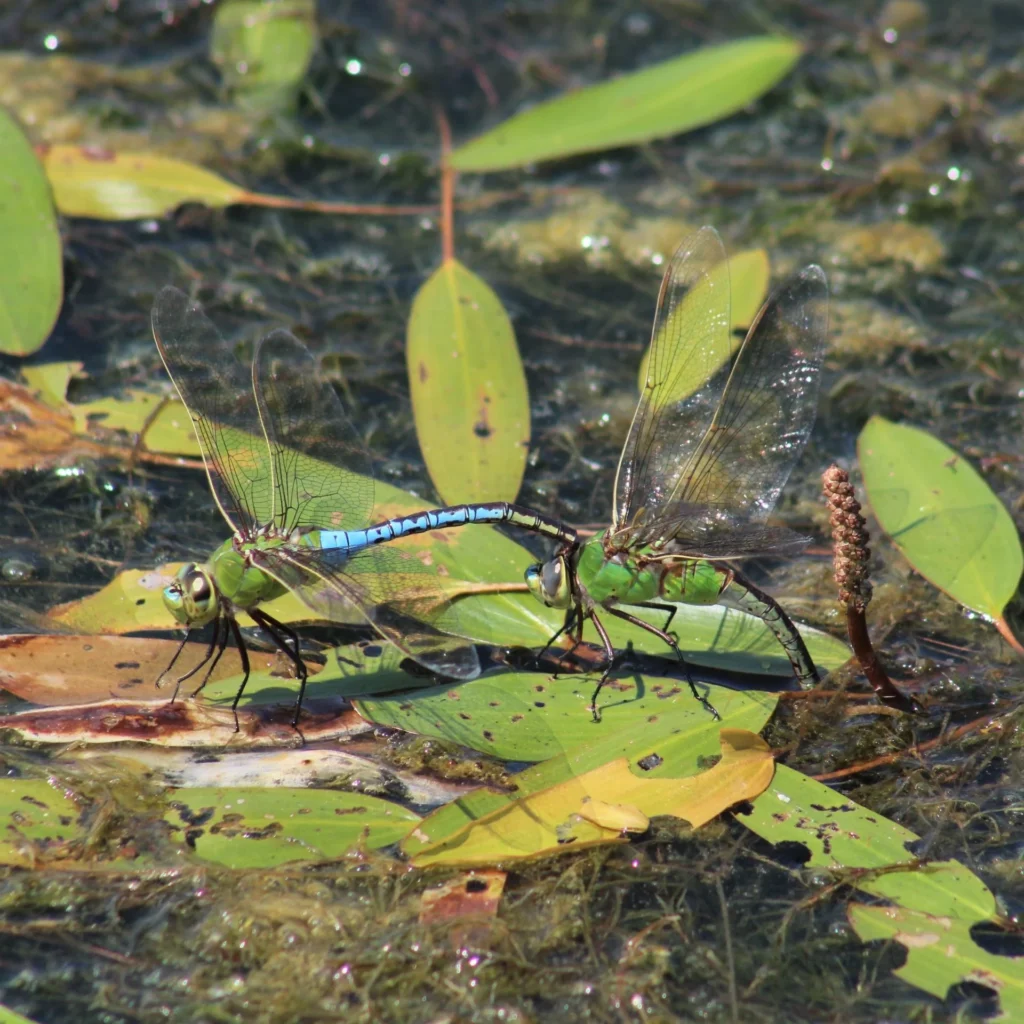
| Two dragonflies physically connected head-to-tail | Tandem flight associated with mating or mate guarding |
| Two connected dragonflies repeatedly approaching the water | Tandem egg-laying behavior in a species that remains attached |
| One dragonfly hovering or following closely behind another near the water | Possible non-contact mate guarding |
| Two dragonflies rapidly chasing, circling, or intercepting each other | Territorial aggression, mate pursuit, or competition |
| Many dragonflies flying in the same area | Feeding aggregation, emergence, dispersal, or migration rather than a bonded pair |
The exact behavior varies among species, so a single observation does not always reveal the full story.
What Is Tandem Flight?
Tandem flight is one of the most recognizable behaviors in dragonflies and other members of the order Odonata.
In a typical true dragonfly pairing, the male is in front and the female is behind. The male’s terminal abdominal appendages grip the female behind the head. They can remain linked while perched or while flying.
This does not mean the insects are stuck together.
The grip is part of normal reproductive behavior. It allows the male to maintain contact with the female during a period when other males may also attempt to mate with her.
If you are trying to determine which individual is male or female, see How to Tell Male and Female Dragonflies Apart.
Is Tandem Flight the Same as Mating?
Not exactly.
Tandem formation and copulation are two related but different stages.
When the pair is stretched out in a line, with the male holding the female behind the head, they are in the tandem position.
For sperm transfer, the female bends her abdomen forward toward the male’s secondary genitalia near the front of his abdomen. This creates the familiar curved wheel position, sometimes loosely described as a heart shape.
The pair may remain perched during copulation, although movement and short flights can occur. After copulation, they may return to tandem or separate, depending on the species.
This distinction matters because a pair of connected dragonflies in flight is not necessarily mating at that exact moment. They may be traveling before or after copulation.
Why Does the Male Stay Attached to the Female?
One important reason is mate guarding.
Female dragonflies can encounter multiple males during the reproductive period. In many species, males therefore benefit from staying with a female long enough for her to begin or complete egg laying.
There are two broad guarding strategies.
Contact guarding
The male remains physically attached to the female in tandem.
The pair may move together from one egg-laying location to another, and in some species the female lays eggs while the male remains connected.
This is the form of behavior most likely to make people ask why dragonflies are “flying in pairs.”
Non-contact guarding
The male releases the female but stays close.
He may hover nearby, patrol around her, or intercept other males while she lays eggs. To a casual observer, the two dragonflies can still look like a pair even though they are no longer touching.
Research on dragonflies has shown that both contact and non-contact guarding occur, and the strategy can vary by species and circumstances.
Why Do Dragonflies Fly in Pairs Near Water?
Freshwater is central to the dragonfly life cycle.
Dragonfly larvae are aquatic, so mature females must eventually place their eggs in or near suitable freshwater habitat. Ponds, lakes, marshes, slow streams, rivers, temporary pools, and vegetated shorelines can all serve as breeding habitat for different species.
That is why paired behavior is especially noticeable near water.
A male may:
- patrol a breeding area,
- intercept a female,
- form a tandem pair,
- mate with her,
- travel with her toward an egg-laying site,
- or remain nearby while she deposits eggs.
The female’s egg-laying method also differs among dragonflies. Some release eggs while dipping the tip of the abdomen toward the water. Others use an ovipositor to insert eggs into plant tissue or other suitable material.
For the broader sequence from egg to aquatic nymph to adult, see the Dragonfly Life Cycle.
Are Dragonflies That Fly Side by Side Mating?
Not necessarily.
If the insects are physically connected, reproductive behavior is the strongest explanation. If they are flying close together without contact, several possibilities remain.
A male may be guarding a recently mated female. A male may also be pursuing a female that has not yet accepted or entered tandem. Alternatively, two males may be interacting over territory or access to a breeding site.
Dragonflies are highly visual insects. Males of many species actively patrol breeding habitat and respond quickly to other flying dragonflies entering their space.
The important point is that proximity alone does not prove mating.
Look for additional clues:
- Are the two insects physically attached?
- Is one hovering near the other while the second repeatedly touches the water?
- Are they moving calmly together or performing a fast chase?
- Are several other males also present?
- Is the behavior occurring directly over a pond, stream, or marsh?
Those details can help separate tandem behavior from territorial conflict.
Why Do Two Dragonflies Chase Each Other?
Chasing is common around breeding habitat and does not always involve a male and female.
A male may chase:
- another male entering a defended area,
- a female he is attempting to mate with,
- a tandem pair,
- or another flying insect that briefly triggers an investigative response.
Territorial behavior is particularly visible in species whose males repeatedly patrol or defend sections of shoreline or open water.
A fast chase that ends with the insects separating is therefore different from a stable tandem pair that remains physically connected.
Do Dragonflies Stay Together After Mating?
Some do for a while, but not as a long-term pair bond.
Depending on the species, a male may remain attached to the female after copulation, or he may release her and guard from nearby while she lays eggs. Other females may lay eggs without a male remaining close.
Once the reproductive episode is over, the pair generally separates.
Dragonflies do not form permanent couples comparable to animals that maintain long-term social pair bonds. Pairing is usually temporary and associated with mating and egg laying.
Do Dragonflies Mate for Life?
No.
Dragonflies generally do not mate for life. Adult males and females may mate more than once, and the reproductive behavior seen around breeding sites is usually temporary.
A male guarding a female should therefore not be interpreted as a long-term partnership. The behavior is better understood as part of a reproductive strategy during a particular mating and egg-laying event.
Which Dragonfly Is the Male When They Are Flying Together?
In a typical tandem pair of true dragonflies, the male is in front.
He holds the female behind the head using specialized appendages at the tip of his abdomen. The female follows behind while the pair is stretched into a tandem line.
During the wheel position, the female bends her abdomen forward, so the arrangement becomes more curved and can be harder to interpret at a glance.
Species-level identification is still important because body shape, color, reproductive structures, and behavior differ across dragonfly families.
Why Does the Male Guard the Female While She Lays Eggs?
Egg laying can expose a female to repeated interference from other males.
A guarding male may reduce those interruptions by remaining attached or by chasing away rivals. This can increase the chance that the eggs being laid are fertilized by his sperm.
Studies of dragonfly mate guarding have documented both tandem guarding and nearby non-contact guarding. In some species, males change guarding behavior according to the level of interference from competing males.
That is why a pair may stay connected for part of egg laying and separate later, while the male continues to hover nearby.
Are Paired Dragonflies Always a Male and Female?
A stable reproductive tandem is normally a male-female pair, but not every close interaction between two dragonflies is a reproductive pair.
Territorial encounters commonly occur between males. Males can also investigate or chase other dragonflies before the interaction ends.
For an observer, physical attachment is much stronger evidence of reproductive behavior than simply seeing two individuals fly close to each other.
What If the “Dragonflies” Are Actually Damselflies?
Many people use the word “dragonfly” for both dragonflies and damselflies, but they are different branches of the order Odonata.
Damselflies are generally more slender, and many species hold their wings together or partly together when resting. True dragonflies usually have broader bodies and typically hold their wings out from the body when perched.
Both groups can form tandem pairs, but the exact attachment point, copulation behavior, guarding strategy, and egg-laying method can differ.
This is one reason broad statements such as “dragonflies always stay attached while laying eggs” are inaccurate.
How Can You Tell What a Pair Is Doing?
A few seconds of observation can reveal a lot.
If they are connected in a straight line
You are probably seeing tandem behavior associated with reproduction.
If they form a loop or wheel
They are in the copulatory wheel position.
If the female repeatedly dips her abdomen toward the water
She is likely laying eggs. If a male remains attached or hovers nearby, he may be guarding her.
If they repeatedly chase and separate
The interaction may involve territorial defense, mate competition, or pursuit rather than an established pair.
If many dragonflies are flying together
The event may be a feeding swarm, a mass emergence, dispersal, or migration rather than pairing behavior.
Habitat provides additional context. Dragonflies seen repeatedly interacting around the edge of a pond are more likely to be engaged in breeding behavior than two individuals that briefly cross paths far from water. Learn more about where these insects breed and feed in Dragonfly Habitat: Where Dragonflies Live.
Frequently Asked Questions
Why are two dragonflies attached while flying?
They are usually in tandem. The male is holding the female with specialized appendages at the end of his abdomen. Tandem can occur before mating, after mating, or during mate guarding and egg laying.
Are dragonflies flying in pairs always mating?
No. A connected pair is usually involved in reproduction, but two unconnected dragonflies flying close together may be courting, guarding, competing, or defending territory.
Why do dragonflies stay connected after mating?
In some species, the male remains attached as a form of mate guarding while the female moves toward an egg-laying site or lays eggs. This reduces opportunities for rival males to interfere or remate with her.
Can dragonflies fly while mating?
Dragonflies can move or make short flights while paired, but the familiar wheel position is often maintained while perched. A straight, connected pair flying together is more commonly described as tandem flight rather than copulation itself.
Why does one dragonfly follow another over a pond?
The follower may be a male guarding a female during egg laying, a male pursuing a potential mate, or a territorial individual responding to another dragonfly. The surrounding behavior determines which explanation is most likely.
Do dragonflies have partners for life?
No. Their pairings are temporary reproductive interactions rather than permanent social bonds.
The Short Answer
When dragonflies fly in pairs, reproduction is usually the reason—especially if they are physically connected. A male may hold a female in tandem before or after mating, travel with her toward an egg-laying site, or remain attached while she lays eggs. If the pair is not touching, the male may still be guarding or pursuing the female.
But not every two-dragonfly encounter is a mating pair. Fast chases can involve territorial disputes or competition, while large groups may be feeding or migrating. The clearest clue is the insects’ position: connected head-to-tail usually means tandem reproductive behavior; close but unconnected flight requires more context.
How This Article Was Created
This article was prepared by comparing established descriptions of Odonata reproductive behavior with specialist dragonfly resources and peer-reviewed research on tandem formation, mate guarding, and oviposition. Because reproductive strategies vary among species, behaviors are described as common patterns rather than universal rules.
No personal field experience is attributed to the author unless it has been independently documented.
References
- British Dragonfly Society. Life Cycle and Biology. https://british-dragonflies.org.uk/odonata/life-cycle-and-biology/
- British Dragonfly Society. Frequently Asked Questions. https://british-dragonflies.org.uk/odonata/frequently-asked-questions/
- Michiels, N. K. & Dhondt, A. A. Post-copulatory guarding strategies in the non-territorial dragonfly Sympetrum sanguineum. Animal Behaviour, 37(1), 56–63. https://doi.org/10.1016/0003-3472(89)90006-7
- Alcock, J. Variable mate-guarding behaviour in the dragonfly Plathemis lydia (Odonata: Libellulidae). Animal Behaviour, 41(6), 979–987. https://doi.org/10.1016/S0003-3472(05)80636-0
- Mendes, T. P. et al. Impact of environmental changes on the behavioral diversity of the Odonata (Insecta) in the Amazon. Scientific Reports, 11, 2021. https://www.nature.com/articles/s41598-021-88999-7