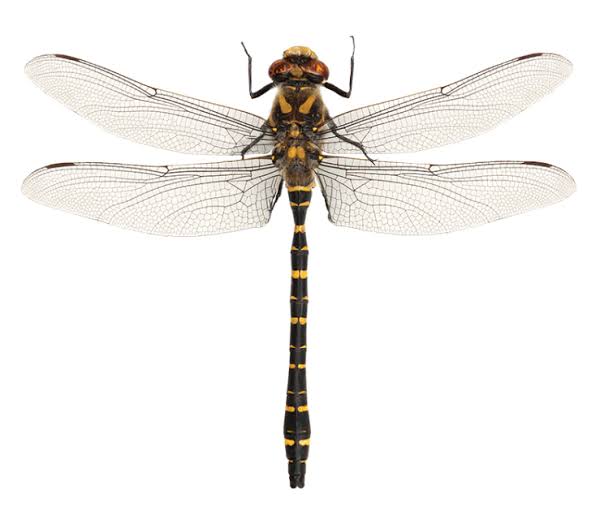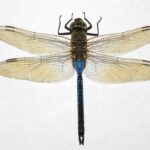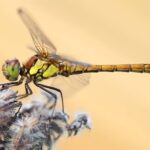
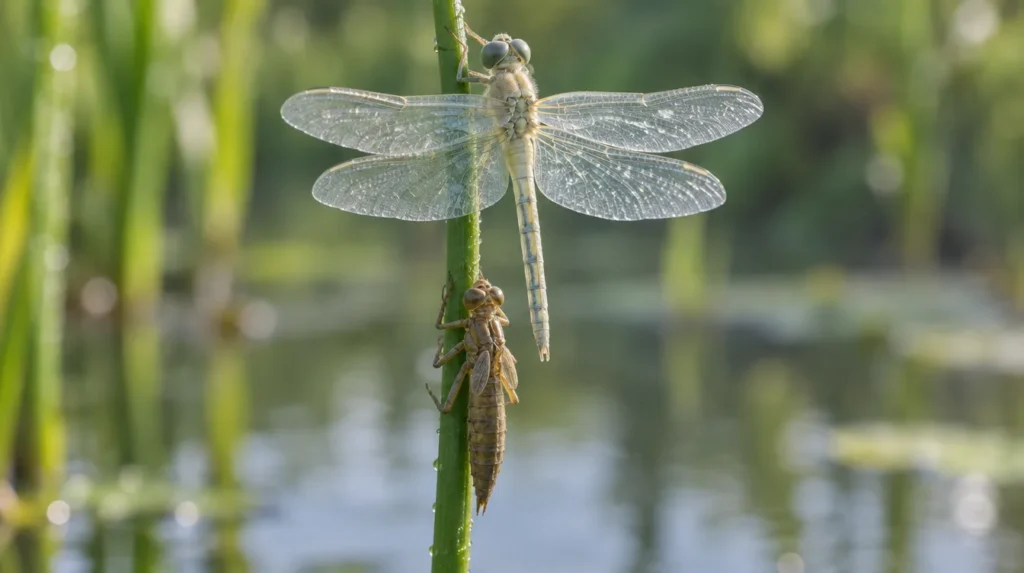
Dragonflies have three life cycle stages: egg, aquatic nymph (larva) and adult. Eggs are laid in or near fresh water. The nymph lives underwater, hunts, and grows through a series of molts. When it is fully grown, it climbs out of the water and molts one last time into a winged adult. There is no pupa stage.
Most of a dragonfly’s life is spent underwater as a nymph. The flying adult you see over a pond is usually the shortest part of the life cycle, not the longest.
The 3 Dragonfly Life Cycle Stages at a Glance
| Stage | Where it happens | What happens | How long it lasts |
|---|---|---|---|
| 1. Egg | In plant tissue, mud, or loose in fresh water | The embryo develops | Days to weeks; some species wait through winter |
| 2. Nymph (larva) | Underwater in ponds, lakes, streams and wetlands | Hunts, grows and molts many times | A few weeks to several years, depending on species and water temperature |
| 3. Adult | In the air, usually near water | Matures, feeds, mates and lays eggs | Often a few weeks; some species longer |
Two transitions link these stages. Emergence is the final molt, when the nymph leaves the water and the adult breaks out of its old skin. The teneral period is the short time right after emergence, when the new adult is pale, soft and not yet able to breed. Both are important parts of the story, but they belong to the adult stage rather than forming extra stages of their own.
Stage 1: The Egg
A dragonfly’s life starts when a mated female lays eggs in or near water. What she does depends on her family.
How dragonflies lay eggs
There are two main methods:
- Inside plant tissue (endophytic). Hawkers and darners have a blade-like ovipositor at the tip of the abdomen. The female perches on a stem, floating leaf or soft wood and cuts small slits to place long, narrow eggs inside. Damselflies lay eggs this way too.
- Loose in the water (exophytic). Many skimmers, chasers and darters lay rounded eggs coated in jelly. The female flies low and taps the tip of her abdomen on the water surface, releasing eggs as she goes. The eggs sink or stick to plants and debris.
In many species the male stays close while the female lays eggs. He may hold on to her in tandem or hover nearby to keep rival males away. You can read more about pairing, the “wheel” position and guarding in our guide to how dragonflies mate.
How long dragonfly eggs take to hatch
There is no single hatching time. For British species, the British Dragonfly Society reports that eggs usually hatch within two to five weeks, while some hawkers and darters lay eggs that do not hatch until the following spring. Waiting through the winter as an egg is one way species in cooler climates time their growth to the warm season.
Temperature matters a great deal. Eggs in warm, shallow water generally develop faster than those in cold water.
Stage 2: The Aquatic Nymph (Larva)
The nymph stage is where a dragonfly does almost all of its growing. You will see this stage called a nymph, larva or sometimes naiad. All three terms refer to the same underwater stage. Many specialists now prefer “larva,” but “nymph” is still common in general writing.
A dragonfly nymph looks nothing like the adult. It has six legs, large eyes, a stout or flattened body, and small wing pads on its back instead of working wings. It breathes with gills hidden inside the rear of its abdomen. By squirting water out of that chamber, it can shoot forward in a quick burst of jet propulsion.
For a closer look at what young dragonflies look like, see what do dragonfly babies look like. For breathing, hunting and identification details, our main dragonfly larvae guide goes further.
The brief prolarva step
The tiny animal that first comes out of the egg is called a prolarva. It does not feed. It molts almost immediately, usually within hours, into the first true feeding nymph. Because the prolarva is so short-lived, most life cycle diagrams leave it out, and it is best understood as the very start of the nymph stage rather than a separate stage.
How dragonfly nymphs grow: molts and instars
An insect’s hard outer skin cannot stretch, so a nymph grows by molting. Each time it sheds its skin, it gets bigger. The period between two molts is called an instar (or stadium).
The number of instars is not fixed. A 2002 review of larval development records by Philip Corbet, covering 118 dragonfly and damselfly species, found a range of 8 to 18 larval stadia, with an average of about 12 and most records falling between 10 and 16. The review also noted that the number can vary within a species, and even among siblings from the same batch of eggs.
You may see other figures, such as “5 to 14 molts.” Numbers differ between sources partly because authors count the earliest stages differently. The safe takeaway is that a dragonfly nymph molts many times, usually around a dozen, and the exact count depends on the species and the conditions it grows in.
What nymphs eat
Nymphs are ambush predators. They catch prey with a hinged lower lip, called the labium or “mask,” which shoots forward and grabs food with hooked tips. Small nymphs eat tiny aquatic animals. Larger ones take aquatic insects, worms and, in some cases, tadpoles or very small fish. See our dragonfly diet guide for how nymph prey differs from adult prey.
How long the nymph stage lasts
This is where dragonfly species differ most. A few examples from specialist sources:
- Fast developers. The Minnesota Dragonfly Society notes that the migratory Wandering Glider (Pantala flavescens) can go from egg to adult in as few as four weeks. Species like this often breed in warm, temporary pools that may dry up.
- Typical temperate species. The same source says most dragonfly larvae mature in one to three years. For Britain, the British Dragonfly Society gives one or two years as typical.
- Slow developers. The British Dragonfly Society reports that the Golden-ringed Dragonfly (Cordulegaster boltonii), which breeds in acidic streams and rivers, can take more than five years. The Minnesota Dragonfly Society mentions some Asian species that may take as long as eight years.
The main factors behind these differences are:
- Species. Large dragonflies often take longer than small ones.
- Water temperature. Warm water speeds up growth; cold water slows it.
- Food supply. Well-fed nymphs grow faster.
- Habitat stability. Species of temporary pools tend to develop quickly. Species of permanent streams and lakes can afford to grow slowly.
The final instar: signs that emergence is near
In the last instar, the wing pads become large and swollen. As emergence gets close, the nymph stops feeding and moves toward the edge of the water, where it can find a stem or other support to climb.
Emergence: How a Nymph Becomes an Adult
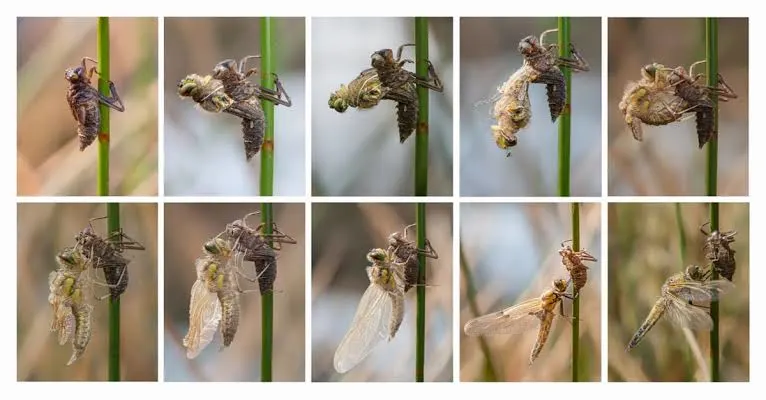
Emergence is the dramatic moment that links the nymph and adult stages. It is the final molt, and it happens out of the water.
Here is the general sequence:
- The nymph climbs out. It crawls up a reed, stem, rock or other support above the water, often at night or in the early morning depending on the species, and grips firmly.
- The skin splits. The old skin opens along the back of the thorax.
- The adult pulls free. The head, thorax, legs and folded wings come out first, then the long abdomen.
- The wings and abdomen expand. The adult pumps body fluid into its crumpled wings and stretches out its abdomen.
- The body hardens. The new adult waits while its wings dry and its outer skin firms up.
The British Dragonfly Society notes that the final molt takes roughly one hour in damselflies and up to about three hours in dragonflies. After that, the Minnesota Dragonfly Society describes the new adult resting for about an hour to let its wings dry before its first flight. Weather, temperature and species all affect the timing.
Emergence is one of the riskiest moments in a dragonfly’s life. A soft, newly emerged adult cannot escape well, and birds and other predators can take many of them. The Minnesota Dragonfly Society reports that up to 90 percent mortality from bird predation has been recorded in one population, although losses vary widely from site to site.
What is a dragonfly exuvia?
The empty skin left behind after emergence is called an exuvia (plural: exuviae). It keeps the shape of the nymph, including the legs, eyes and wing pads, with a split along the back where the adult escaped.
Exuviae are useful to naturalists. An exuvia on a pond plant shows that a dragonfly actually grew up in that water, not just that an adult flew past. In well-studied regions, experienced recorders can identify many exuviae to species with a magnifier and a specialist key, though some remain difficult.
Stage 3: The Adult
The adult stage begins at emergence and has two phases: the teneral period and mature adulthood.
Teneral adults
A teneral dragonfly is one that has just emerged. It usually looks pale or dull, its wings have a glassy shine, and its flight is weak and fluttery. It is not yet ready to breed.
Most tenerals leave the water and spend their first days feeding in sheltered places such as meadows, hedges or woodland edges. For British species, the British Dragonfly Society describes this period as lasting about a week, though it varies by species and weather. During this time, the adult builds up its flight muscles and develops its mature colors.
Because colors change as adults mature, a teneral may look quite different from a mature adult of the same species. Keep this in mind when trying to identify a pale or unusual-looking dragonfly.
Mature adults
Once mature, dragonflies return to water to breed. Males often patrol or defend a stretch of shoreline. Females visit to mate and lay eggs. Adults catch flying insects on the wing, and they use the same hunting skills to fuel both flight and breeding.
The adult’s main job is reproduction. Mating and egg laying bring the life cycle back to Stage 1.
How long adult dragonflies live
Adult life is usually short compared with the nymph stage. For British species, the British Dragonfly Society says most adults live no more than a week or two, though some survive six to eight weeks. The Natural History Museum in London describes adult dragonflies as typically living a few weeks at most. Our article on how long a dragonfly lives explains lifespan by stage in more detail.
How Long Does the Whole Dragonfly Life Cycle Take?
From egg to adult, a complete life cycle can take anywhere from about a month to several years. Scientists describe this pattern with a few terms:
- Multivoltine: more than one generation a year. This mainly happens in warm regions or warm, temporary waters.
- Univoltine: one generation a year, common in many temperate species.
- Semivoltine: one generation takes more than a year, often two or more years, typical of large species and cold waters.
The same species can follow different schedules in different places. A population in a warm, southern lowland pond may develop faster than one in a cold upland pond.
Why Dragonflies Have No Pupa Stage
Dragonflies go through incomplete metamorphosis, also called hemimetabolous development. The young stage grows gradually through molts, and the wings develop outside the body as wing pads. The final molt turns the nymph directly into a winged adult.
Butterflies, beetles and flies are different. They go through complete metamorphosis, with a resting pupa stage between the larva and the adult.
| Dragonfly | Butterfly | |
|---|---|---|
| Type of metamorphosis | Incomplete | Complete |
| Stages | Egg → nymph → adult | Egg → larva (caterpillar) → pupa (chrysalis) → adult |
| Pupa or chrysalis | None | Yes |
| Young stage lives | Underwater | Usually on land, on plants |
| Wings develop | Outside, as wing pads | Inside the pupa |
If you see a life cycle chart that shows a dragonfly with a cocoon or chrysalis, it is wrong.
Do Damselflies Have the Same Life Cycle Stages?
Yes. Damselflies are close relatives of dragonflies. Both belong to the insect order Odonata. True dragonflies belong to the suborder Anisoptera, and damselflies to Zygoptera. Both go through egg, aquatic nymph and adult stages with no pupa.
The differences are in the details:
- Egg laying. Damselflies place their eggs inside plant tissue. Among dragonflies, only some families do this; many drop eggs loose into water.
- Nymph gills. Damselfly nymphs have three leaf-like gills at the tip of the abdomen. Dragonfly nymphs keep their gills inside the abdomen and have no visible tail gills.
- Body shape. Damselfly nymphs are usually slender. Dragonfly nymphs are generally stockier.
Where You Can See Each Stage
You do not need special equipment to see much of the dragonfly life cycle. Here is what to look for near a pond, lake or slow stream in spring and summer:
- Egg laying: Watch for females tapping the water surface in flight, or perched on stems and floating leaves with the abdomen curled down. The eggs themselves are tiny and hard to see.
- Nymphs: A gentle sweep of a pond net through underwater plants may bring up nymphs. Look at them in a shallow tray of pond water, then return them to the same spot.
- Exuviae: Check reeds, stems and rocks just above the waterline, especially in the morning during the emergence season.
- Tenerals: Look for pale, shiny-winged dragonflies with weak flight in grassy areas near water.
- Mature adults: Watch sunny shorelines where males patrol, perch and chase rivals.
A few simple habits protect the animals you are watching:
- Do not handle newly emerged dragonflies. Their wings are soft and easily damaged.
- Leave emergent plants along the water’s edge in place, since nymphs need them to climb out.
- Do not move nymphs from one pond to another.
Our dragonfly habitat guide explains which kinds of water different dragonflies use for breeding.
Dragonfly Life Cycle Stages for Kids
A dragonfly has three stages in its life:
- Egg. A mother dragonfly lays her eggs in water or inside water plants.
- Nymph. A baby dragonfly, called a nymph, hatches and lives underwater. It has no wings yet. It hunts small water animals and sheds its skin many times as it grows.
- Adult. When the nymph is fully grown, it climbs up a plant, splits open its old skin, and a dragonfly with wings comes out. At first it is pale and soft, but soon it can fly.
Dragonflies do not make a cocoon or chrysalis like butterflies do. They change from nymph to adult in one final molt.
FAQ
Does a dragonfly have 3 or 4 life cycle stages?
Biologists describe three stages: egg, nymph and adult. Some charts add emergence or the teneral adult as a fourth step. Those are real and important transitions, but they are part of the move from nymph to adult, not a separate stage like a pupa.
Which dragonfly life stage is the longest?
For most species, the nymph stage. It can last from a few weeks in fast-developing species to several years in slow-growing ones, while most adults live only a few weeks.
Do dragonflies only live for one day?
No. Adult dragonflies usually live for days to weeks, and the whole life cycle often takes a year or more. The one-day idea may come from confusion with mayflies, which are different insects with very short-lived adults in many species.
Can you tell what species a dragonfly exuvia came from?
Often, yes, but not always. Many exuviae can be identified with magnification and a regional specialist key. Some groups are hard to separate, and damaged or very small exuviae may only be identifiable to family or genus.
How This Article Was Checked
We checked the life cycle stages, egg-laying methods, hatching and development times, molt counts, emergence timing and adult lifespans against specialist Odonata societies (British Dragonfly Society, Minnesota Dragonfly Society), natural history museums (Natural History Museum London, Australian Museum) and a peer-reviewed review of larval development in Odonata. Figures are given with the species, region or study they come from, because development times vary widely between species and climates.
References and Further Reading
- British Dragonfly Society. “Life Cycle and Biology.” https://british-dragonflies.org.uk/odonata/life-cycle-and-biology/
- British Dragonfly Society. “Golden-ringed Dragonfly (Cordulegaster boltonii).” https://british-dragonflies.org.uk/species/golden-ringed-dragonfly/
- Minnesota Dragonfly Society. “Dragonfly Life Cycle.” https://www.mndragonfly.org/html/life-cycle.html
- Natural History Museum, London. “Dragonflies: The Ultimate Hunters.” https://www.nhm.ac.uk/discover/dragonflies-the-ultimate-hunters.html
- Australian Museum. “Dragonfly Life Cycle.” https://australian.museum/learn/teachers/learning/dragonfly-life-cycle/
- Corbet, P. S. (2002). “Stadia and growth ratios of Odonata: a review.” International Journal of Odonatology 5(1). https://doi.org/10.1080/13887890.2002.9748176 (summary via Worldwide Dragonfly Association: https://www.worlddragonfly.org/article/13887890-2002-9748176/)