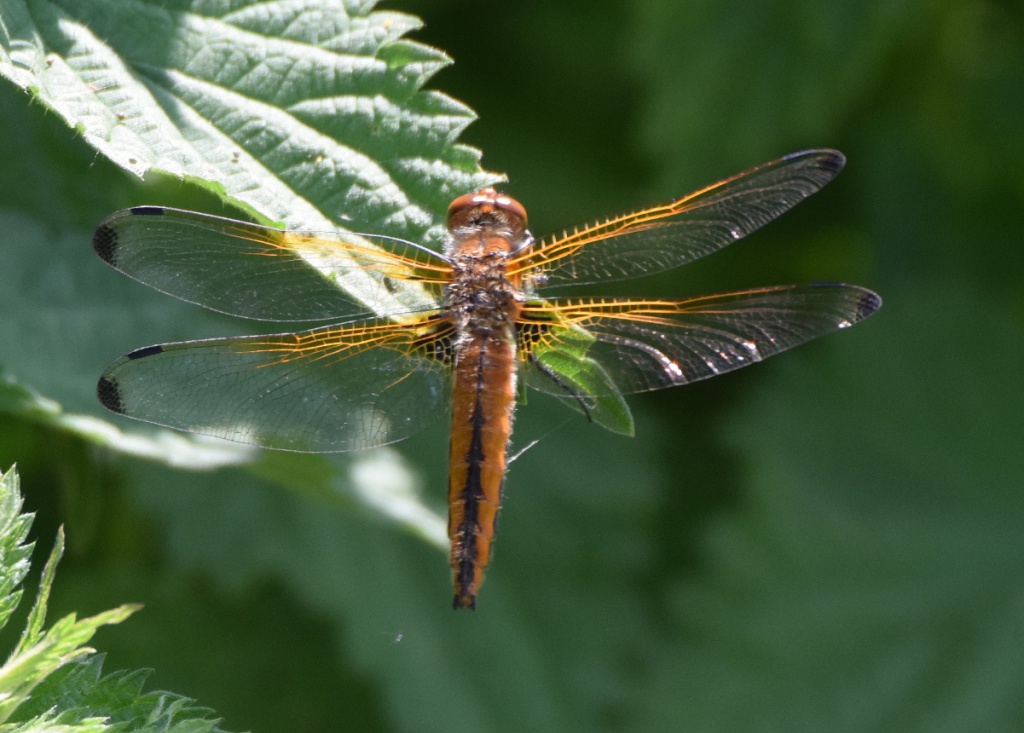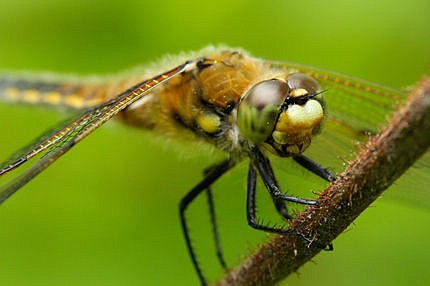
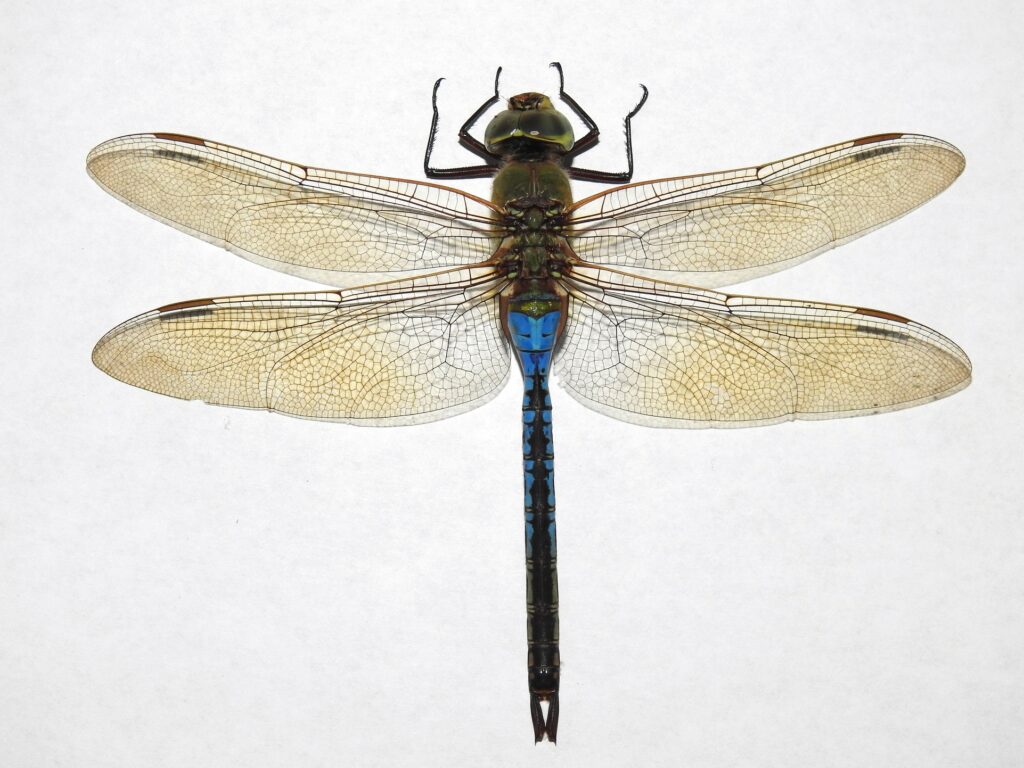
The most reliable way to tell a male dragonfly from a female is to look at the abdomen, not the color. There are two places to check:
- The tip of the abdomen. Males carry clasping appendages there.
- The underside near the base of the abdomen. Males have a bulge of secondary genitalia there.
Females lack that bulge. Instead, they have egg-laying structures near the tip. Color can help once you know the species, but young males often look like females, and some older females take on male-like colors.
This guide covers true dragonflies (Anisoptera). Damselflies follow slightly different rules, explained near the end. For broader identification help, see our dragonfly identification guide.
Quick reference
| Feature | Male | Female |
|---|---|---|
| Abdomen tip | Clasping appendages: two upper and one lower | Two small upper appendages only |
| Underside of segments 2–3 | Visible bulge (secondary genitalia) | Smooth; no bulge |
| Underside of segments 8–9 | Plain | Ovipositor or egg-laying plate |
| Abdomen shape | Often slimmer, sometimes with a “waist” | Often thicker and more even |
| Color | Varies with age and species | Varies with age and species |
1. Check the tip of the abdomen
A dragonfly’s abdomen has ten segments. The easiest way to find a particular segment is to start at segment 10, at the very tip, and count backward.
Males have a set of claspers at the tip. These are formed by two upper appendages, called cerci, and a single lower appendage, called the epiproct. During mating, the male uses these claspers to hold the female by the head.
Females have much simpler appendages. They consist of a pair of cerci with little or no function, and in some species these break off easily.
This is the most useful check in skimmers, chasers and darters, where young males and females can look almost identical. In those groups, female appendages are short and set wide apart, while male appendages are longer and sit closer together.
From the side, look for the male’s lower appendage. A third prong pointing back beneath the upper pair is a strong sign of a male.
2. Look under the base of the abdomen
Males have an unusual reproductive layout. Their sperm is produced near the abdomen tip, in segment 9, but a separate set of secondary genitalia sits near the base of the abdomen. These structures are on the underside of the second and third segments.
In a side-view photo, this shows up as a small bump or keel just behind where the legs attach. Females have no bump there.
Females have their own structures near the tip instead. Under segment 8, a female has either an ovipositor or a subgenital plate, depending on the species. Both are used for egg-laying and extend over segment 9, sometimes beyond it.
3. Compare the shape of the abdomen
Body shape is a helpful supporting clue. The male abdomen is often narrower, or “waisted,” at segment 3, while the female abdomen is almost always sturdier. The British Dragonfly Society illustrates this contrast with male and female Southern Hawkers. See our Southern Hawker profile for that species.
Shape differences vary between species. They are easiest to judge when you compare two individuals of the same species side by side.
4. Look at the base of the hindwing (in some families only)
In some dragonfly families, the rear edge of the hindwing base differs between the sexes:
- Males: the base has an angled corner.
- Females: the base is rounded.
This has been described in darners, for example in the tropical darner Gynacantha rosenbergi. It has also been described in clubtails, for example in the Small Pincertail, Onychogomphus forcipatus. WikipediaWikipedia
This clue does not work everywhere. In skimmers and their relatives (family Libellulidae), both the male hindwing angle and the small ear-like lobes (auricles) on the side of segment 2 have been lost. For the backyard skimmers many people photograph, stick with the abdomen checks. Lima-city
5. Use color carefully
In many species, mature males and females really do look different. In chasers and skimmers, many males develop a powdery blue waxy coating called pruinescence, and male darters turn red or black. Once you know a species well, color can be a quick first guess. You can read more about how dragonfly colors vary. Odo-nutters
Color becomes unreliable in four common situations.
Young males often look like females. Early in the flight season, many recently emerged adults have not yet developed their mature colors, and males at this stage tend to resemble females. In the Black-tailed Skimmer, females and immature males are both deep yellow with wavy black lines. The Widow Skimmer shows the same pattern, with younger males at first resembling females and keeping yellow abdominal markings.
Older females can take on male-like colors. Some very mature female chasers and skimmers develop a little pruinescence, though rarely as much as a mature male. Very mature female darters can develop a red flush similar to a male’s. In the Keeled Skimmer, some females become bluish like the male late in their reproductive life.
Colors change through adult life. In many species, freshly emerged adults (tenerals) are paler, mature adults change color as they become sexually mature, and some become darker with age. The Common Darter is a familiar example.
Photos distort color. Lighting, shade, camera settings and screen display can all shift what you see.
So a blue dragonfly is not automatically a male, and a yellow-brown one is not automatically a female. If the color says one thing and the abdomen says another, trust the abdomen.
6. Behavior as a supporting clue
Behavior can support an identification, but it should not decide it.
Pairs in tandem. When two dragonflies fly or perch connected end to front, the one in front is the male. He holds the female by her head with his claspers. In the “wheel” position, the female curls her abdomen forward to connect with his secondary genitalia. Learn more about how dragonflies mate.
Egg-laying. A dragonfly tapping its abdomen tip into water or pushing it into plant stems is a female laying eggs. In some groups, such as darters and chasers, she releases eggs while dipping over the water. Hawkers insert eggs into plants and often do so alone.
Activity at the water. Many dragonfly species are strongly territorial around breeding sites, and females typically visit water less often than males. A dragonfly repeatedly patrolling the same stretch of shoreline is more likely to be a male, but that alone is not proof.
What about damselflies?
Damselflies (Zygoptera) are close relatives, not true dragonflies, and their end-of-body anatomy differs. In damselflies, both sexes have cerci on segment 10, and males also have a pair of lower appendages called paraprocts. That gives males four appendages at the tip rather than a dragonfly’s three.
The side view is often easy to read. The male’s secondary genitalia under segments 2 and 3 are conspicuous from the side, and the female’s genital opening lies under segments 8 and 9. During mating, a male damselfly grips the female by the pronotum, a plate just behind the head, rather than by the head itself.
If you are not sure whether you are looking at a damselfly or a dragonfly, start with how dragonfly and damselfly wings differ.
A photo checklist for sexing a dragonfly
You don’t need to catch a dragonfly to tell its sex. A clear photo usually works if it shows the right angle.
- A side view of the whole abdomen. This is the single most useful shot, because it shows both the base (segments 2–3) and the tip.
- A close view of the abdomen tip. Try to capture it from the side or slightly below so the lower appendage is visible.
- A top view. This helps with abdomen shape and pattern.
- Where and when you took it. Species identity depends on location and season, and knowing the species makes color clues far more useful.
Some photos simply can’t answer the question. Examples include a dragonfly seen only from above, a tip hidden by vegetation, or a blurred shot. In those cases, “sex uncertain” is the honest answer.
Please avoid handling dragonflies just for a photo. This matters most for freshly emerged adults, whose wings and bodies are still soft.
FAQ
Is the brightly colored one always the male?
No. Mature males are often brighter, but young males can look like females, and some older females develop male-like blue or red tones. Check the abdomen tip and the base of the abdomen to confirm.
In a mating pair, which one is male?
The male is in front. He holds the female behind her eyes with the claspers at his abdomen tip.
Can I tell the sex from a top-down photo?
Sometimes, if the species is known and the individual is fully mature. A side view showing the abdomen base and tip is much more reliable.
References and Further Reading
- British Dragonfly Society. “Dragonflies” (characteristics, male/female features, age-related color). british-dragonflies.org.uk
- Minnesota Dragonfly Society. “Dragonfly Biology” (text from Kurt Mead, Dragonflies of the North Woods). mndragonfly.org
- Curd, J. “Sorting the Boys from the Girls.” Odo-nutters, 2022 (originally written for the BDS e-publication Hawker). odonata.org.uk
- Makeham, A. “Reproduction.” Bedfordshire Odonata. makeham.org
- Bechly, G. “Phylogenetic Systematics of Odonata – Anisoptera.” bechly.lima-city.de
- Wikipedia: “Damselfly,” “Keeled skimmer,” “Black-tailed skimmer,” “Onychogomphus forcipatus,” “Gynacantha rosenbergi” (used only for species-level examples)