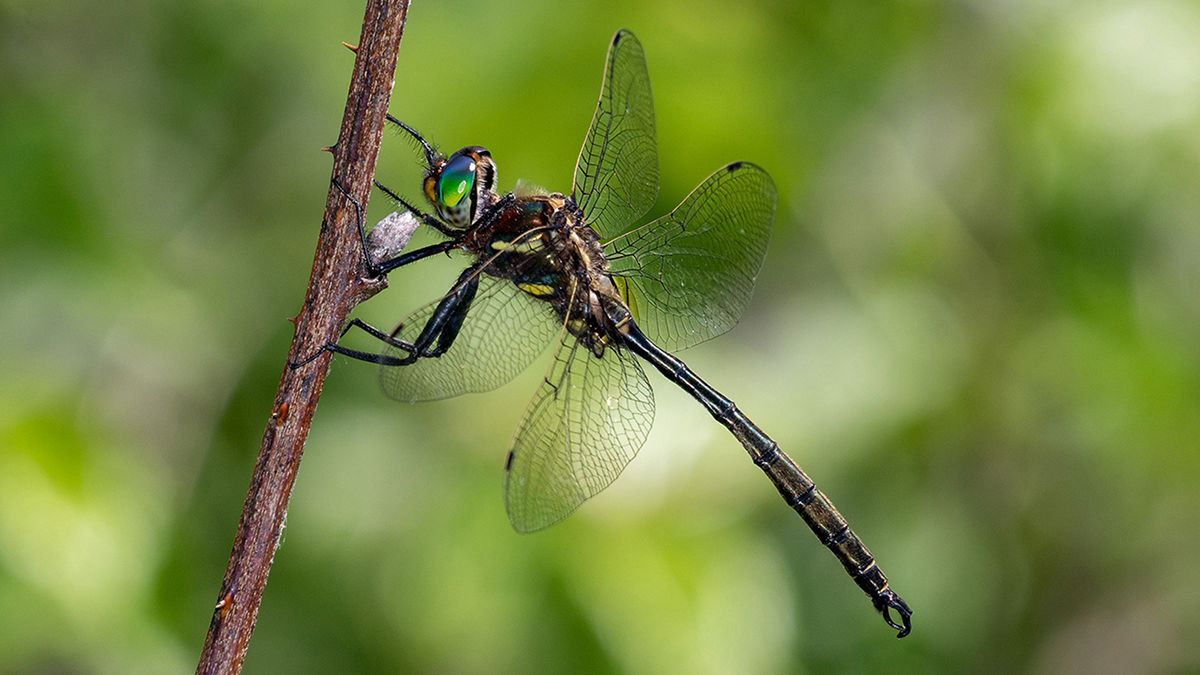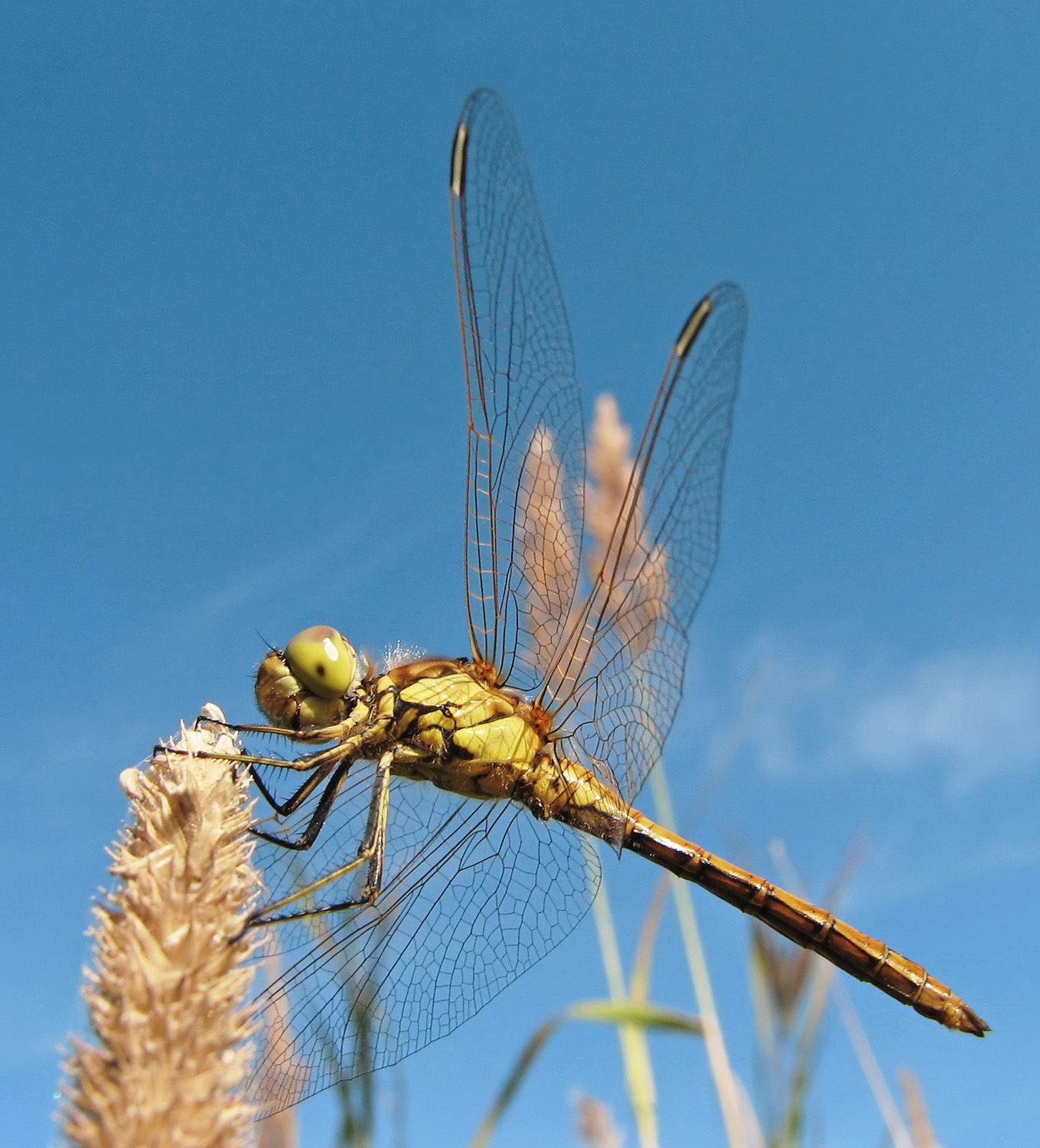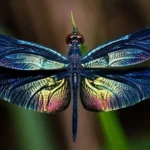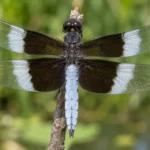
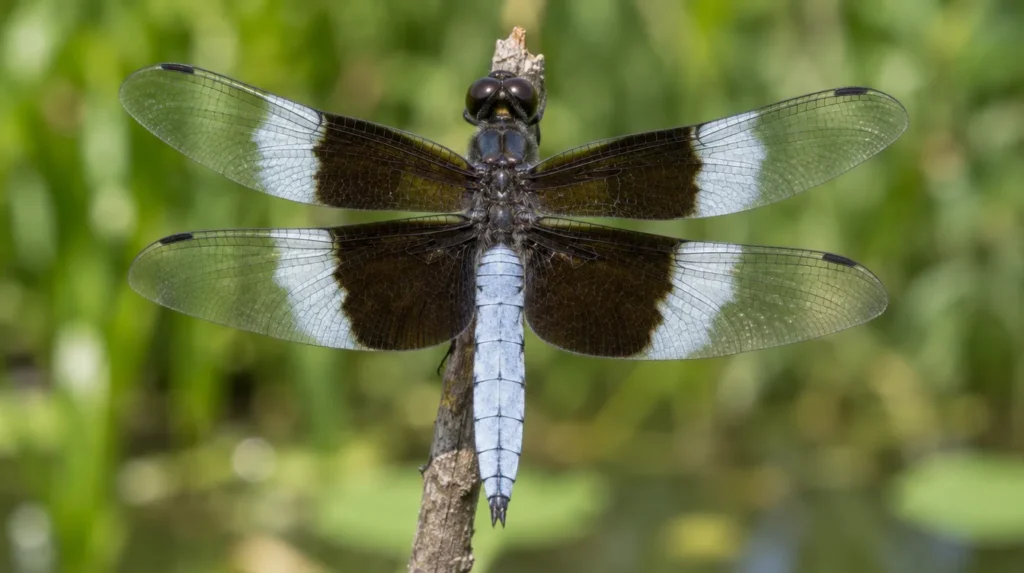
A black dragonfly has no single, universal meaning. In modern spiritual writing it is most often linked with transformation, protection, mystery, grief and remembrance — ideas that come from combining general dragonfly symbolism with Western associations for the color black. We did not find an established historical tradition that gives black dragonflies their own fixed meaning. Biologically, a “black dragonfly” is usually a mature male of a dark species, a dragonfly with dark wing patches, a black-winged damselfly, or an ordinary dragonfly seen against the light.
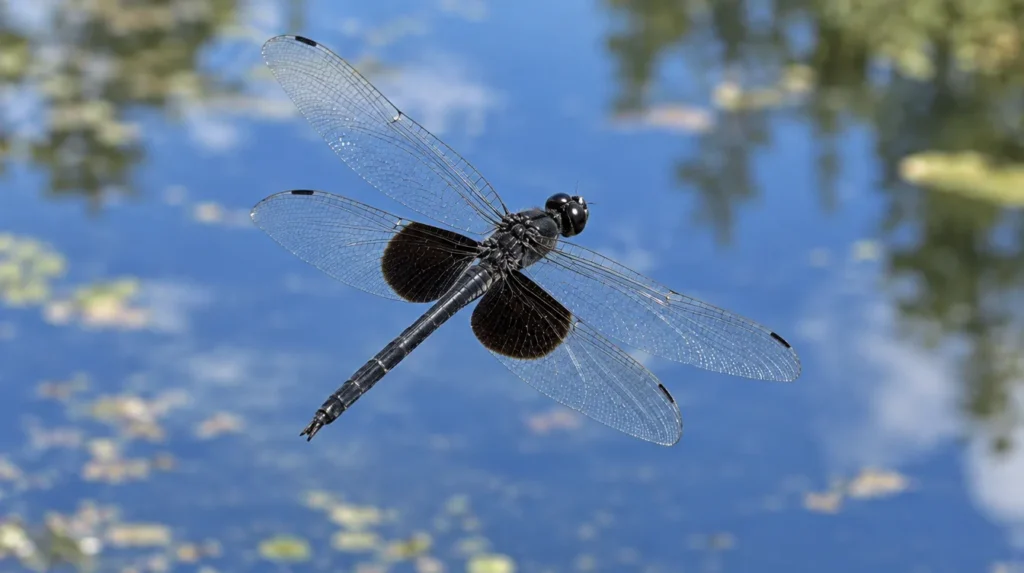
Those layers are often blended together online. This guide keeps them apart, so you can see which meanings are modern interpretations, which come from a named source, and what the insect you saw was most likely doing.
Black Dragonfly Meaning at a Glance
| Layer | What it says about black dragonflies | What kind of claim it is |
|---|---|---|
| Modern symbolism | Transformation, protection, mystery, inner reflection | Recent interpretation built from general dragonfly symbolism and Western color associations |
| Grief and remembrance | Comfort after a loss, or a reminder of someone who has died | Personal belief; black’s link to mourning is a documented Western dress custom, but nothing ties it to the insect |
| Documented naming | A Japanese black-winged damselfly has a regional folk name meaning “god dragonfly”; a North American skimmer’s scientific name means “mournful” | Documented names, not a shared belief system about what a sighting means |
| Biology | Dark coloring usually reflects species, age, sex, wing pigment or lighting | Observable and studied |
What Does a Black Dragonfly Symbolize?
Most black dragonfly meanings you will find online are assembled from two older ideas.
The first is general dragonfly symbolism. Because a dragonfly spends its early life underwater as a nymph and then emerges as a flying adult, it is widely used as a symbol of change and new beginnings. Our guide to dragonfly meaning and symbolism explains where that idea comes from and which cultural traditions are actually documented.
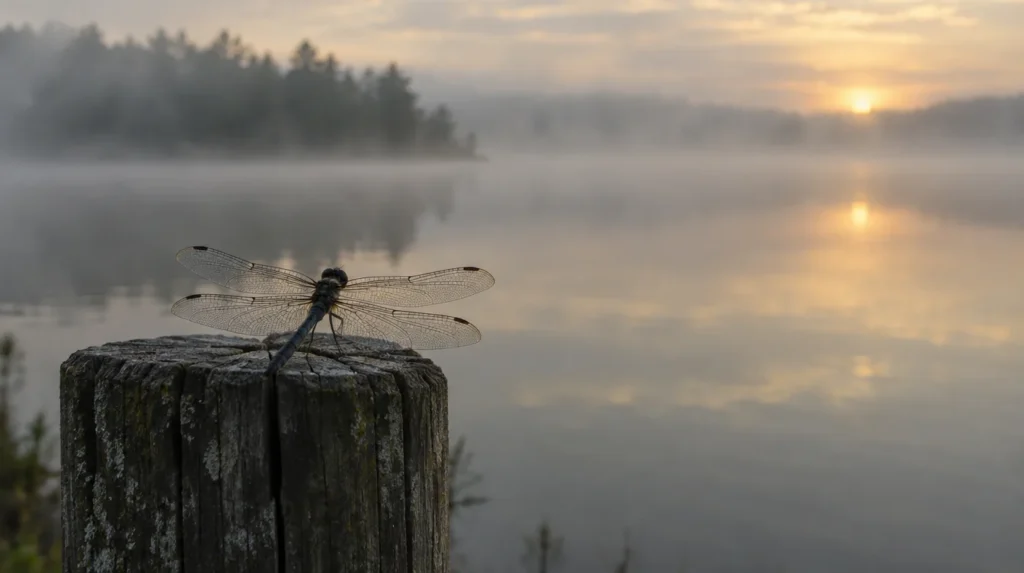
The second is what black means in Western color symbolism. Black has long been the color of mourning in European and American dress. The Metropolitan Museum of Art’s 2014–2015 exhibition Death Becomes Her surveyed a century of mourning clothing, from 1815 to 1915, much of it black. Black is also used in modern design and fashion for formality, mystery and seriousness.
Put those together and you get the meanings most often attached to black dragonflies today:
- Transformation that happens out of sight. The nymph changes underwater, unseen, before it emerges. Some people connect a dark-colored dragonfly with change that is happening quietly or internally.
- Protection and boundaries. In modern spiritual writing, black is often treated as a protective color, so a black dragonfly is sometimes read as a sign to guard your energy or set limits.
- Grief and remembrance. Because black is a mourning color in Western culture, some people associate a black dragonfly with a loved one who has died, or with a period of loss.
- Reflection and the unknown. Black is also used to stand for mystery, introspection and what has not yet been revealed.
These are interpretations, not findings. They vary from writer to writer, and none of them can be traced to one culture, text or period. If one of them resonates with you, it can still be meaningful — as long as it is understood as personal symbolism rather than a fact about the insect.
Is There a Documented Tradition About Black Dragonflies?
Not much, and what exists is narrower than many websites suggest.
A Japanese folk name for a black-winged damselfly
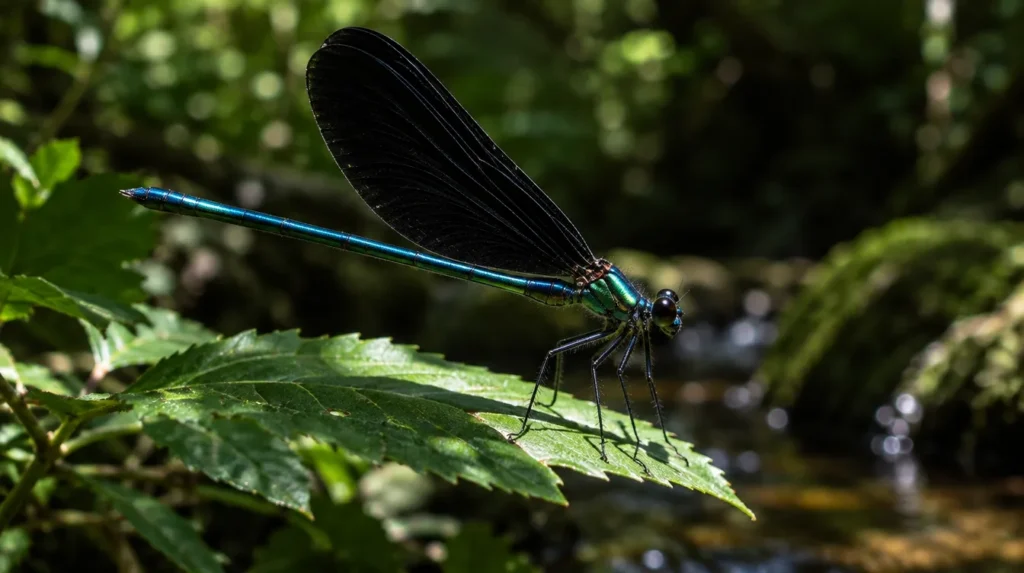
In Japan, the haguro-tonbo (Atrocalopteryx atrata), whose name refers to its black wings, is a familiar insect of shady streams. A September 2026 report from KSB, a regional broadcaster covering Okayama, noted that because it is often seen in shaded woods around the time of Obon grave visits, it is sometimes called by names such as kami-sama tonbo, roughly “god dragonfly.”
Two cautions apply. First, this insect is a damselfly (suborder Zygoptera), not a true dragonfly. The everyday Japanese word tonbo covers both groups, so the “dragonfly” in its name is a language convention, not a classification. Second, a regional folk name is not the same as a documented belief about what seeing one means. We did not find a folklore study describing how widely the name is used or what, if anything, people believe the insect signals.
A dragonfly named for mourning
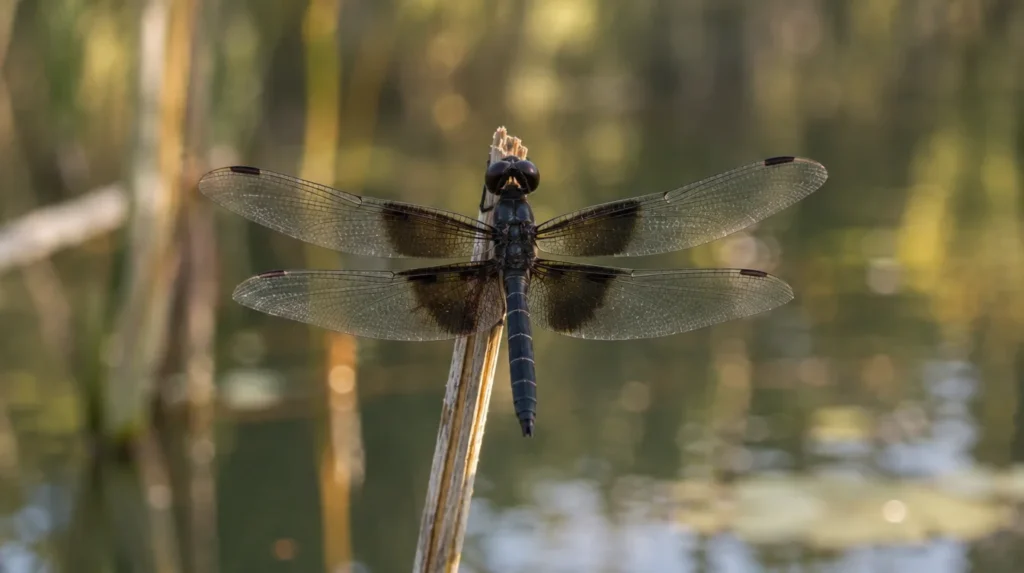
The widow skimmer (Libellula luctuosa), common across much of the United States and southern Canada, carries a mournful name in both languages. The Latin luctuosa means “mournful” or “sorrowful,” and the Missouri Department of Conservation compares the dark bands on its wings to mourning clothing. This is a naturalist’s naming choice based on appearance, not a folk belief about what the insect means.
General dragonfly traditions are not color-specific
The best-documented cultural associations — such as dragonflies as a “victory insect” in Japanese warrior culture, or European nicknames like “devil’s darning needle” — apply to dragonflies in general, not to black ones. If you see a website attach these traditions specifically to black dragonflies, that connection is usually the writer’s own.
Is a Black Dragonfly a Bad Omen or a Sign of Death?
There is no evidence that a black dragonfly predicts death, illness or misfortune, and we found no documented tradition that treats it as a death omen. The association seems to come from black’s role as a mourning color, not from anything the insect does.
Dragonflies are also harmless to people. They have no stinger. A large dragonfly held in the hand may try to bite in self-defense, but it is not dangerous. A dark-colored dragonfly is no different in this respect from a red or blue one.
If seeing a black dragonfly brings someone to mind, that feeling is real and worth respecting. It simply does not mean the insect carries a warning.
Does a Black Dragonfly Mean a Loved One Is Visiting?
Many people describe a dragonfly appearing after a loss and feeling that it was a sign. That is a personal and spiritual interpretation, and it can be a source of comfort. It is not something that can be tested or confirmed.
What can be explained is why the dragonfly was there. Adult dragonflies spend much of their day hunting small flying insects, perching in a favorite spot, defending a patch of water, or looking for a mate, usually near a pond, stream or wet meadow. A dragonfly that lingers near you or returns to the same perch is often using that spot as a lookout. Our guides to what it means when a dragonfly visits you and why dragonflies land on people cover these behaviors in more detail.
Black Dragonfly Claims You May See Online That We Could Not Trace
While researching this guide, we checked natural-history, museum and regional sources for black-dragonfly traditions. Some claims that circulate widely did not hold up:
- “Native Americans believed a black dragonfly means…” Claims like this usually treat hundreds of distinct nations as one group and do not name a specific nation, source or recorded account. We did not find one that did.
- “In ancient cultures, a black dragonfly was an omen of death.” We found no named culture, text or period behind this.
- “A black dragonfly is a rare spiritual sign.” Several black or dark species are common in their regions, so a sighting is usually not rare at all.
That does not prove no such tradition exists anywhere. It means these claims should not be repeated as established fact without a source. Our dragonfly meaning guide explains how to evaluate claims about Indigenous and “ancient” traditions.
Why Is the Dragonfly Black? The Biology Behind the Color
A dragonfly can look black for several different reasons, and the reason affects which insect you are likely to be looking at.
Dark pigment in the body. Some species have dark pigment in the hard outer skeleton (cuticle). In the black saddlebags of North America, mature males are mostly black, while females and young males are browner with pale abdominal spots, according to the Wisconsin Odonata Survey.
Age. Many dragonflies change color as they mature. A newly emerged adult, called a teneral, is pale and soft, and its adult colors develop over the following days or weeks. The Missouri Department of Conservation notes that newly emerged black saddlebags are pale and darken with age. In Britain’s black darter, the British Dragonfly Society describes immature adults as looking like the yellow-ochre females before mature males turn black. Our dragonfly life cycle guide explains emergence and the teneral stage.
Sex. In many species the darkest individuals are mature males. Females of the same species may be yellow, brown or olive, so a black dragonfly and a brown one seen at the same pond may be the same species.
Dark wing patches. Some dragonflies look black mainly because of their wings. In a 2021 study in Proceedings of the National Academy of Sciences, Michael Moore and colleagues examined 319 dragonfly species and found that the dark wing patches of males can warm the insect by up to about 2°C (about 3.5°F). These patches also help males attract mates and deter rivals. Males in warmer regions tended to have less wing pigment, which the researchers linked to avoiding overheating.
Climate and body color. A separate study by Stefan Pinkert, Roland Brandl and Dirk Zeuss, published in Ecography, compared dragonfly communities across North America and Europe. Communities in colder northern regions tended to be darker overall, and those in warmer southern regions lighter. This fits the thermal melanism idea: darker bodies absorb more sunlight and warm up faster, which helps in cool climates. The authors note that other factors, such as camouflage and behavior, also shape color, so the pattern does not explain every dark species.
A wax coating over dark skin. Some dragonflies with dark bodies develop a whitish or bluish powdery wax called pruinescence as they age. Mature male widow skimmers, for example, develop a pale, powdery abdomen this way. Our guide to white dragonfly meaning explains pruinescence in more detail.
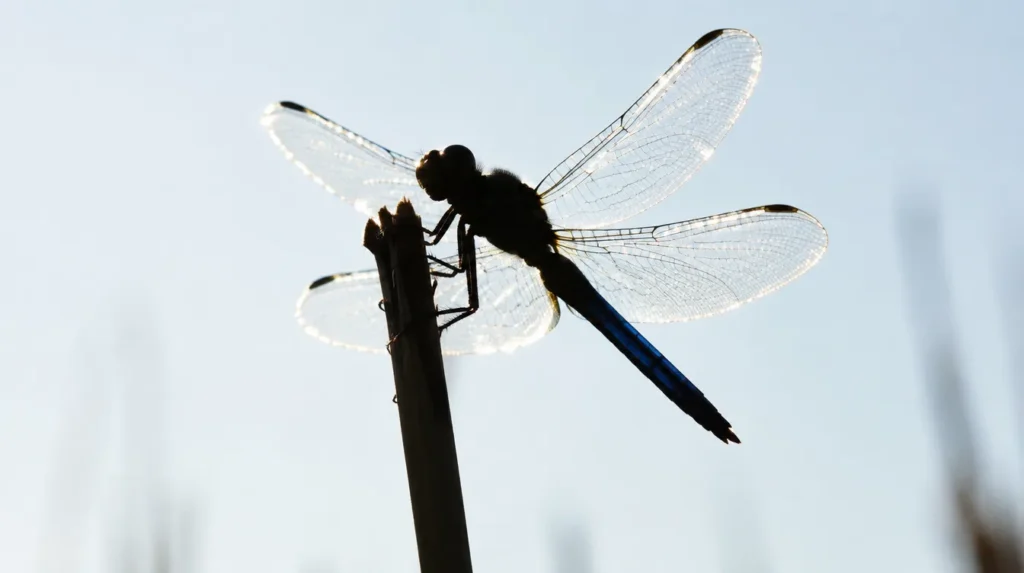
Lighting and photos. A dragonfly seen against a bright sky, perched in deep shade, or flying at dusk can look black even when it is blue, green or brown. Metallic blue-green bodies in particular can appear black in low light, and phone cameras often underexpose a small subject against a bright background. Our article on how dragonfly colors vary covers color variation more broadly.
Which Black Dragonfly Did You See?
“Black dragonfly” is not one species. Several unrelated dragonflies — and some damselflies — look black or very dark. Color alone is not enough for a reliable identification; location, date, habitat, size, wing pattern, face color, and whether the insect is male or female all matter.
| Region | Dark dragonflies and damselflies often seen | Identification notes |
|---|---|---|
| North America | Black saddlebags (Tramea lacerata) | Large black band at the base of each hindwing; mature males mostly black; usually seen patrolling in flight rather than perched |
| North America | Widow skimmer (Libellula luctuosa) | Broad dark bands on the inner half of all four wings; mature males add white wing patches and a pale, waxy abdomen |
| North America | Slaty skimmer (Libellula incesta) | Mature males are dark slate blue with a black face and can look black in shade; females and young males are brown |
| Northern Europe, northern Asia and northern North America | Black darter, called black meadowhawk in North America (Sympetrum danae) | Small; mature males black with yellow markings; females and immatures yellow-ochre. In Britain, mostly on boggy moorland pools |
| Eastern North America | Ebony jewelwing (Calopteryx maculata) | A damselfly, not a true dragonfly. Black wings and a metallic blue-green body; females have a white spot near each wingtip. Found along wooded streams |
| Japan, Korea and China | Haguro-tonbo (Atrocalopteryx atrata) | Also a damselfly. Black wings; males have a metallic blue-green body, females a duller dark body. Shaded streams |
If the insect you saw was slender, held its wings closed above its back at rest, and had eyes set apart on either side of the head, it was probably a damselfly rather than a true dragonfly. Our guide to the wings of dragonflies and damselflies explains one of the clearest differences.
To identify a black dragonfly, try to photograph it from the side as well as from above, and note the place, date and type of water nearby. Our dragonfly identification guide explains which features to check.
How to Hold a Personal Meaning Without Treating It as Fact
If a black dragonfly sighting felt significant to you, a few habits help keep the meaning personal and the facts accurate:
- Ask where the meaning comes from. Is it modern color symbolism, a named tradition, or your own feeling in that moment? All three can matter to you, but they are different kinds of claims.
- Look for a source. If a website says a meaning is “ancient” or belongs to a particular culture, check whether it names a people, place, period or text.
- Remember what the dragonfly was doing. It was most likely hunting, basking, guarding a perch or searching for a mate.
- Let the meaning serve you. A black dragonfly can be a prompt to reflect on a change in your life, or a quiet moment of remembrance, without needing to be a message from outside.
- Enjoy it at a distance. There is no need to catch it. A perched dragonfly often returns to the same spot if you wait patiently.
Frequently Asked Questions
Is a black dragonfly rare?
Usually not. Black saddlebags are described by the Wisconsin Odonata Survey as fairly common across the southern two-thirds of Wisconsin, and widow skimmers are widespread in much of the eastern and central United States. Rarity depends on the species and the region. In Britain, the British Dragonfly Society reports that the black darter has declined significantly over the past 50 years, especially in England, so it is less common there than it once was.
Is a black dragonfly good luck?
Some people see it as a positive sign of transformation or protection; others connect it with grief. Neither view comes from a documented tradition specific to black dragonflies. The insect itself is neither lucky nor unlucky — it is simply going about its life near water.
What does a black and blue dragonfly mean?
Most websites combine the meanings given for each color — black for protection or reflection, blue for calm or clarity. Like the meanings for single colors, this is modern interpretation. See our guide to blue dragonfly meaning for the blue side of that pairing. Biologically, a black-and-blue dragonfly is often a male with blue pruinescence or blue markings on a dark body.
Are black dragonflies dangerous?
No. Black dragonflies are no more dangerous than any other dragonfly. They do not sting, and they only bite if handled. They are predators of small flying insects and are harmless to people, pets and gardens.
What does it mean when a black dragonfly comes into your house?
Most often, it flew in through an open door or window while hunting or moving between perches and could not find its way out. Open a window or door on the bright side of the room and give it time; dragonflies tend to fly toward light. Avoid grabbing it by the wings, which are easily damaged.
How This Article Was Checked
Biological details in this guide were checked against regional and specialist sources: the British Dragonfly Society’s account of the black darter; the Missouri Department of Conservation’s field guides for the black saddlebags, widow skimmer, slaty skimmer and ebony jewelwing; and the Wisconsin Odonata Survey’s account of the black saddlebags. Research on wing pigment and temperature comes from Moore and colleagues’ 2021 study in Proceedings of the National Academy of Sciences, as summarized by Washington University in St. Louis, and research on body color and climate comes from Pinkert, Brandl and Zeuss’s study of North American and European dragonfly communities in Ecography. The Japanese folk name for Atrocalopteryx atrata comes from a September 2026 KSB regional news report from Okayama; we did not find a folklore study confirming how widely the name is used. Information on Western mourning dress comes from the Metropolitan Museum of Art’s Death Becomes Her exhibition. Modern spiritual meanings are described as interpretations and are not attributed to any single culture.