Red Dragonfly Facts: Habitat, Diet, Life Cycle and Identification
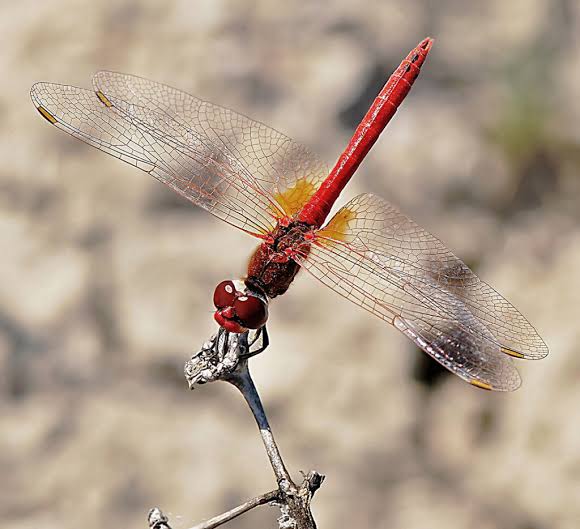
The name “red dragonfly” can describe several unrelated species. This guide focuses on the Red-veined Darter, Sympetrum fonscolombii—a small, strongly migratory dragonfly recognized by its colored wing veins, pale wing spots and blue-grey lower eyes.
What is a red dragonfly?
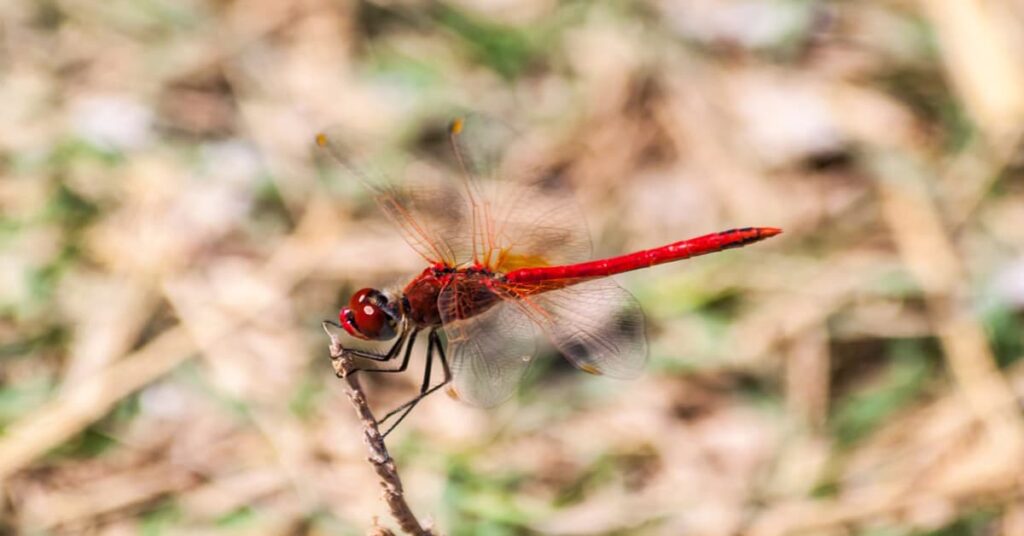
A red dragonfly is not a single biological species. Many male darters, meadowhawks, skimmers and dropwings become red as they mature. The species discussed here is the Red-veined Darter, also called the Nomad, whose accepted scientific name is Sympetrum fonscolombii.
It occurs across much of Africa, southern Europe and parts of Asia, while migrants regularly travel farther north. Adults hunt small flying insects. Their aquatic larvae are also predators, and the species can develop rapidly enough to produce an additional generation during favorable warm seasons.
- Adult body length is approximately 38–40 mm.
- Males are red; females and immature adults are usually yellow or ochre.
- Colored wing veins and pale, black-bordered pterostigmas aid identification.
- It favors sunny, warm and often shallow bodies of water.
- The species is capable of long-distance seasonal migration.
- It has no stinger and is not dangerous to people.
Red-veined Darter quick facts
| Common names | Red-veined Darter and Nomad |
|---|---|
| Scientific name | Sympetrum fonscolombii (Selys, 1840) |
| Order and family | Odonata; Libellulidae |
| Adult length | Approximately 38–40 mm |
| Male coloration | Deep red abdomen, reddish thorax and red veins along parts of the wings |
| Female coloration | Yellow, ochre or sandy-brown abdomen with yellowish wing veins |
| Main identification marks | Pale pterostigmas outlined in black, blue-grey lower eyes, colored wing veins and yellow bases to the wings |
| Distribution | Much of Africa, southern and central Europe, the Mediterranean region and eastward to the Indian subcontinent |
| Preferred habitat | Sunny, shallow ponds, lakes, marshes, coastal wetlands, rice fields, quarry pools and temporary waters |
| Adult diet | Small flying insects, especially midges, flies, mosquitoes and similar aerial prey |
| Larval diet | Aquatic insect larvae and other small freshwater animals |
| Metamorphosis | Incomplete metamorphosis: egg, aquatic larva and adult, with no pupal stage |
| Conservation status | Least Concern in the 2024 European and EU27 IUCN assessments |
How to identify a Red-veined Darter
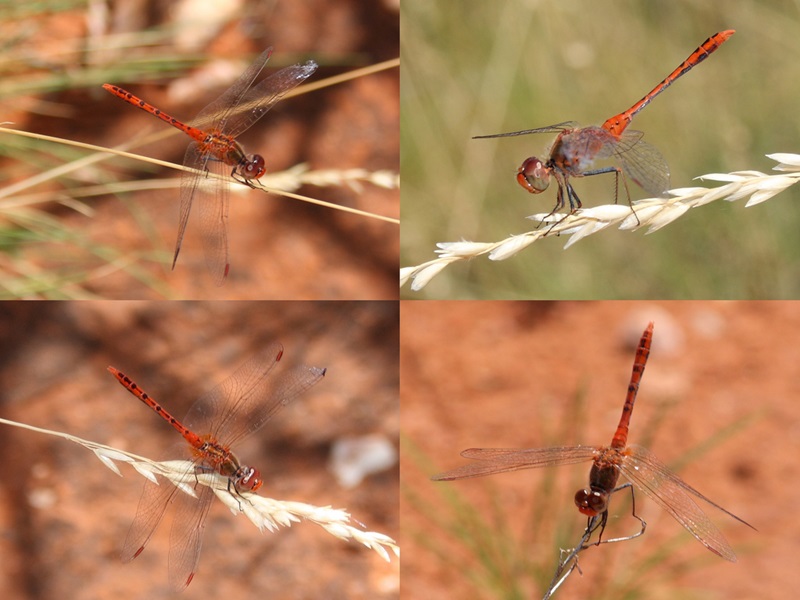
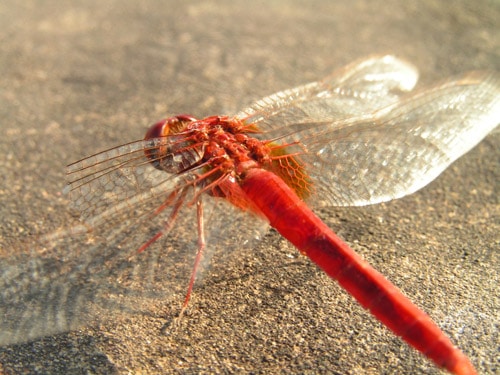
A mature male can appear intensely red, but several dragonflies share that characteristic. A confident identification should combine body color with the eyes, legs, wing veins, pterostigmas and overall body shape.
Mature male
- Deep red abdomen and reddish face.
- Conspicuous red veins, especially near the leading edges of the wings.
- Pale wing spots, or pterostigmas, bordered by dark veins.
- Eyes brownish above and blue-grey below.
- Dark legs with pale or yellow markings.
- Yellow or amber suffusion at the bases of the hindwings.
Female and immature adult
- Usually yellow, sandy or ochre rather than bright red.
- Wing veins are yellowish instead of strongly red.
- The pale, dark-bordered pterostigmas remain useful.
- Immature males initially resemble females.
- Red coloration develops gradually as a male matures.
Similar red dragonflies
| Possible lookalike | Useful distinction |
|---|---|
| Common Darter Sympetrum striolatum | Usually lacks the same combination of extensively red wing veins, blue-grey lower eyes and very pale black-bordered pterostigmas. |
| Ruddy Darter Sympetrum sanguineum | Typically has completely black legs and a more noticeably narrowed, then expanded, club-shaped male abdomen. |
| Broad Scarlet Crocothemis erythraea | Has a broader, flatter abdomen and largely reddish legs rather than the distinctly dark-and-pale legs of a Red-veined Darter. |
Taxonomy: is it still a member of Sympetrum?
Yes. The currently accepted name remains Sympetrum fonscolombii. The Catalogue of Life continued to list this name as accepted in its June 2026 release.
Molecular research has found that the “fonscolombii group” is an old and distinctive lineage within the wider Sympetrum radiation. However, relationships among several major Sympetrum groups have not always been resolved with strong statistical support.
Where do Red-veined Darters live?
The Red-veined Darter has a broad Afro-Eurasian range. It is common across much of southern Europe and occurs widely in Africa, extending eastward through parts of western, central and southern Asia to the Indian subcontinent.
In Europe, it becomes less regular toward the north. Nevertheless, observations have increased greatly in central and northwestern Europe, and wandering individuals have reached Norway, Sweden and Finland.
Is it established in Britain and Ireland?
The situation requires careful wording. The British Dragonfly Society describes the Red-veined Darter as a fairly frequent migrant, particularly in southern Britain. Breeding is recorded regularly, and locally produced adults sometimes emerge later in the same season.
However, British colonies have generally not been consistently stable from year to year. The 2024 European IUCN assessment categorized Great Britain and Ireland as areas where the species is extant but vagrant, rather than presenting both as securely established parts of its permanent breeding range.
How far can a Red-veined Darter migrate?
The alternative name “Nomad” reflects one of the species’ most important characteristics. Red-veined Darters can appear far from breeding water, cross unsuitable dry landscapes and rapidly colonize newly available wetlands.
Stable isotopes are useful because the chemical signature incorporated into an insect’s wings during larval development can reflect the geographic conditions where it grew. Adult dragonfly wings do not regrow, so they retain evidence of the natal region after migration.
Earlier isotope research in Central Asia also supported regular seasonal north–south movements. Spring migrants may reproduce farther north, and their descendants can emerge during late summer or early autumn.
This does not mean that every Red-veined Darter flies thousands of kilometers. Migration distance varies among individuals, regions, seasons, winds and available breeding sites.
Red dragonfly habitat
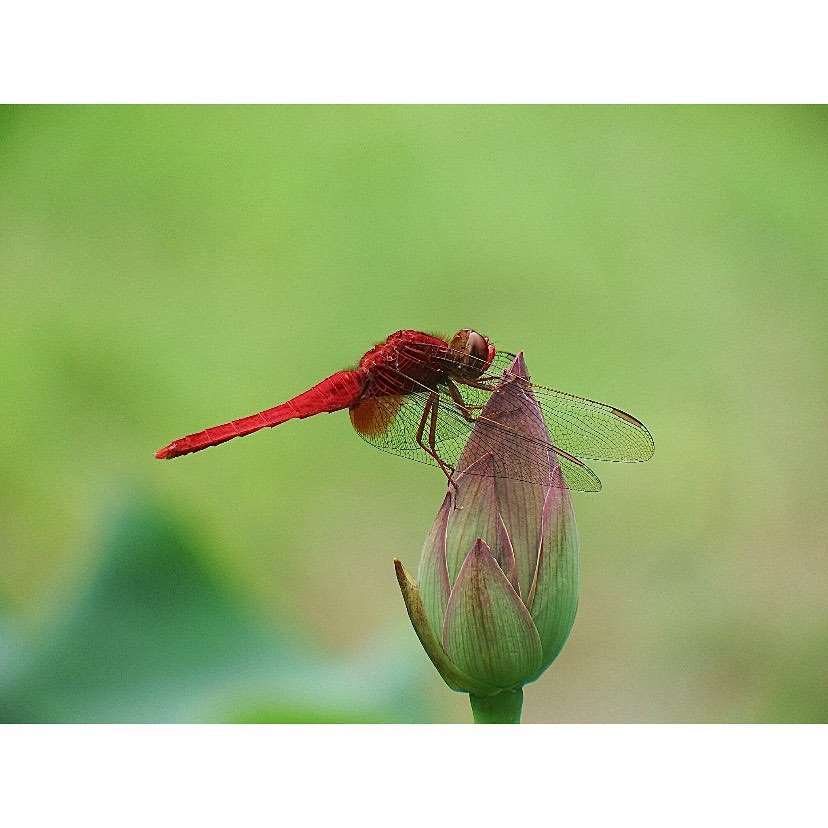
Red-veined Darters breed most successfully in warm, sunny aquatic habitats. They are especially associated with shallow standing water, although they can also occur beside slowly flowing or larger permanent waters.
Typical breeding sites
- Shallow ponds and lakes
- Seasonal pools and temporary wetlands
- Marshes and coastal wetlands
- Rice fields and irrigation systems
- Reservoir margins
- Quarry lakes and sand pits
- Recently created ponds
- Slow sections of rivers and streams
Useful habitat characteristics
- High exposure to sunlight
- Warm, relatively shallow water
- Open banks or limited dense shade
- Aquatic invertebrates for larval prey
- Emergent stems or banks for final emergence
- Nearby vegetation for resting and feeding
In northern Europe, the species is frequently reported at bare, warm and newly formed habitats such as quarry pools, sand pits and recently excavated ponds. In Mediterranean areas, it can be abundant around rice fields and coastal wetlands.
Migrating adults may also be seen over farmland, coastal headlands, urban areas or even the sea. Such sightings do not show that the species can reproduce without freshwater; they show that adults are capable of moving between breeding areas.
Red-veined Darter life cycle
The Red-veined Darter undergoes incomplete metamorphosis. Its three main life stages are egg, aquatic larva and winged adult. Unlike a butterfly, beetle or fly, it never forms a pupa.
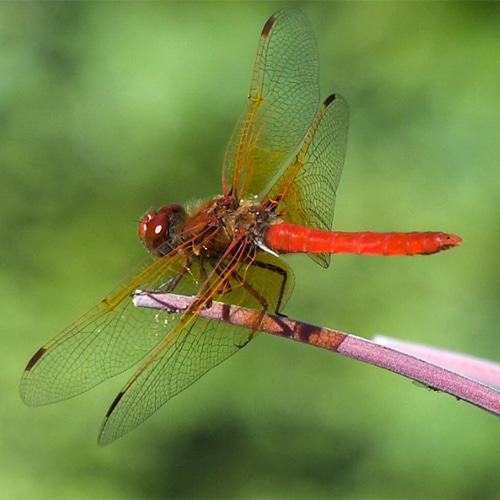
Mating and egg laying
A male clasps a female behind the head, and the pair may form the characteristic mating wheel. After mating, they commonly remain connected in tandem while laying eggs. The female repeatedly touches or dips the end of her abdomen against the water, releasing eggs.
Egg development and hatching
Development rate depends on temperature, water conditions and season. Eggs hatch into aquatic larvae rather than caterpillar-like larvae. Some populations develop immediately, while cold conditions can slow or interrupt development.
Aquatic larval stage
The larva lives underwater, hunting small aquatic animals and repeatedly shedding its exoskeleton as it grows. Dragonfly larvae are sometimes called nymphs or naiads.
Emergence
When development is complete, the larva climbs out of the water onto a stem, stone or bank. Its skin splits, the adult pulls free and then expands its abdomen and wings. The empty larval skin is called an exuvia.
Immature and mature adult
A newly emerged adult is pale, soft and unable to fly strongly. As the exoskeleton hardens, it leaves the water to feed. Mature males gradually develop the species’ characteristic red coloration before returning to breeding sites.
Can the life cycle be completed in three months?
It can develop rapidly under favorable conditions, but “less than three months” should not be presented as a universal duration. Research on dragonfly voltinism shows that generation time changes with latitude, temperature, hydroperiod and local climate.
In warm regions, Red-veined Darters may produce two or more generations in a year. In northern invasion areas, spring or early-summer immigrants can lay eggs whose offspring emerge in late summer or autumn. Other larvae may develop more slowly and overwinter before emerging.
What do red dragonflies eat?
Both adults and larvae are predators, but they hunt in completely different environments. Adults catch insects in the air, whereas larvae ambush prey underwater.
Adult diet
Likely prey includes:
- Midges
- Mosquitoes
- Small flies
- Small moths
- Other suitably sized flying insects
- Occasionally smaller dragonflies or damselflies
Larval diet
Likely prey includes:
- Mosquito larvae
- Midge and other fly larvae
- Small aquatic insects
- Small crustaceans and other invertebrates
- Any suitably sized aquatic animal they can overpower
Dragonfly larvae use an extendable lower mouthpart called the labium. It folds beneath the head when not in use and can be projected rapidly to seize nearby prey.
Larger dragonfly larvae are capable of taking tadpoles or very small fish. However, this is a general observation about Odonata and should not be described as the regular or dominant diet of the Red-veined Darter unless supported by species-specific gut-content or feeding research.
Do red dragonflies control mosquitoes?
Mosquitoes can form part of the diet during both aquatic and adult stages. Nevertheless, a dragonfly is an opportunistic predator rather than a mosquito-only specialist. Its actual diet depends on which prey species are locally abundant and small enough to capture.
How do red dragonflies hunt?
Like other darters, Red-veined Darters frequently hunt from a perch. An adult watches for passing insects, launches into the air, intercepts its target and may return to the same or a nearby perch to feed.
Its large compound eyes provide an exceptionally broad field of view, while the legs form a forward-facing basket that helps trap prey. Independent control of the forewings and hindwings supports hovering, rapid turns and controlled aerial interception.
Do dragonflies really catch 90–95% of their prey?
Some experimental studies have documented very high capture success in selected dragonfly species under controlled or semi-controlled conditions. One widely cited study tested dragonflies pursuing different sizes of fly prey and found that success changed with prey size and speed.
These results demonstrate impressive hunting performance, but they do not prove that every dragonfly species catches exactly 90–95% of its prey in every natural setting. The figure has not been established specifically for Sympetrum fonscolombii.
Behavior and reproduction
Perching and territorial behavior
Mature males frequently occupy exposed perches near water. From these positions they watch for prey, females and rival males. A male may repeatedly leave and return to the same stem, stone or patch of bare ground.
Tandem egg laying
After mating, the male often remains attached to the female while she deposits eggs. Tandem oviposition can reduce interference from rival males and helps the pair remain together over the breeding site.
Seasonal activity
In warm southern parts of the range, adults may be recorded during much of the year. Farther north, records are concentrated in the warmer months, often from late spring through autumn. Exact flight periods vary substantially with location and yearly weather.
Why are males red?
Immature males begin with yellowish or ochre coloration and become red as they mature. Color change in dragonflies is associated with changes in pigments, cuticular structure and sexual maturation. The red color is therefore a sign of adult development rather than a separate life stage or species.
How fast can a Red-veined Darter fly?
No reliable species-specific study was located that establishes a maximum speed of 56 km/h, or 35 mph, for the Red-veined Darter. General speed estimates for large dragonflies should not automatically be applied to this much smaller species.
Red-veined Darters are clearly capable and persistent fliers, as demonstrated by their long-distance migration. However, migration distance is not the same measurement as maximum instantaneous flight speed.
Conservation status and population trend
The 2024 IUCN assessment classified the Red-veined Darter as Least Concern in both Europe and the EU27. It is widespread, common across much of its range and can occur at high densities.
The European assessment listed its current population trend as increasing. Its strong dispersal ability and use of newly created or temporary waters help it colonize suitable habitat quickly.
The species has expanded northward in Europe during recent decades. The IUCN assessment considers continued climatic warming likely to facilitate further expansion, although weather, water availability and migration conditions also affect individual years.
Red dragonfly meaning and symbolism
Dragonflies are frequently used as symbols of transformation because they move from an aquatic larval existence to an aerial adult life. Modern symbolic interpretations of red dragonflies also associate the color red with energy, passion, courage, love, remembrance or major life transitions.
These interpretations belong to personal belief, art, folklore and cultural storytelling. They are not zoological characteristics and should not be presented as scientific facts.
Does a red dragonfly predict death?
No scientific evidence shows that seeing a red dragonfly predicts death, misfortune or any future event. A sighting normally means that an adult is feeding, resting, searching for a mate or moving between suitable habitats.
Someone may still choose to view the encounter as a personal symbol of memory or change. The important distinction is that personal meaning is subjective, while the insect’s presence has ordinary ecological explanations.
Red dragonfly claims: fact or myth?
-
Claim: Every red dragonfly is a Red-veined Darter.
False. Numerous dragonfly species develop red males. -
Claim: The species is permanently established throughout Britain and Ireland.
Misleading. Migrants and local breeding occur, but stable colonies have not been consistently maintained across those areas. -
Claim: Its life cycle always takes less than three months.
False. Development can be rapid, but generation time changes with location, water conditions and temperature. -
Claim: Red-veined Darters fly at exactly 56 km/h.
Unsupported. No reliable species-specific measurement was found. -
Claim: Every dragonfly catches 90–95% of all prey.
Overgeneralized. High rates come from particular experiments and cannot be assigned to every species and habitat. -
Claim: Dragonfly larvae mainly eat fish and tadpoles.
Misleading. Most prey consists of suitably sized aquatic invertebrates; vertebrate prey is possible for larger larvae but is not necessarily a staple. -
Claim: Red dragonflies are dangerous or can sting.
False. Dragonflies have no stinger and do not attack people. -
Claim: A red dragonfly is a scientific sign of death or bad luck.
False. Such meanings are spiritual or cultural interpretations, not biological evidence.
How to find and observe a Red-veined Darter
- Visit warm, sunny ponds, shallow lakes, quarry pools, marshes or rice-growing areas during suitable seasonal weather.
- Search exposed stems, stones and open banks where males can perch with an unobstructed view.
- Use binoculars or a telephoto lens to check the eyes, pterostigmas, wing veins and legs rather than relying only on body color.
- Photograph the insect from the side and slightly above so that the abdomen, thorax, legs and all four wings are visible.
- Record the date, location, habitat and behavior, especially tandem egg laying, newly emerged adults or discarded larval skins.
- Avoid chasing, handling or repeatedly flushing a resting dragonfly, particularly during hot weather.
Frequently asked questions
Are red dragonflies rare?
It depends on the species and location. The Red-veined Darter is common in many southern parts of its range but remains an irregular migrant farther north. A red dragonfly may seem rare simply because only mature males display the strongest red coloration.
What is the scientific name of the Red-veined Darter?
Its currently accepted scientific name is Sympetrum fonscolombii (Selys, 1840).
How large is a Red-veined Darter?
The British Dragonfly Society gives an adult body length of approximately 38–40 mm, making it a relatively small dragonfly.
Where are Red-veined Darters found?
Their range covers much of Africa, southern and central Europe, the Mediterranean region and parts of Asia extending to the Indian subcontinent. Migrants can travel much farther north.
What habitat do red dragonflies prefer?
Red-veined Darters favor warm, sunny and often shallow waters, including ponds, marshes, seasonal pools, rice fields, coastal wetlands, quarry lakes and recently created ponds.
What do adult red dragonflies eat?
Adults catch small flying insects such as midges, flies and mosquitoes. They may also take small moths or other suitably sized aerial insects.
What do Red-veined Darter larvae eat?
Larvae prey mainly on small aquatic animals, including mosquito larvae, midge larvae and other freshwater invertebrates.
Do red dragonflies eat mosquitoes?
Yes. Aquatic larvae may eat mosquito larvae, and adults may catch flying mosquitoes. However, mosquitoes are only one part of a varied predatory diet.
Do Red-veined Darters migrate?
Yes. They are strong seasonal migrants. Stable-isotope research has indicated migration distances of approximately 2,000–4,000 km for some individuals reaching European Russia from southwestern Asia.
How many generations can they produce each year?
The number varies. Warm climates can support two or more generations, while cooler northern sites may support only a summer generation or require some larvae to overwinter.
Do dragonflies have a pupal stage?
No. They undergo incomplete metamorphosis and develop from egg to aquatic larva and then directly to the winged adult.
Are female Red-veined Darters red?
Females are generally yellow, ochre or sandy brown. Immature males initially look similar to females and become red as they mature.
Are red dragonflies dangerous?
No. Dragonflies have no stinger and do not attack humans. They are beneficial insect predators and should be observed without handling.
What does seeing a red dragonfly mean?
Biologically, it means a dragonfly is resting, feeding, breeding or migrating in the area. Symbolically, some people associate red dragonflies with energy, love, remembrance or transformation, but those interpretations are personal rather than scientific.
Is the Red-veined Darter endangered?
No. It was assessed as Least Concern in Europe and the EU27 by the IUCN, with an increasing regional population trend.
Scientific sources and further reading
- British Dragonfly Society. Red-veined Darter: identification, status, habitat and distribution .
- Prunier, F., Billqvist, M., De Knijf, G., van Grunsven, R.H.A. and Vinko, D. 2024. IUCN Red List assessment for Sympetrum fonscolombii .
- Catalogue of Life. Accepted taxon record for Sympetrum fonscolombii .
- Borisov, A.S. et al. 2024. Origin of Red-veined Darters migrating into European Russia revealed by stable hydrogen isotopes . Ecological Entomology, 49: 974–978.
- Borisov, S.N. et al. 2020. Isotope evidence for latitudinal migrations of Sympetrum fonscolombii in Middle Asia . Ecological Entomology, 45: 1445–1456.
- Borisov, S.N. et al. 2020. Northern limits of distribution and migration strategy of Sympetrum fonscolombii in Russia . Eurasian Entomological Journal, 19(6): 322–328.
- Pilgrim, E.M. and von Dohlen, C.D. 2012. Phylogeny of the dragonfly genus Sympetrum . Organisms Diversity & Evolution, 12: 281–295.
- Corbet, P.S., Suhling, F. and Soendgerath, D. 2006. Voltinism of Odonata: a review . International Journal of Odonatology, 9(1): 1–44.
- Combes, S.A., Salcedo, M.K., Pandit, M.M. and Iwasaki, J.M. 2013. Capture success and efficiency of dragonflies pursuing different types of prey . Integrative and Comparative Biology, 53(5): 787–798.
- Natural History Museum. Dragonflies: the ultimate hunters .
Editorial fact-check methodology
Taxonomy was checked against the current Catalogue of Life record. Identification and British status were checked against the British Dragonfly Society. European range, habitat, status and population trend were checked against the 2024 IUCN assessment.
Migration claims were limited to results supported by peer-reviewed stable isotope studies. General findings about dragonfly diet, larval feeding and capture success are clearly identified as general Odonata evidence when they have not been measured specifically in the Red-veined Darter.
Unsupported claims concerning a fixed 56 km/h flight speed, a universal three-month life cycle, imminent taxonomic reclassification and supernatural omens were removed or qualified.
Last fact-checked: July 14, 2026