Do Dragonflies Like the Rain?
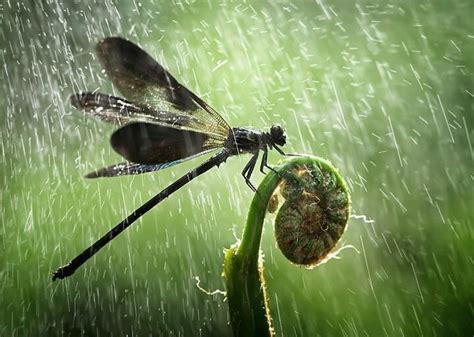
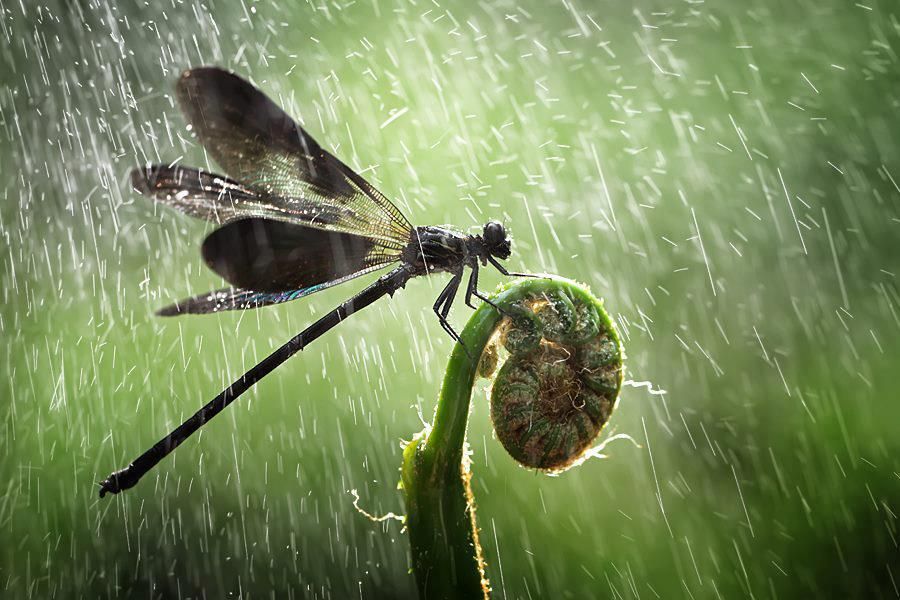
Most adult dragonflies reduce flight and seek sheltered perches during cold conditions, strong wind, or heavy rain. Light rain does not necessarily stop every species immediately, especially when the air remains warm and calm. Their response depends on species, temperature, wind, light, rainfall intensity, and whether they are feeding, breeding, or migrating. Biologically, saying dragonflies “like rain” is usually too simple.
Do Dragonflies Actually Like Rain?
Rain is neither something all dragonflies actively seek nor something every individual completely avoids. Adult dragonflies are ectothermic insects, so their flight performance is strongly influenced by environmental heat. They can gain heat from sunlight, warm air, muscular activity, and, in some larger species, rapid wing vibration.
Cloud cover can reduce solar warming, while wind increases heat loss and makes controlled flight more difficult. Rain may add further cooling and expose an insect to repeated droplet impacts. For these reasons, a cold, windy downpour usually suppresses adult activity much more than a brief shower on a warm, still day.
There is no single temperature or rainfall threshold that applies to every dragonfly. Large, continuously flying hawkers do not necessarily respond in the same way as smaller skimmers or perch-hunting species. Age, body size, habitat, reproductive behavior and local adaptation also matter.
Light rain
Some adults may continue short feeding, territorial or travel flights, particularly when temperatures remain warm and the air is calm.
Heavy rain
Flight usually becomes less favorable, and adults are more likely to remain perched until rainfall weakens.
Windy storms
Strong or turbulent wind can be as important as the rain itself because it affects stability, direction and heat loss.
Cool overcast weather
Activity often declines when reduced sunlight and cooler air make it harder to maintain effective flight-muscle temperature.
Can Dragonflies Fly in Light Rain?
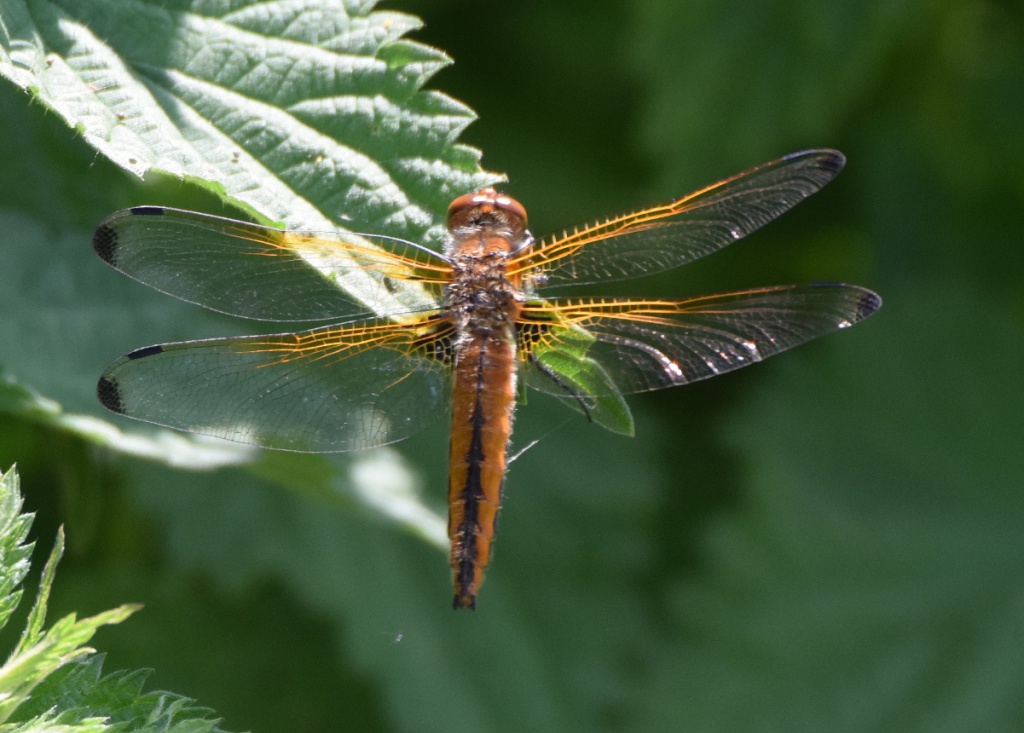
Some dragonflies can remain airborne during drizzle or scattered light rain. A few drops do not automatically make a mature dragonfly incapable of flying. Dragonfly wings have microscopic surface structures and wax-like compounds that make them water-repellent. Laboratory studies have found hydrophobic or superhydrophobic properties in the wings of multiple species, allowing droplets to bead or roll away.
However, water repellency should not be interpreted as unlimited rain resistance. Wing studies measure surface wettability; they do not establish that every dragonfly can fly normally through a prolonged storm. Rainfall also changes air temperature, wind, visibility and prey behavior. A dragonfly may therefore stop flying even when its wing surface is still shedding water.
Can a dragonfly fly when wet? A few droplets on an undamaged, hardened wing do not necessarily prevent flight. A thoroughly chilled or saturated insect may remain perched until conditions improve. Newly emerged adults are much more vulnerable because their wings and body tissues have not yet fully hardened.
What Happens During Heavy Rain?
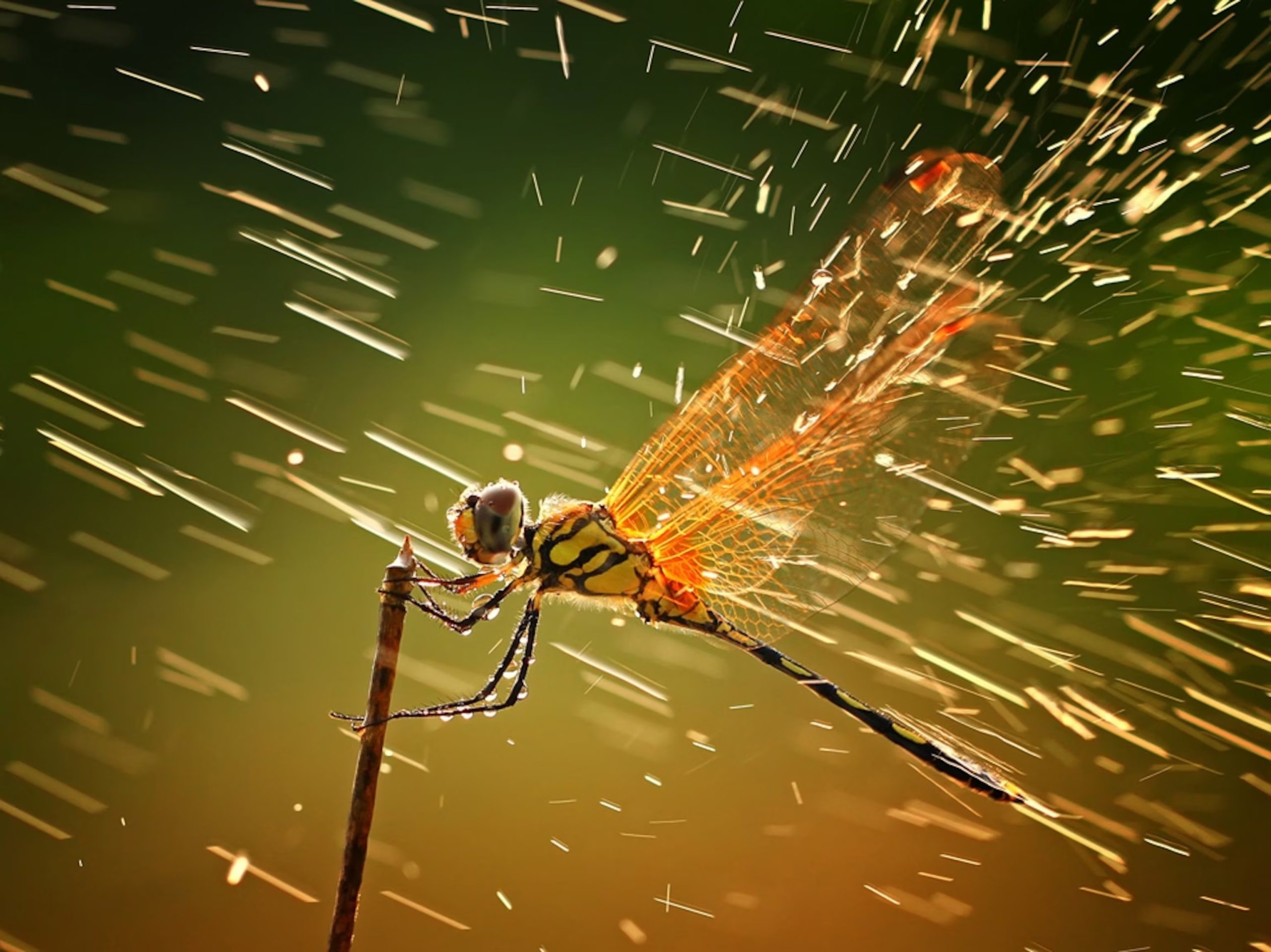
During sustained or forceful rain, most visible adult activity is likely to decrease. Flying exposes the insect to cooling, wind and repeated droplet impacts, while remaining attached to a stable perch conserves energy and reduces displacement.
Heavy rain is especially hazardous during emergence. A dragonfly nymph must climb above the water, shed its larval skin and expand its new wings. Until the wings harden, rain or strong wind can deform or damage them. This is different from a mature dragonfly with fully hardened wings.
A storm may also temporarily disrupt territorial patrols, mating and egg-laying at open water. These activities can resume when rain weakens, but the timing varies among species and locations.
Where Do Dragonflies Go When It Rains?
Dragonflies do not have one universal storm shelter. Adults commonly perch in reeds, grasses, shrubs, trees and other vegetation. During poor weather they may move into a lower, denser or more sheltered part of the vegetation, where leaves and stems reduce exposure to rain and wind.
The shelter may be beside a pond, farther into bankside plants, or in terrestrial feeding and resting habitat away from water. Because females and immature adults of many species spend substantial time away from breeding water, the dragonflies that disappear from a pond have not necessarily left the entire area.
Why Do Dragonflies Appear After Rain?
Dragonflies may become easier to see when a shower is followed by warmth, sunlight and calmer wind. Adults that were resting can return to feeding, territorial patrols, mating or egg-laying. This sudden return to flight can create the impression that rain produced or attracted the dragonflies.
Rain may also change the habitat. Seasonal rainfall can refill wetlands, raise pond levels or create temporary pools. These changes may make some sites suitable for species adapted to temporary water, but they do not benefit every dragonfly. Flooding, fast runoff, sediment and abrupt water-quality changes can be unfavorable to other species.
Small flying insects may sometimes become abundant after warm rain, providing feeding opportunities. It is nevertheless inaccurate to say that every rainfall event produces large numbers of mosquitoes or that mosquitoes alone explain every post-rain dragonfly gathering. Dragonflies eat a varied diet of midges, flies and other airborne insects, and local prey responses differ with season and habitat.
Do Dragonflies Know a Storm Is Coming?
Seeing dragonflies fly low before rain does not prove that they consciously predict storms. They may be responding to conditions that have already changed, such as stronger wind, lower light, cooling air or changes in the height and distribution of their prey.
Flying lower can place an insect in a more sheltered layer of air near vegetation, but a single low-flying dragonfly is not a reliable weather forecast. Claims that dragonflies always fly low before rain go beyond the available evidence.
How Weather Affects Dragonfly Activity
- Temperature: influences how quickly flight muscles can reach and maintain an effective operating temperature.
- Sunlight: provides radiant heat used by many species while basking or perching.
- Cloud cover: can reduce light and solar warming, although warm overcast conditions do not stop every species.
- Wind: affects flight control, direction, energy use and convective heat loss.
- Rain intensity: separates a brief light shower from a prolonged, physically disruptive downpour.
- Species and behavior: perchers, continuous fliers, territorial adults and migrants may respond differently.
Weather can be particularly important during migration. Studies of migrant hawkers and darters along the Baltic coast found that temperature, cloud cover and wind direction helped predict migration intensity, but the species did not respond identically. Research on the globe skimmer, Pantala flavescens, also links its long-distance movements with favorable winds, seasonal rain systems and temporary breeding waters.
These findings apply to particular migratory species and routes. They should not be used to claim that all dragonflies follow storms or migrate with monsoon rainfall.
What Rain Means for Dragonfly Nymphs
Adult dragonflies respond to rain over minutes or hours, but aquatic nymphs experience its effects through changes in their water habitat. Rainfall can alter water depth, temperature, current, dissolved oxygen, sediment and water chemistry. The result depends on the type of waterbody and the species living there.
Some dragonflies are adapted to temporary pools filled by seasonal rain and can develop rapidly before those pools dry. Species associated with permanent ponds, slow streams, bogs or rivers may have very different requirements. Severe flooding can disturb substrate or vegetation, while drought can reduce habitat or strand suitable emergence supports.
To understand why dragonflies remain closely associated with water, see the guides to the dragonfly life cycle and aquatic dragonfly larvae.
Frequently Asked Questions
Can dragonflies fly when their wings are wet?
They may still fly if the wings are mature, undamaged and carrying only limited water. Their water-repellent wing surfaces help droplets move away, but cold, saturation, strong rain or wind can keep an adult perched.
Do dragonflies hide during storms?
Most adults reduce exposed flight during cold, windy or heavy rain and rest on vegetation or other stable perches. The precise shelter varies among habitats and species.
Why are dragonflies flying low before rain?
They may be following low-flying prey or using calmer air near vegetation as weather conditions change. Low flight does not prove that a dragonfly can predict an approaching storm.
Does rain attract dragonflies?
Rain does not universally attract adult dragonflies. It can change water availability, vegetation, prey activity and migration conditions, making dragonflies more noticeable in some places but less active in others.
Are dragonflies more active after rain?
They can be more visible after rain when sunshine returns, temperatures rise and wind decreases. Continued cool, cloudy or windy weather may instead keep activity low.
Sources and Further Reading
- British Dragonfly Society: Dragonfly Survey Guidance
- British Dragonfly Society: Life Cycle and Biology
- British Dragonfly Society: Frequently Asked Questions
- Knoblauch et al.: Autumn Southward Migration of Dragonflies Along the Baltic Coast
- Wikelski et al.: Simple Rules Guide Dragonfly Migration
- Hedlund et al.: The Indian Ocean Crossing of the Globe Skimmer Dragonfly
- Hasan et al.: Surface Characteristics and Wettability of Dragonfly Wings
- National Biodiversity Data Centre: Dragonfly and Damselfly Biology