Dragonfly biology
How Long Does a Dragonfly Live?
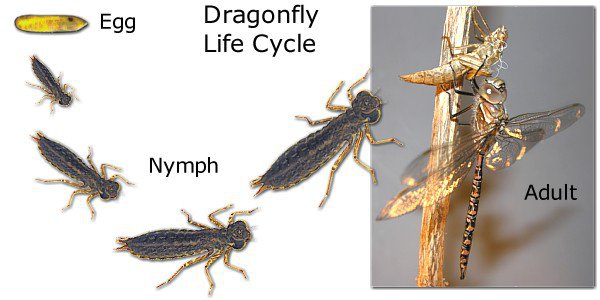
Adult dragonflies commonly live for several weeks, although some individuals may survive longer under favorable conditions. The complete life cycle can take a few months in fast-developing species or several years in species from cooler or less productive waters. Most of that time is usually spent underwater as an aquatic nymph, whose development ranges from weeks or months to more than five years in exceptional species. [1] [3] [5]
Dragonfly Lifespan at a Glance
Some adults survive only days, while favorable conditions may allow certain species to remain alive for one or more months.
There is no single duration that applies to every species, climate, latitude or aquatic habitat.
Rapid species may develop within weeks or months, while cold-water species may remain aquatic for years.
How Long Do Adult Dragonflies Live?
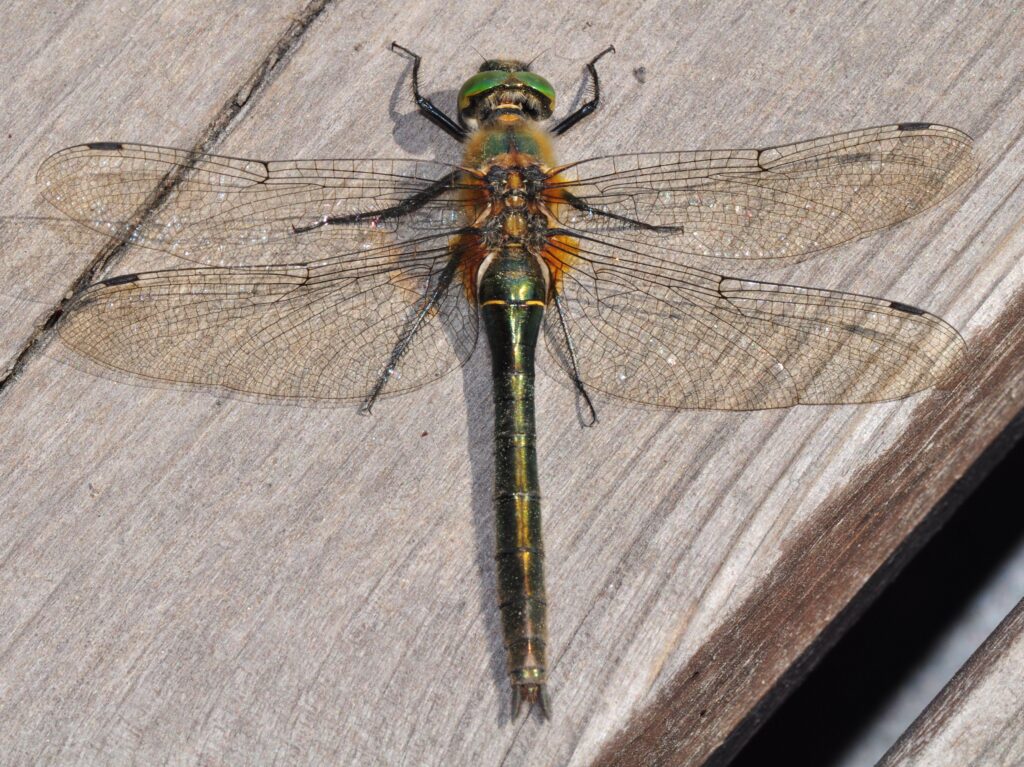
For many dragonflies, the winged adult stage lasts for several weeks rather than many months. A U.S. Fish and Wildlife Service account reports that fully adult Hine’s emerald dragonflies have been documented living for at least 14 days and possibly four to six weeks. A University of Michigan species account describes adult common green darners as likely living for several weeks to a little over a month. [3] [4]
These examples should not be converted into a universal average. Adult survival depends on species, weather, food availability, migration, predation and whether researchers are measuring a known individual or simply recording how long a species remains visible at a site.
A flight season is not the same as an individual lifespan. A pond may have dragonflies on the wing for several months because new adults continue emerging while older individuals die. The observation period for the population can therefore be much longer than the life of any one dragonfly.
How Long Do Dragonflies Live Underwater?
Dragonflies live underwater during the nymph, or larval, stage. For most species this is the longest part of life. The range is exceptionally broad: rapidly developing dragonflies in warm temporary waters may complete larval growth in roughly one or two months, while species in cold streams, northern ponds or less productive habitats may take several years. [1] [5]
The wandering glider, Pantala flavescens, illustrates the fast end of the range. Research from hot desert ponds estimated complete larval development at about 33 days, while other published observations place development at roughly 38 to 65 days under particular regional conditions. Those figures describe a fast-developing species in warm water, not a standard duration for all dragonflies. [5] [6]
At the opposite end, Hine’s emerald larvae may spend two to four years in small streamlets. Treeline Emerald larvae collected in the Yukon formed several size groups that suggested a development period of about five or possibly six years. At that high latitude, the larvae may have only a short summer growth period each year. [3] [7]
For nymph appearance, anatomy and underwater feeding behavior, see the dedicated guides to dragonfly larvae and what baby dragonflies look like.
How Long Is the Egg Stage?
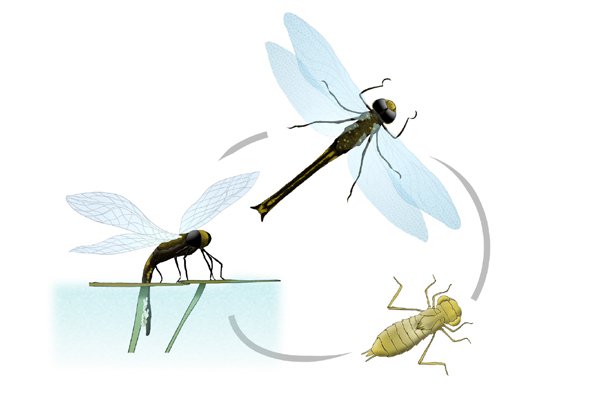
Dragonfly eggs may hatch within a few days or remain unhatched for weeks or months. The British Dragonfly Society reports that many eggs hatch within two to five weeks, while eggs of some hawkers and darters remain dormant and hatch the following spring. [1]
Fast development is possible in warm-water species. Common green darner eggs have been reported to hatch after at least six or seven days, and research on wandering gliders recorded embryonic development in approximately five to seven days under warm study conditions. [4] [6]
Temperature is not the only influence. Species differ in where and when they lay eggs, and some use egg diapause to pass through winter or wait for suitable water conditions. A number from one species should therefore not be presented as the dragonfly egg duration worldwide.
Dragonfly Lifespan by Life Stage
| Life stage | What happens | Typical duration | Why it varies |
|---|---|---|---|
| Egg | Embryonic development occurs in or near freshwater before the young nymph hatches. | Often a few days to several weeks; some eggs may remain dormant until the next season. | Species, temperature, egg-laying method, diapause and seasonal water conditions. |
| Aquatic nymph | The wingless predator feeds, grows and molts repeatedly underwater. | May be about one or two months in some rapid warm-water species, but often lasts many months or years. Exceptional cold-region species may exceed five years. | Water temperature, food, latitude, habitat permanence, overwintering and species-specific growth strategy. |
| Emergence | The mature nymph leaves the water and completes its final molt into a winged adult. | The physical emergence usually occurs within hours, followed by a period in which the wings and body harden. | Temperature, weather, species, body size and the security of the emergence site. |
| Adult | The dragonfly feeds, matures, disperses, mates and lays eggs. | Often several weeks; some individuals or species may survive for one or more months under favorable conditions. | Predation, food, weather, migration, injury, reproductive activity and observation method. |
How Long Is the Complete Life Cycle?
The complete life cycle runs from egg laying to the death of the adult. It may take only a few months in rapidly developing dragonflies that use warm, temporary water, but it can take several years in species whose nymphs grow slowly or pass through several winters.
It is therefore misleading to describe the normal dragonfly lifespan as exactly six months, one year or seven years. Each of those durations might resemble a particular species or regional observation, but none represents all dragonflies.
The winged adult normally represents only the final and most visible part of life. A dragonfly that appears beside a pond for a few weeks may already have spent years developing below the surface. For a stage-by-stage explanation rather than a timing-focused guide, visit the dragonfly life cycle page.
Why Lifespan Varies Between Species
Within a suitable thermal range, warmer water can accelerate growth. Controlled studies should not be treated as universal predictions for natural ponds and streams.
High-latitude larvae may have only a short annual growing season and may need several summers to reach their final instar.
Species adapted to temporary pools often develop rapidly, while species in permanent streams or ponds may follow slower multi-year schedules.
Growth can slow when prey is limited or competition is strong. Abundant food does not make every species follow the same timetable.
Dragonflies may overwinter as eggs or nymphs. Some larvae reduce activity during cold periods and resume growth when conditions improve.
Migratory species may have rapid generations, but a long-distance annual movement can involve several generations rather than one adult surviving the entire cycle.
Laboratories control temperature, food and predators. In field studies, a missing marked dragonfly may have died, dispersed or simply avoided detection.
Body size alone does not determine longevity. Closely related dragonflies can have different growth rates, habitats and seasonal strategies.
Research on wandering gliders demonstrates that temperature and water management can change larval growth, while capture–mark–recapture research shows that observation methods also affect estimates of adult survival. [6] [8]
Do Dragonflies Really Live for Only One Day?
No. The idea that dragonflies live for only one day is normally a confusion with the very short adult stage of some mayflies. Dragonflies and mayflies are different insect groups.
Even the mayfly comparison is incomplete because mayflies usually spend much longer underwater before becoming adults. A dragonfly also has an aquatic juvenile stage followed by a winged adult stage, and its entire life cannot be measured only from the day it is first seen flying. [2]
A particular adult dragonfly could die shortly after emergence because of predation, bad weather or injury, but that does not mean one day is the species’ normal complete lifespan.
What Usually Kills Adult Dragonflies?
Adult dragonflies face much higher exposure than aquatic nymphs. They must fly to feed, avoid predators, find mates and reproduce while weather and seasonal conditions continue to change.
- Predation: birds, spiders, frogs and larger dragonflies may catch adults.
- Bad weather: prolonged cool, wet or windy conditions can restrict flight and reduce access to flying prey.
- Starvation and energy loss: adults require regular prey and may weaken when feeding opportunities decline.
- Accidents and injury: damaged wings, collisions and failed emergence can reduce survival.
- Seasonal decline: falling temperatures and shorter periods suitable for flight can end the adult season in temperate regions.
These risks make a maximum possible lifespan different from the lifespan commonly achieved in the wild. The British Dragonfly Society specifically identifies predation, accidents and starvation during poor weather as important causes of adult mortality. [2]
Adult and nymph prey are explained more fully in the dragonfly diet guide.
Dragonfly Lifespan vs. Damselfly Lifespan
Dragonflies and damselflies both belong to the order Odonata, but dragonflies are Anisoptera and damselflies are Zygoptera. Some general references use “dragonflies” informally for the entire order, which can cause damselfly development times to be repeated as though they apply to true dragonflies.
British observations often describe small damselfly adults as shorter-lived than larger dragonflies, but that regional tendency is not a global rule for every species. The two groups have overlapping life-history strategies, and neither group has one standard lifespan. [2]
On this page, “dragonfly” refers to true dragonflies unless a source explicitly discusses the wider order Odonata. Damselfly figures are not used to create a default dragonfly lifespan.
Examples From Specific Species
These cases demonstrate why a single global lifespan number is unreliable. Each figure belongs to a named species, place and type of evidence.
| Common name | Scientific name | Geographic context | Reported timing | Source and evidence type |
|---|---|---|---|---|
| Hine’s Emerald | Somatochlora hineana | Illinois and Wisconsin, United States | Larvae may take two to four years. Adults have been documented for at least 14 days and may live four to six weeks. | U.S. Fish and Wildlife Service species account summarizing formal field studies and observations. |
| Common Green Darner | Anax junius | North America; resident and migratory populations | Resident development is described as about one year, while migratory populations may mature in three to five months. Adults likely live several weeks to a little over a month. | University of Michigan Animal Diversity Web literature-based species account. |
| Wandering Glider | Pantala flavescens | Warm temporary waters, including desert ponds and Asian rice-field studies | Published studies report very rapid larval growth, including approximately 33 days in hot desert ponds and broader estimates near 38 to 65 days in particular environments. | Peer-reviewed field and laboratory research. These are regional developmental measurements, not global adult lifespan estimates. |
| Treeline Emerald | Somatochlora sahlbergi | Yukon and other high-latitude northern regions | Larval size groups suggested approximately five or possibly six years of development, with only a short annual summer growth period. | Dragonfly Society of the Americas species account based on field collection and published larval research. |
Frequently Asked Questions
What is the average lifespan of an adult dragonfly?
There is no reliable average for all species. Several weeks is a reasonable general expectation for many documented adults, while some die sooner and others may survive for one or more months.
How long do dragonflies live underwater?
The aquatic nymph stage may last from weeks or months in fast-developing species to several years in cold-water or high-latitude species. It is usually the longest stage.
Can a dragonfly live for six or seven years?
Some species may spend five or more years developing as aquatic nymphs, and exceptional reports approach six or seven years. That does not mean every dragonfly has a six- or seven-year lifespan.
Do adult dragonflies live for only two weeks?
Some adults may live about that long, but two weeks is not a universal limit. Documented adult survival varies among species, regions, seasons and study methods.
Do dragonflies die immediately after laying eggs?
Not necessarily. Females may lay more than one batch of eggs over a period of days or weeks. Predation, weather, food availability and physical condition influence how long an adult survives after reproducing.
Where do dragonflies spend the winter?
Many temperate species overwinter as aquatic nymphs, while some remain dormant as eggs. Certain migratory species move to warmer regions, but migration patterns differ by species and may involve multiple generations.
Does a long flight season mean one dragonfly lived all summer?
No. A long flight season usually includes many individuals emerging at different times. Population-level observation dates should not be treated as the lifespan of one adult.
Sources and Further Reading
- British Dragonfly Society — Life Cycle and Biology. Overview of egg, larval and adult stages, including regional developmental ranges and delayed hatching.
- British Dragonfly Society — Frequently Asked Questions. Regional guidance on adult survival, the one-day myth and common causes of mortality.
- U.S. Fish and Wildlife Service — Hine’s Emerald Dragonfly. Species account summarizing larval development, adult survival and seasonal field studies.
- University of Michigan Animal Diversity Web — Common Green Darner. Literature-based account of egg hatching, resident and migratory development, and adult longevity.
- Troast et al. — A Global Population Genetic Study of Pantala flavescens. Peer-reviewed discussion of rapid larval development and global migration.
- Augustine et al. — Effects of Temperature and Water Management on Pantala flavescens Larval Growth. Field and laboratory evidence showing that temperature and water management influence development.
- Dragonfly Society of the Americas — Treeline Emerald. High-latitude species account describing field collections and an estimated five- to six-year larval period.
- Khelifa et al. — Integrating High-Speed Videos in Capture–Mark–Recapture Studies of Insects. Research demonstrating how detection methods affect apparent survival estimates in adult dragonflies.