Aquatic Dragonfly Guide
Dragonfly Larvae: Identification, Diet, Habitat and Life Cycle
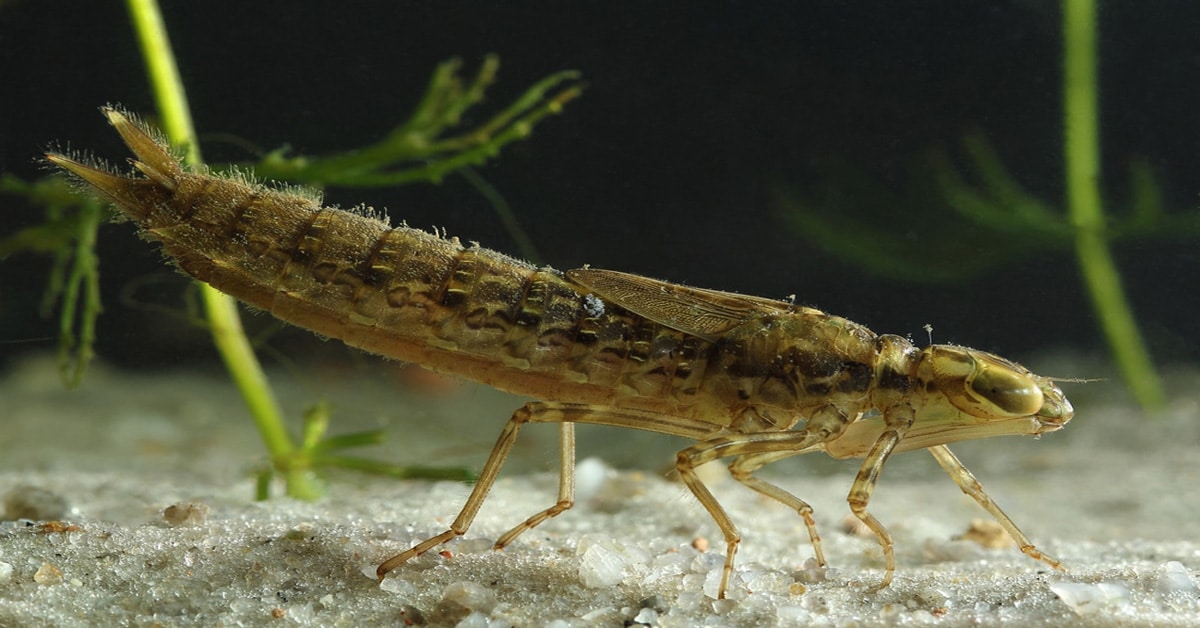
Dragonfly larvae are aquatic, wingless young dragonflies commonly called nymphs or naiads. They have six legs, large compound eyes, developing wing pads and a hinged predatory mouthpart folded beneath the head. Unlike damselfly nymphs, they do not normally have three leaf-shaped external tail gills.
General identification guide. Exact size, body shape, habitat and development time vary by species and region.
What Is a Dragonfly Larva?
A dragonfly larva is the aquatic immature stage between the egg and the winged adult. It spends its time feeding, growing and repeatedly shedding its outer skeleton underwater. When development is complete, the final-stage nymph leaves the water and becomes an adult during one last molt. There is no pupal stage.
A young dragonfly does not look like a miniature flying dragonfly. Its wings are still developing inside flattened pads on the thorax, its body is usually brown, olive, gray or green, and its legs are adapted for gripping plants, crawling over sediment or holding position in moving water.
Dragonfly larvae are predators, but they are also prey for fish, amphibians, water birds and larger aquatic invertebrates. Their position in freshwater food webs is one reason scientists study them in ecological and contaminant monitoring projects.
Dragonfly larva, nymph or naiad?
All three immature-stage terms may appear in books and identification guides. “Dragonfly nymph” is especially useful when distinguishing this stage from beetle or fly larvae living in the same water.
How to Identify a Dragonfly Nymph
Begin with the complete body rather than one isolated feature. Dragonfly nymphs vary from streamlined, long-legged hunters to broad, flattened or heavily camouflaged bottom dwellers. No single body shape represents every species.
- Six jointed legs attached to the thorax
- Large compound eyes and a broad or moderately elongated head
- Short, slender antennae
- Visible wing pads or wing sheaths in older nymphs
- A segmented abdomen that may be narrow, broad, oval or flattened
- Several short terminal appendages rather than three broad leaf-shaped tails
- A folded, extendable labium beneath the head
- No row of exposed gills along the sides of the abdomen
Young instars can be difficult to recognize because the wing pads may be small, while mud, algae and organic debris can hide the outline of the body. Family- or species-level identification usually requires a regional key and examination of features such as the labium, antennae, abdominal spines and terminal appendages.
Identification rule: Do not identify a specimen only by color, size or the absence of visible tail gills. Combine body form, legs, wing pads, mouthparts, abdominal structures, habitat and geographic location.
Dragonfly Larva Anatomy

The extendable predatory labium
The most distinctive feeding structure is the prehensile labium, sometimes called a mask because it folds beneath the front of the head. When prey enters range, the nymph aims its head and releases the labium in a rapid forward movement. The captured animal is then pulled back toward the mandibles.
Older explanations often described the strike as purely hydraulic. Pressure changes within the body are relevant to larval function, but modern biomechanical research has identified elastic structures that store and release energy in a synchronized, controllable catapult-like system. It is therefore more accurate to call the labium a fast, spring-assisted predatory apparatus than simply a “hydraulic jaw.”
How Do Dragonfly Larvae Breathe?
Dragonfly nymphs have internal respiratory surfaces inside a modified rectal chamber. They rhythmically draw water through the opening at the end of the abdomen, move it across the rectal gills and then expel it. Dissolved oxygen passes from the water into the tracheal respiratory system.
These gills are internal, so a dragonfly nymph does not display the three prominent leaflike tail gills seen on most damselfly nymphs. The abdomen may appear to pulse slightly as water is moved through the chamber.
Do dragonfly larvae have gills? Yes. Their principal aquatic respiratory surfaces are internal rectal gills rather than exposed gills projecting from the tail.
Jet propulsion
A nymph can forcefully expel water from the rectal chamber. The resulting jet pushes the insect in the opposite direction, producing a short burst that can help it escape, reposition or move through open water. Research has also shown that the three-part anal valve can alter the direction and shape of the jet.
Jet propulsion is not the nymph’s only form of movement. Many species spend much of their time crawling, climbing or remaining almost motionless while concealed against vegetation or sediment.
How Dragonfly Nymphs Move
Movement reflects habitat and body form. Long-legged nymphs may climb through submerged stems, roots and leaves. Broad-bodied species often sprawl across mud, detritus or plant surfaces. Burrowing forms push into sand or fine sediment, while species from flowing water may grip stones, woody debris or submerged roots.
Some nymphs slowly stalk prey, but many rely on camouflage and short, carefully controlled movements. A sudden jet of water is more conspicuous and is generally useful for rapid escape rather than routine cruising.
Where Do Dragonfly Larvae Live?
Dragonfly larvae occupy a wide range of freshwater habitats. The presence of water alone does not mean every species can live there. Water movement, temperature, vegetation, sediment, oxygen, hydroperiod, predators and surrounding land all influence which species occur.
- Ponds and small lakes: nymphs may hide among submerged vegetation, roots, leaf litter and shallow bottom sediment.
- Marshes and swamps: dense emergent and submerged plants provide hunting surfaces, cover and routes for final emergence.
- Streams and rivers: species may live under stones, among roots, in gravel or sand, or along slower marginal areas.
- Temporary pools and seasonal wetlands: some species are adapted to waters that periodically dry and may develop more rapidly under suitable conditions.
- Garden ponds: suitable ponds can support dragonfly nymphs, especially where aquatic vegetation and different water depths are present.
A nymph may be found resting on the bottom, partly buried in sediment, clinging to a stem or concealed beneath dead leaves. These microhabitats are important: moving a specimen from one part of a pond to another may place it in unsuitable current, cover or substrate.
Finding one dragonfly nymph does not prove that water is completely clean. Species differ in tolerance, and a meaningful assessment normally considers the identity, abundance and diversity of the entire aquatic community.
What Do Dragonfly Larvae Eat?
Dragonfly larvae are predators of other aquatic animals. The usual prey depends on the nymph’s size, species, habitat, hunting method and the organisms available at that location.
Potential prey can include:
- Mosquito and midge larvae
- Mayfly and other aquatic insect nymphs
- Small crustaceans and aquatic worms
- Small mollusks and other soft-bodied invertebrates
- Other odonate nymphs when appropriately sized
- Tadpoles or very small fish taken by some larger nymphs
Tadpoles and fish should not be presented as the normal daily food of every dragonfly larva. Small or early-stage nymphs usually take much smaller invertebrate prey, while larger late-stage individuals may be capable of attacking larger animals.
Do they control mosquitoes?
Dragonfly nymphs can eat mosquito larvae when the larvae are present, accessible and appropriately sized. This makes them one of several natural mosquito predators in freshwater habitats. It does not mean that placing or attracting dragonflies will guarantee mosquito control.
Mosquito abundance is also influenced by water depth, fish, other predators, vegetation, temperature, rainfall and whether temporary containers or stagnant water are available. No fixed daily number of mosquito larvae can be applied to every dragonfly nymph.
How they hunt
Many nymphs remain still until movement brings prey within striking distance. Camouflage helps broad-bodied species blend with mud, algae or decaying leaves, while vegetation-dwelling hunters may slowly change position among stems. Once aimed correctly, the labium extends, grips the prey and retracts toward the biting mouthparts.
Dragonfly Nymph vs. Damselfly Nymph
| Feature | Dragonfly nymph | Damselfly nymph |
|---|---|---|
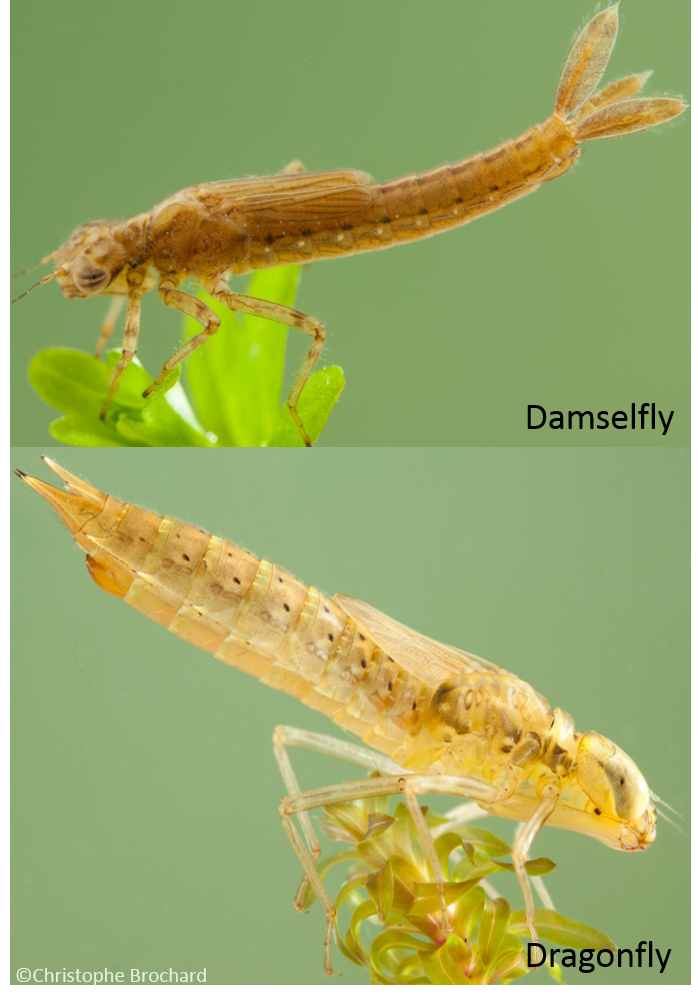
| Typical body form | Often robust, oval, broad or moderately elongated | Usually narrower, slender and more parallel-sided |
| Tail structures | Several short terminal appendages; no three broad leaflike gills | Usually three elongated leaflike or paddlelike caudal lamellae |
| Main visible gills | Rectal gills are internal and not externally obvious | Caudal lamellae are external respiratory surfaces |
| Escape movement | May expel water for a rapid jet-propelled burst | Often swims by undulating the body and caudal lamellae |
| Typical position | Vegetation, sediment, stones, roots, leaf litter or burrows | Frequently among vegetation, rocks and bottom material |
| Wing pads | Present in older nymphs | Also present in older nymphs |
The tail is useful but not infallible. A damselfly nymph can lose one or more caudal lamellae through damage. Confirm the identification with body shape, remaining tail structures, wing pads, legs, mouthparts and a regional key.
Dragonfly Nymph vs. Other Aquatic Insects
| Aquatic insect | Useful identifying features | Important caution |
|---|---|---|
| Dragonfly nymph | Six legs, large eyes, wing pads, extendable labium, internal rectal gills and no three broad tail gills | Body form varies greatly among dragonfly families |
| Damselfly nymph | Slender body with three leaflike caudal lamellae at the abdominal tip | One or more lamellae may be missing after injury |
| Mayfly nymph | Usually two or three long threadlike tails and visible leaflike or feathery gills along the abdomen | Tail number and gill form vary among families |
| Stonefly nymph | Two long tails, long antennae, two claws on each foot and a flattened body commonly associated with flowing water | Some species occur outside fast, clear streams |
| Mosquito larva | Legless, narrow and wormlike; many hang below the surface and wriggle downward when disturbed | Not every mosquito larva uses the same surface-breathing posture |
| Predaceous diving beetle larva | Elongated body, six legs and conspicuous curved, pincerlike mandibles; no dragonfly-style wing pads or folded labial mask | Large beetle larvae can bite painfully if handled |
Photographs can usually establish the insect order or broad group, but species-level identification may require close views from above, below and from the side. Record the location and habitat without removing the specimen permanently.
How Long Do Dragonfly Larvae Stay Underwater?
There is no universal duration. Depending on species, climate, water temperature, food availability and seasonal conditions, aquatic development may last from a relatively short period to several years.
Development can slow in cold conditions or during seasons when prey is scarce. Species using warm or temporary waters may complete development more quickly than species living in cold, permanent streams. A time reported for one species or country should not automatically be applied worldwide.
Molting and instars
A nymph’s rigid outer skeleton cannot expand continuously. To grow, the insect periodically sheds it and forms a larger one. The developmental interval between two molts is called an instar.
Published molt totals differ among species and can also reflect differences in how very early stages are counted. The safest general explanation is that a dragonfly nymph passes through repeated instars rather than claiming one fixed number for all dragonflies.
The final instar
The final instar is the last aquatic nymphal stage. As emergence approaches, the wing pads are well developed and the nymph moves toward shallow water, emergent vegetation, rocks, tree trunks, bridge supports or another secure surface. Physiological changes prepare it to leave the water and breathe air.
How a Dragonfly Nymph Becomes an Adult
A very early stage enters the water and soon molts into an active nymph.
The aquatic predator feeds on small prey and begins repeated growth.
Each molt produces a larger nymph; wing pads become more noticeable.
The mature nymph approaches the margin and prepares to breathe air.
It climbs out, sheds the larval skin and expands its adult body and wings.
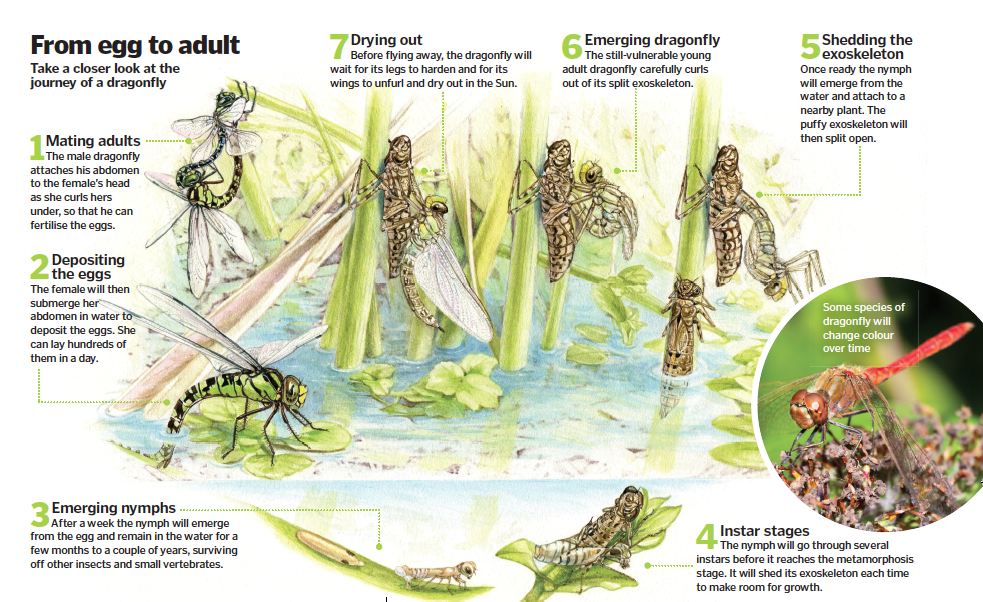
The final molt takes place out of water. The nymph secures its legs to a plant or other support, and the old exoskeleton splits along the upper thorax. The adult gradually pulls free, expands its abdomen and pumps fluid into the wings. The wings and body must harden before normal flight is possible.
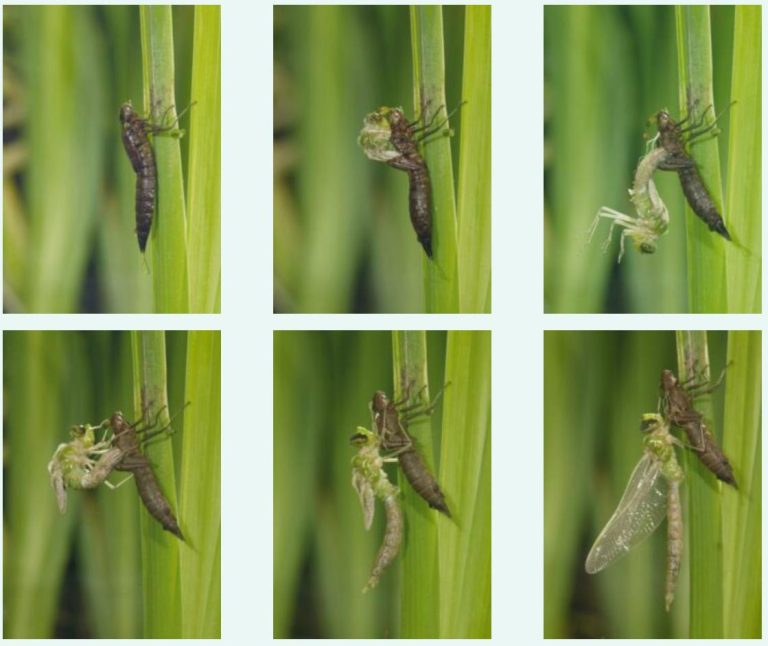
This is incomplete metamorphosis: egg, aquatic nymph and adult, with no pupa between the nymph and winged form. For the complete sequence from egg laying through adulthood, see the dragonfly life cycle guide.
What is a dragonfly exuvia?
An exuvia is the empty outer skeleton left after a molt. The exuvia from the final nymphal stage is usually dry, brown or gray and shaped like a hollow dragonfly nymph. It retains six legs, wing pads, abdominal segments and short structures at the tip of the abdomen. A split along the upper thorax marks where the adult emerged.
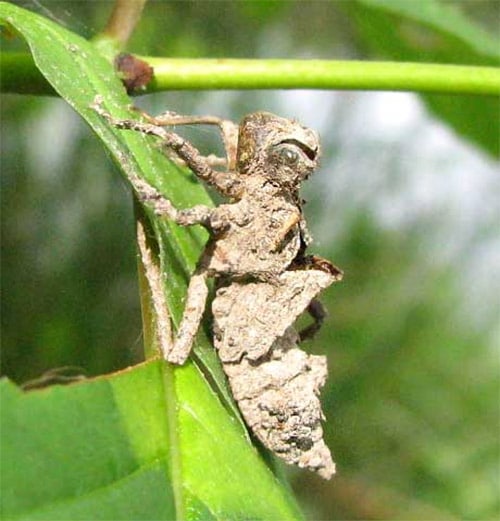
Exuviae are valuable evidence because they show that a dragonfly successfully completed aquatic development at that waterbody. Identifying them to species may require a specialist exuvia key.
Are Dragonfly Larvae Dangerous?
Dragonfly larvae do not sting and do not hunt people. A large nymph may use its mouthparts defensively if squeezed or held, producing a pinch, but it is not considered dangerous to people. The best practice is to avoid handling the insect with bare fingers.
A nymph placed in an aquarium can prey on shrimp, insect larvae, tadpoles or very small fish. It should therefore not be treated as a harmless addition to a community aquarium.
How to Observe a Dragonfly Nymph Safely
- Place the nymph briefly in a shallow, clear container holding water from the exact pond or stream where it was found.
- Keep the container shaded and stable. Avoid direct sun, rapid temperature change and untreated replacement water.
- Observe without squeezing or repeatedly touching it. Use a soft aquatic net, spoon or submerged container rather than bare fingers.
- Photograph the top, side, underside and abdominal tip. Include a ruler beside the container rather than pressing it against the insect.
- Return the nymph promptly to the exact waterbody and microhabitat where it was collected.
- Never transfer aquatic organisms, plants, sediment or water between ponds, streams or aquariums. Check local wildlife and collecting rules.
Should you keep one as a pet? Long-term care depends on species, water chemistry, prey, temperature, emergence timing and local regulations. For a casually discovered wild nymph, brief observation followed by release at the discovery site is usually the more responsible option.
Frequently Asked Questions
Do dragonfly larvae bite?
A large nymph may pinch defensively if it is restrained or squeezed. It does not seek out people, has no stinger and is not considered dangerous. Avoid handling it directly.
Are dragonfly larvae dangerous to people?
No. They are aquatic predators of appropriately sized animals, not people. The main practical concern is avoiding unnecessary handling and returning wild specimens safely to their habitat.
Can dragonfly larvae live out of water?
Their normal nymphal life is aquatic. A mature final-instar nymph leaves the water to complete emergence and may spend time above water while transforming into an adult. A collected aquatic nymph should not be left to dry out.
How long do dragonfly nymphs stay underwater?
Development can range from a relatively short period to several years. Species, climate, temperature, food supply, season and habitat all affect the duration, so there is no reliable universal number.
Do dragonfly larvae have gills?
Yes. Dragonfly nymphs have internal rectal gills. They pump water through a chamber at the end of the abdomen to obtain dissolved oxygen.
Do dragonfly larvae eat mosquito larvae?
They can eat mosquito larvae when suitable larvae are available and within capture range. This does not guarantee that dragonflies will eliminate mosquitoes from a pond or garden.
Can dragonfly larvae live in a garden pond?
Yes. Many dragonflies use suitable garden ponds, particularly those with aquatic plants, shallow margins, varied depth and places for emerging adults to climb. Fish and other predators can reduce nymph survival.
What does dragonfly exuvia look like?
It resembles a dry, hollow, brown nymph attached above the water. It has six legs, wing pads, a segmented abdomen and a split in the upper thorax through which the adult emerged.
How can I tell a dragonfly nymph from a damselfly nymph?
A typical dragonfly nymph is broader and lacks three long leaf-shaped tail gills. A typical damselfly nymph is slender and carries three caudal lamellae at the abdominal tip. Use several features because damaged damselfly nymphs may have missing lamellae.
What should I do if I find one in an aquarium?
Isolate it carefully because it may prey on small aquarium animals. Do not release aquarium water, plants or animals into natural waterways. The appropriate action depends on whether the nymph arrived with locally collected material and on local invasive-species and wildlife rules.
Related Dragonfly Guides
Sources and Further Reading
- British Dragonfly Society — Life Cycle and Biology
- Missouri Department of Conservation — Dragonfly Larvae Field Guide
- Missouri Department of Conservation — Damselfly Larvae Field Guide
- University of Florida IFAS Extension — Dragonflies and Damselflies
- Büsse et al. — The Strike of the Dragonfly Larvae
- Büsse et al. — Functional Morphology of Larval Dragonfly Mouthparts
- Roh et al. — Underwater Jet Vectoring Mechanism by Dragonfly Larvae
- Missouri Department of Conservation — Mayfly Larvae
- Missouri Department of Conservation — Stonefly Larvae
- Missouri Department of Conservation — Mosquito Larvae
- Missouri Department of Conservation — Predaceous Diving Beetles
- Worthen — Distribution of Dragonfly Larvae in a South Carolina Stream